
7 LAWS OF ENTERPRISE PRODUCTS
At a high level, product managers across any product uses the same range of methods, tactics, and skills. As you get to know different products, businesses, lifecycle states, and types however, the skill sets of product management needed will specialize. A PM working on hyper scale user acquisition for a SaaS product will have a different focus than one operationalizing a hardware product with a multi-million dollar, five-year lifespan plan. If you’re a PM or aspiring PM who loves deep technology, enterprise products provide a deep well of career and learning opportunity.
Enterprise products are a different animal than most however. Wikipedia has a succinct definition for enterprise software. ‘Computer software used to satisfy the needs of an organization rather than individual users.’ In my experience, enterprise software has many other connotations based on the expectations that organizations have of them. This is where the enterprise definition is really critical.
‘Computer software used to satisfy the needs of an organization rather than individual users.’
Enterprise product solutions are not household names. From the point of a regular person, you may have never heard of the companies or the products in this sector. These products power the things you use every moment of the day. From the technology stack running the browser on the device in your hands now, back to the datacenter it’s reading from, instantly across the Internet. Even everyday items you might not think about. E.g. The power grid that keeps your house warm and lit, or the supply chain systems that keep groceries arriving at your local store from thousands of farms around the world daily. The names of these companies that make this happen often remain hidden. Instead you know the final names Walmart, Chevrolet, Netflix, and AT&T. Some enterprise company examples include:
- Server/Storage/Network Information Technology (IT) E.g. Nutanix, VMware, NetApp, Cisco, DellEMC, HPE
- Cloud Computing E.g. AWS, Azure, GCP, Alibaba Cloud
- Enterprise Resource Planning (ERP) E.g. SAP, Oracle ERP Cloud, Dynamics 365
- Customer Relationship Management (CRM) E.g. Salesforce, Marketo, Dynamics 365
IN CASE OF FAILURE DO NOTHING
The reason that enterprise products are so complex comes down to some key rules and principles. Many of these boil down to requirements for hands-free resiliency. Failure is expected and failure handling is built-in. If my phone freezes I can power it off and on again. Annoying but no big deal. If a hospital patient monitoring system server freezes and stops working; someone (or many) may die. This failure outcome can be catastrophic. Product failure planning is a key requirement that is baked into enterprise products from day one. If this sounds dramatic, consider the following examples of things you never want to fail.
- Hospital equipment and monitoring systems that keep patients alive
- Air traffic control systems the keep planes in the sky
- Banking systems keeping you fed and housed via reliable wages access
If these systems fail, the results can be very bad. The way enterprise products address this is to build for reliability. When failures occur, these products already have mechanisms to keep working and fail over, rebuild, restart, etc. Performance may go down, but the application stays up (online and working).
7 LAWS OF ENTERPRISE PRODUCTS
If you’re an aspiring product manager, or a PM who has not yet worked in enterprise, below is a set of 7 laws that pertain to building and offering enterprise products. These help describe why enterprise products are complex and different.
1. THE FIVE “9”s LAW
Enterprise software is supposed to never go unexpectedly offline. High availability is a requirement and is often expressed in terms of ‘nines’. The most common ‘nines’ definition is “Five 9s” which means your application must have an availability percentage of 99.999% (count five 9s). That amount of uptime only allows you to have 5.26 minutes of unplanned downtime per year. To achieve that, enterprise software builders and PMs have to think intensely on how their solutions deliver this. Failure to deliver means you will lose this customer.
2. THE REDUNDANCY LAW
In service to the five 9s law, many datacenter hardware solutions have duplicate parts that do the exact same thing. Servers have two CPUs, two power supplies, two network connections, etc. This is based on the expectation that all hardware components eventually break. Software code isn’t usually duplicated, but software can also provide multiple ways to recover according to your needs. Each part builds resilience themselves, or rely on a resilient platform they get deployed on (i.e. virtualization or hardware). If that’s not enough redundancy, customers will also design and build to include hot hardware spares just in case.
3. THE MUTUAL CERTIFICATION LAW
For platform products that bring together different vendors, customers demand in most cases that all software and hardware providers cross-certify each other’s solutions where relevant. This is a large burden on the enterprise product providers to ensure. The customer requires that there is no chance that any vendor they use will declare any part of their environment unsupported because the risk is too high.
4. THE SUPPORT LAW
Customers of enterprise products demand support. Unsupported products are for pure open source fans and hobbyists. When customers need help to solve technical or functional issues, they require a defined process on how to get a hold of the vendor that built the product. There is a ticket system, an escalation path, a response team, and a follow-up system to ensure customers are taken care of. Enterprise customers demand that they can call a vendor and know that the phone will always get picked up. Many companies even offer 24 hour a day support across different geographies.
5. THE SLA LAW
SLA is Service Level Agreement. When things break, customers pay for and demand a response within a known time frame by the vendor. That might be a ticketed support case, a shipped piece of replacement hardware, or a phone call from your provider. Not every issue can be fixed in a predictable time frame, but response SLAs can be delivered. This is often an attribute of a paid support tier. You can usually pay more for a premium, faster SLA.
6. THE SERVICES LAW
Often called Professional Services, these exist to give customers access to specialized skills for installations, scripting, procedures, etc. which they pay for. This might not sound like a law. It may sound like an upsell, and sometime it is. More importantly though, customers often need expertise in order to be successful. Enterprise products are not iPhone apps. They connect into tens of other enterprise applications like Active Directory, ServiceNow, CRM, ERP, DNS, etc. Services can help your customers be successful in getting your product connected and running.
7. THE AUTOMATION LAW
A great consumer grade UI and UX has become the standard for modern enterprise products in the last 10 years. Before that UI was included, but UX was not. I’ve seen a lot of terrible legacy user interfaces in past years. At scale today, however, big enterprise customers also require access to documented APIs for automation and code-based usage of your product. The UI is still useful, but for at-scale customers it is not the primary consumer interface.
While thinking about the laws of enterprise products I also noted down several thoughts or axioms which didn’t quite feel like laws. I felt these were relevant and useful to include.
7 ADDITIONAL ENTERPRISE OBSERVATIONS
1. ALL SOFTWARE HAS BUGS
No one likes bugs, but they exist. Even perfect software will have unexpected behavior when something new is introduced into the ecosystem. E.g. Perfect software gets deployed on hardware from the same vendor, same model, but with a brand-new CPU generation? Or a new configuration? Or a swapped out device? Hello new bug. You will always be tuning and improving your product. Given quality support your customers will stay with you through the bumps. If you think your favorite software has no bugs, your vendor probably spent millions of dollars over the years in development, testing, fixing, patching, and supporting the software which you didn’t see (which is the way they want it).
2. YOUR USER IS NOT YOUR BUYER
The person that approves the PO (purchase order) for your enterprise product purchase is usually not remotely the person that will use it. This is very different than consumer software and hardware. When I buy a new car, phone, or TV subscription, I am the consumer who will use it, and I decide if I make the purchase. In enterprises, you have to sell to two different audiences at once; the end user and the management chain. Even then there may be groups like Procurement or Accounts Payable involved. Sales teams need to convince the user since they influence the purchase decision. They also need to sell to the management director, VP, or higher to get the purchase agreed-to and sold. These can be very different groups.
3. ENTERPRISE BUYERS TIME PURCHASES
Your customers will time when to buy to make it most advantageous to them. Expensive software requires budgets and approvals. A full datacenter rack of hardware and software, plus support, can cost more than a house in some parts of the United States. Customers therefore, align their needs to budget availability, approval windows, and time of the vendor’s quarter. Others will simply time when in the quarter they are able to get the best price, provided they can afford to wait for that given their business needs. I.e. If I wait until the final three days of your quarter, and you need to make your number, I can negotiate a better discount. It’s pretty similar to buying a new car off the lot.
4. RELATIONSHIPS WIN MORE OFTEN
Unlike many consumer goods, you can’t just go to the store and buy what you want, or buy them direct from the vendor. These products are often sold via a “channel” of vendors which specialize in these kind of products. These channel providers are known as Value Added Resellers (VARs) and System Integrators (SIs). As a customer you will have a relationship team that supports you from the product vendor and the reseller channel vendor. The best account managers and sales teams build long-term relationships they can benefit from for years. Superior teams also solve customer problems first vs. selling product first which strengthens relationships and puts you into the coveted trusted advisor role. FWIW, trusted advisor is not a self-appointed title.
5. VENDOR LOCK-IN CREATES TENSION
Customers hate vendor lock-in. Lock-in is when a single vendor provides the only hardware or software solution they use, making it procedurally hard or financially painful to get out of. Replacing datacenter solutions isn’t like choosing between Safeway, Trader Joe’s, and Whole Foods grocery stores. Unlike shopping for dinner, switching cost in the datacenter is high and slow. Vendors get more pricing leverage when they’re your sole provider. Vendors also use pre-paid, multi-year entitlement agreements to keep customers on their solution. E.g. I’ll give you a significant percentage off the cost for a 3-year agreement if you pay up front. That creates product commitment by the buyer, and difficulty of an alternative vendor to sell into that customer who already paid for a different product.
6. GUARANTEED RELIABILITY IS VERY EXPENSIVE
Resiliency under all circumstances for specialized, hard use cases and problems creates valuable, but expensive products. Enterprise-scale products are big ticket items to purchase. This creates high customer expectations back to the company, the product manager, and the product.
7. YOU (THE PRODUCT MANAGER) WILL BE ON CALL
When you’re the PM for Google Chat or Facebook News Feed with millions of users, it’s probably challenging to have direct relationships with your customers outside of coworkers and friends who use the products. When customers of enterprise products are unhappy, however, they will contact their Account Manager (sales rep) and Sales Engineer and let them know. If it’s a hot issue, it will escalate (sometimes via your executive team). As the PM you’ll then be on call communicating to the field team and the customer directly. Your customers will get to know you, and know that they can speak to you if needed. Your professional demeanor and polish will help in these situations.
BECOMING AN ENTERPRISE PM
If this world interests you, you can have a long career digging into ever deeper technologies and customers. It can be a lot of fun too. I’ve written about how to enter the field of product management, Breaking Into Technical Product Management, and The Product Management Career Decoder Ring, in previous posts. While those still apply, it’s important to note that enterprise products are often very technical since they often solve technical problems. This is why you’ll often see PMs with engineering and computer science backgrounds in these roles. If you don’t have that background, but really want to work in this area, you’ll have to work to build the baseline understanding required to be effective as a PM for these products.
ABOUT LUKE
Luke Congdon is a career product manager living and working in Silicon Valley since 2000. His areas of focus include enterprise software, virtualization, and cloud computing. He has built and brought numerous products to market including start-up MVPs and billion-dollar product lines. Luke currently lives in San Francisco. To contact, connect via luke@lukecongdon.com or https://www.linkedin.com/in/lukecongdon/.

FINDING CUSTOMERS TO INTERVIEW IS PRODUCT MANAGEMENT
USING YOUR RESOURCES TO FIND ENTERPRISE CUSTOMERS TO INTERVIEW
Interviewing customers is perhaps one of the most important things you need to continually do as product manager. The voice of the customer is your number one most valuable piece of ammunition when make a case internally to support, build, kill, or modify a product. As a PM you do need intuition, but absent customer input, your intuition is just your opinion based on one person’s input (yours). Over time you’ll simply be making it up and your product will suffer as a result. Interviews are how to you get to intimately get to know your customer and discover new needs, new problems, and new areas that only get revealed across many conversations as you reveal undiscovered country.
FINDING INTERVIEW CANDIDATES IS EASIER THAN YOU REALIZE
Buying enterprise products is infrequently done with a credit card. It’s most often done with a Purchase Order (PO). Therefore the purchase cycles can be long and include many touch points. It’s equally common to see a deal take 30 days or 300 days. While a consumer Apple App Store purchase might be $0.99 or $3.99, an enterprise product may easily be $50,000 or $300,000. It’s a very different world.
This can help you as a product manager because long sales pipelines create many opportunities to find and speak to these current and future customers. Even lost deals provide great learning opportunities. It’s the learning that you’re after in the end. You can learn a lot when customers don’t select you too.
Ultimately you should cultivate a pocket team or stable of customers you can always reach out to.
Here are several resources you can tap for reaching out to your customers:
EXISTING CUSTOMERS SOURCES
These are the actual customers who have purchased your product in the past. Look up these customers in win alerts, your CRM (e.g. Salesforce), or ask around.
- Known customers you’ve met or interacted with
- New customers you just learned about via Win alerts from your salesforce
- Questions from the field
- Ask your sales team
SOCIAL DISCOVERY SOURCES
Social platforms can be good places to hear from customers you were unaware of. Some customers will post their experiences here because they don’t know who to contact for product feedback, or they want other people to hear their perspective and start a conversation. Look in here, or set up Google Alerts.
- Company community sites
- Customer fan and technology blogs
- VAR/SI/Reseller blogs
INTERNAL DISCOVERY SOURCES
- Listen to your salespeople. Sometimes they reach out for help with a deal.
- Listen to your sales engineers. They often reach out for clarifications on product functionality and futures as they work with your customers.
- Other teams at work (other PMs, support, customer success)
- Talk to employees who used to be operators of your product at other companies
- Trade shows
- Volunteer and attend Executive Briefings for Customers (EBC)
- Ask the people that run the EBC
GO LEAD HUNTING
Do your customers have commonly assigned titles? E.g. Admin, DBA, help desk, support engineer, etc? Use the search provided by different sites and tools to find people that match these roles. You may need to further tune in by industry or technology in use.
- Go hunting on LinkedIn
- Go hunting on a community site
- Explore your CRM. E.g. Salesforce. If you’re a PM, you may already have access to this. NOTE: If you’re in a big company, don’t email customers directly. Contact the sales team (account manager, SE). Enterprise accounts can bring in millions a year, and those sales cycles can last a year, or budgets may only open once a year. Be friends with the account team. Don’t go around them and maintain a positive working relationship. They will bring you back in the future.
KEEP A PERSONAL CUSTOMER REFERENCES FILE
- Keep an escalations file. When you fix a problem for a customer, they may remember you fondly if it all turned out well. Reach out to them.
- Keep a questions file. Customers reach out for Q&A. Use that to forge a relationship.
- Keep a list of customers who’ve asked for features. Either get back to them when you’ve built it, or when you start and you want UX or design feedback. Some customers love being part of the process. It also gives them confidence that it’s actually coming to life.
LEARN FROM YOUR LOSSES
- Sales loss alerts from people that didn’t choose you. They might tell you why which can inform your planning. Reach out to them.
- Customers that used to be your customer and then changed their mind in favor of the competition. It’s a pretty strong negative signal. Reach out and find out why.
GET MORE CREATIVE
- Create a company Slack group with external, trusted customers (may require NDA access depending on your company security rules)
- Send a Survey… (if you must). Surveys validate signal you’ve already received. They aren’t that good for detailed feedback or primary research which is why I'm not a strong fan of them. When’s the last time you spent a lot of time writing feedback to the faceless person on the other side of the ‘Additional Comments’ box?
Ultimately you should cultivate a pocket team or stable of customers you can always reach out to. Build this informal team and add more to it over time. Sometimes you’ll need to take one out. These people are your insiders and a very valuable source of intel, and you are one of their trusted advisors.
Customers who like your product, or who are considering it, are often interested in hearing about what’s coming up.
PRO TIPS FOR PRODUCT MANAGERS
Getting customer feedback isn’t always easy. In the process you’ll have to reach out over and over to get these meetings on your calendar. You’re not always the most important conversation for a customer. I find that a ‘give for get’ is useful when it comes to the near-term roadmap. Customers who like your product, or who are considering it, are often interested in hearing about what’s coming up. Trade that access to your access to their feedback. Pro tip: Get your feedback first and save the roadmap Q&A until the end of the call to maintain focus.
- Keep on asking. You’ll hear a lot of crickets with non-responses. People are busy and it may not be the right time for them to speak to you. Perhaps there is a big deal in the pipeline and now is not the time for a new face in the conversation by the account manager. You may need to ask 20 customers to get 5 interviews. YMMV.
- Be time flexible. Enterprise products are global products. If you want feedback from a customer in Europe and you’re in California, you may need to take a 7:00am call. You customer is in NYC and only has a standing account team meeting at 8:30am? Wake up in time for coffee and a fresh mind for that 5:30am call. Do what you have to do.
- Dig when you hear no. If you ask about Acme Company to your account manager and she says they’re too busy, ask who else is in her patch. Every account manager has multiple accounts. You might not realize it, but just hearing back from the account team is half the battle sometimes. Find additional opportunities.
- Double tap your customer contacts. Did you get great feedback from a customer? Keep them on file and do it again a year later. A lot can change in a year.
- Take and share notes. You want to be respected as the source of customer truth inside your company? Take detailed notes, clean them up and share them out. Enable your peers and your engineering team with insights and opinions direct from the customers’ mouths. By sharing customer feedback with engineering, they will know that you understand the customers, and they will have confidence that you do in fact represent the customers so the engineers can trust you.
- Support ride-alongs. Engineers often want to hear what customers say directly. Invite them to listen into a phone call. Some will and some won’t, but those that do are often illuminated. Customers don’t always use your product they way you intended. Insight creates better products.
- Sometimes a sticker or a t-shirt goes a long way. Your fans want to rep your brand. Bring them something fun to show off. Many engineers love a new, cool sticker for their laptop. Let it be yours and let them be the exclusive person in their company to have it.
- Develop a customer following and a brand. Whether it’s because of a customer interview or another reason, you will get Googled. Show your customers, your industry, your peers that you have opinions or are a thought leader. Do videos of you speaking at trade shows come up? Writing? Company blogs? LinkedIn posts? Show them you’re the person to speak to.
- Have a great rapport with a customer? Invite them to connect on your LinkedIn profile and make a professional contact you can call on in the future regardless of which company you’re at.
ABOUT LUKE
Luke Congdon is a career product manager living and working in Silicon Valley since 2000. His areas of focus include enterprise software, virtualization, and cloud computing. He has built and brought numerous products to market including start-up MVPs and billion-dollar product lines. Luke currently lives in San Francisco. To contact, connect via luke@lukecongdon.com or https://www.linkedin.com/in/lukecongdon/.

MEDIUM, LOW, HIGH: DIAL INTO YOUR IDEAL PM JOB TITLE
MAKING RANK: ENLISTED, CORPORAL, MAJOR, GENERAL
Your title matters; don’t be convinced otherwise. Like military ranks, established companies and start-ups use titles to establish role and expectations. Title is a key component, and effectively part of your compensation package. Companies at different lifecycle stages handle titles differently however. In order to get the title you want, you can’t wait until you’re in a promotion cycle or interviewing a new company to advocate for a role promotion. You must be a great employee to start with. It’s also useful to understand how companies young and old use title assignment to entice you to join, or get you onboard while mitigating risk in case you’re not as awesome as advertised.
Start-ups in my experience have two modes when it comes to titles. Either they attract you to join with generous titles, or they apply the philosophy of ‘titles don’t matter’ where most people have basic titles including ‘member of technical staff’, ‘account manager’, or ‘product manager’. Established corporations can be more risk averse. Using established levels, each role and associated success criteria are well-defined.
WHY IT MATTERS
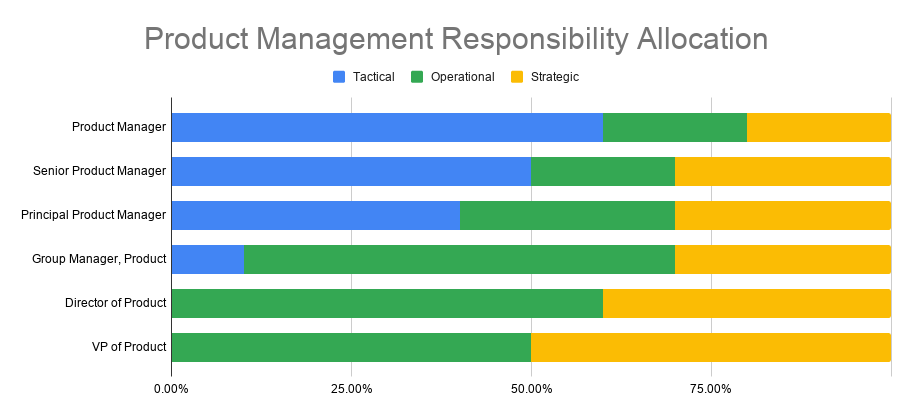
Product managers don’t write code, engineers don’t write marketing campaigns, and salespeople don’t take product support calls. Your title is an indicator of what your job role is. Within your career role, the correct role level also matters. A Junior PM, a PM, a Senior PM, a Group PM, and a Director of PM do different things. It’s all in the range of product management roles, but the responsibility and the results expectations are very different.
Melissa Perri has a great visual for this from her book, ‘The Build Trap’ which clarifies this.
Your title level also sets baseline for your future job prospects and success. When you apply to move to another company, they look at what you last did. Recruiters running initial searches inside an ATS or LinkedIn Recruiter are led to find people on the basis of keywords and search criteria. If your title is ‘Associate PM’ and they’re looking for ‘Senior PM’ you won’t show up in the query result. The ATS after all is just a database that stores profiles and gets searched for results.
Great recruiters will dig deeper and cast the net wider, if they need to. Many won’t need to, however, when the first ATS query gives them 2,000 candidates already at the target level. If you’re operating at a more senior level with success and results, therefore, it behooves you to get recognized in your title (and compensation). Making the jump across role levels in a job search is harder than a lateral job search since you’re seeking two transitions at once. I.e. You’re trying to convince a new company you’re the best candidate for them, and that you’re qualified for a role with more responsibility that you’ve had in past roles.
CAREERS TAKE TIME
This can make career progression a long game. For many, careers invested in continued vertical and horizontal learning and progress take years to develop. Directors and VPs at many public companies have usually spent 20+ years working and getting better at their craft, while also expanding their exposure and education into other parts of the business.
I’m not in my first job, and it’s likely that I’m not in my last job before retirement. When you change companies, your next role will very likely be a permutation of your current role. This assumes you’re not changing career paths, industries, or something altogether different. E.g. If you’re an Account Manager, in most cases you’ll probably look for another Account Manager role, or perhaps seek vertical growth as a Senior Account Manager. This will be factored into your job search with the position level you applied for. The recruiter and hiring manager on the other side know this too.
Your current title matters for the future you because it sets the baseline for the job opportunity conversation. A Sales Associate won’t be getting called to interviews for a SVP of Sales opportunity. It’s not the correct next role because they’d be missing huge swaths of necessary experience and skills. That same person may get asked to interview for another Sales Associate role, or perhaps a Senior Sales Associate role if they had several years of experience. If you have the wrong title for the superior work you’re actually performing, you’re doing yourself a disservice since it’s limiting your opportunities.
THE NEW JOB ZIG ZAG TITLE CYCLE
A pattern I’ve seen many times in the careers of friends, and have even witnessed in my own career, is the up-down title bounce of your role when you transition to a new company. This can happen for a number of reasons; some of which are justified. This shouldn’t be cause for alarm because there are normal reasons for it, and because you can’t always believe what you read in someone’s self-written public profile.
Start-Up Job Title Inflation
Cash is king at a start-up because they’re always operating with a burn rate and a visible horizon to a zero balance bank account. The only way to fill up that bank account is to earn revenue, or get a cash infusion (investment). Salaries are one of highest operating costs for a start-up. Therefore start-up salaries can often be modest in the early years, with more weight placed on equity compensation. Titles, however, are free in terms of cash. It’s easier to give someone a better title than more money. It’s also a way to entice them to take on start-up life and work like a maniac. As a result, start-up titles tend not to map to the same title in large corporations. Upon acquisition, you will often see people’s titles reset to something a level or two lower in the corporate hierarchy. This is the zig zag.
No one loves this but in some cases it makes sense. If you’re the CPO of an eight-person start-up that’s just been bought by a large public company, you’re not going to retain that title. It’s much more likely that the scope of your former role translates into a Senior or Group Product Manager inside the larger company. Your role is still valuable, but you’re not the CPO of a public company with broad management responsibility, overall product direction leadership, P&L, etc. In addition, the larger company may already have someone in that role. If your company/product is now a small piece of the larger portfolio, it makes sense to rationalize the combined organization.
Corporate Risk Hedging
Large companies will sometimes hedge and offer you a lowered role title when you join if they want to hire you but have some uncertainty. This is a way to mitigate risk of you not working out, or not working to the level of your title. In the latter case, you may be a good employee who is doing the job of the lower title well, but the job of the higher title poorly. Mis-leveling can set you up for failure and cause some serious negative downstream effects. You might actually cause greater damage seen in poor performance, unnecessary team member attrition, or unhappy employees who also want higher titles. This outcome may or may not happen. The difficulty is that when it occurs, the impact may take months or a year to be realized. These mistakes are expensive to fix.
If you’re great at your job and you’re a fit for the same or better title, stand your ground and negotiate for it.
Some large companies will also reset your title as a matter of policy or culture. This is a hard sell when you’ve spent years developing your career and someone wants you to start over. If that company is a Silicon Valley giant, you will still get paid very well at least, depending on seniority.
You have to decide if this is a deal-breaker when receiving a job offer. If you’re great at your job and you’re a fit for the same or better title, stand your ground and negotiate for it. If you need the job and your leverage isn’t high, you may need to make a yes/no decision about accepting the role. If you are good and take a slightly deflated title, you should make it up in short order if you’re with a good company by killing it in your new role.
GETTING BOUGHT VERSUS BEING SOLD
There is an aphorism regarding how companies are valued in the acquisition process. When a company is acquired by another company you may hear, ‘Were they bought or were they sold?’ The nuance is this: If the larger company really wanted and pursued the smaller company, the company was probably bought and the acquirer paid a premium to get them. Getting sold is the opposite. If you need another company to buy you, it reads as, ‘you need an exit’. Perhaps you’re not doing well. Perhaps you’re out of money for operations? Maybe your market went flat, etc. If you need a buyer, you’re selling yourself and it’s not hard for acquiring companies to be aware of it. Therefore the company will sell at a discount. E.g. Acquihire, asset purchase, buy to kill.
These can apply to the job seeker too. If a new employer pursues you when you weren’t looking for a job it may result in a great offer. This can apply if you’re a passive job seeker who’s open to new roles but not seeking them actively. This is where internal and external recruiters are active.
In contrast, if you’re looking for a job actively, you’re applying for roles and presenting your candidacy. There’s nothing wrong with this. If you’re a great candidate it will shine through. It puts you in the salesman role (for yourself), however, and the company in the buyer role. This changes the dynamics of the negotiation. Most of us start our careers in this mode.
DIALING INTO YOUR IDEAL JOB TITLE
Set the dial to HIGH for best results; if that’s what you’re going for of course. You might be more of a MEDIUM person and that’s ok too. By the time you’re interviewing for a new company, many of the factors that will drive your opportunity range are already defined. If you’re career-driven, getting better roles is a long-term objective set in place and maintained over several years.
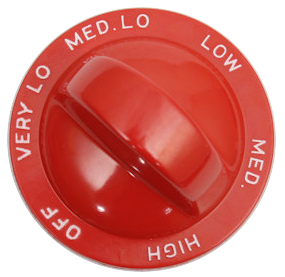
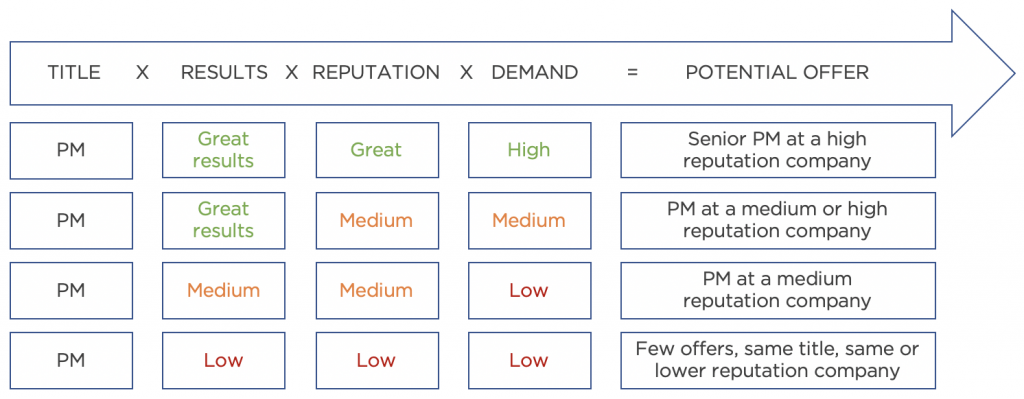
Let’s look at the framework for this from the hiring company point of view. You’re a Product Manager at Acme company and you’re interviewing for new product roles. This is a general formula for your potential outcome:
CURRENT ROLE x RESULTS x REPUTATION x DEMAND = OUTCOME
In short, multiply these four values to predict your job offer outcome. I gave this some thought because early in my career I focused on what I did and what I wanted to do next. It was only after a several years that I started to understand that results tied directly to your work are critical to show. Later I understood how reputation and demand also mattered. Working hard and hoping to get recognized is not enough. Many cultures teach people humility as a virtue which can make learning how to position and promote your accomplishments very awkward. It is best to learn to overcome this barrier. Self-promotion is an important skill to learn and it needn’t swing all the way over to self-centeredness.
Current Role
This is who you are now. Are you a Support Engineer? A Product Manager? An Engineer? What’s your starting position and seniority level?
Results
If you’re looking for a promotion or changing jobs for better roles, you must be able to show that the product, business, or unit you were in is demonstrably and measurably better because of your direct efforts. What did you accomplish? What is the result? Why is it better? If you don’t have results to show, it will be hard to show that you’re a great hire or promotion candidate.
Reputation
Do you work at Joe’s Computer Shack or do you work at Microsoft Azure? This probably sounds elitist, but where you have worked shows your progression and your choices. All things being equal, which of two candidates would you look at first given these two companies? Progression is also very descriptive of a candidate. Not everyone starts at a high-profile company with a high-profile role. I certainly didn’t. Do the companies you’ve worked for have a reputation for excellence and success? Though not a guarantee, this signals that you may also share that caliber. It’s smart if you can target the companies that you work for to align with the arc of your career.
Demand
How much do they want you? Are they pursuing you or are you pursuing them? The difference will set the tone for the outcome. E.g. When you’re in high demand you will get more competitive offers.
Scenarios
THE EASIEST DIAL TO TURN TO HIGH
None of this is easy to be honest. If you are looking to grow in your career, the easiest item in your control is demonstrating results. Your current role and company you work for are what they are. You don’t directly control how in-demand you are. If you want a promotion within your current company or your future company, focus on delivering results and value. This might take a few years. You also need to understand how to show your results so that others see them. E.g. Your resume, your professional social profile.
ZIG ZAG YOUR WAY TO THE TOP
As described, roles and titles can appear to fluctuate on paper in the course of your career. If long-term growth is your goal, pursue growth opportunities and don’t worry about your title so much. This may sound contrary to what I wrote earlier. What I mean is, follow your trajectory and fight for better roles, more learning, more exposure, and deliver more value to your company. Your roles will get and sound better over time. Smart recruiters and hiring managers know that titles don’t mean the same thing between start-ups and large companies and will calibrate for that. Instead they want to see the arc of the career story and determine if it makes sense for them. You also need to be able to tell your cohesive story and thread the career progression needle for your audience. If you focus on the long-term goal, your titles may zig zag a bit but you will make progress in the direction you want to go in.
PROMOTIONS AREN’T PARTICIPATION PRIZES
Ambitious people often work hard and drive for success with results. It’s a combination that can lead to career growth, increased responsibilities, and corresponding title increases. Getting the right title for the role you fill matters. The title itself isn’t the outcome however. It’s recognition that you can perform at that role level. To complicate matters, it takes more than results to grow upwards. Can you work across groups, hire teams, demonstrate leadership? As you grow, you’re no longer directly responsible for producing the actual outcomes. You need to create and grow teams that can do this.
DON’T ALWAYS BELIEVE THE HYPE
Comparison is the thief of joy. Careers span years and some people do get lucky. Don’t be too self-critical when you see a perfect trajectory in someone else’s professional profile. Career progressions are rarely shaped like a hockey stick graph that goes, ‘up and to the right’ in a perfect arc. They zig zag. If you see LinkedIn profiles that look perfectly smooth, they are very likely summarized to now show the story the author wants you to see. After all, resumes are marketing documents. I know of a few people I’ve seen over a long career omit irregularities entirely from their glossy LinkedIn profile.
WHEN IN DOUBT, BE AWESOME
Titles are not frivolous. They have meanings that directly map to what you do. Within a title, you might be new, you might be experienced, or you might be a stellar performer. If you’re succeeding beyond the scope of your title, you might be ready for the next level. If so, make a case for promotion.
If you want a promotion but aren’t yet fulfilling the full scope of your current role, or have more to learn, you should focus on becoming stronger, adding value, and accruing accomplishments. When you are great, you show it with results, respect from peers, and have created a strong foundation beneath you for someone to follow, you deserve the right title that goes with your work.
ABOUT LUKE
Luke Congdon is a career product manager living and working in Silicon Valley since 2000. His areas of focus include enterprise software, virtualization, and cloud computing. He has built and brought numerous products to market including start-up MVPs and billion-dollar product lines. Luke currently lives in San Francisco. To contact, connect via luke@lukecongdon.com or https://www.linkedin.com/in/lukecongdon/.

THE DAYS OF FREE ARE OVER
THE ATTENTION ECONOMY MOAT JUST GOT SIGNIFICANTLY WIDER
First let me begin by acknowledging that we are in painful times not seen for over a decade. Many are ill or worse, many have lost jobs, and many companies have closed temporarily or will soon cease to exist. We are already seeing this in spades. What we’re also seeing is that the Coronavirus pandemic has tipped the scales on a global economy poised to falter after 10 or more growth years.
For those of us who have been working for 15 years or more, this is not the first time we’ve hit rough patches. The dot com crash hit within months of my move to Silicon Valley in 2000. I finished a MBA while still in a recession in 2003, and of course the 2007-2009 sub-prime mortgage crisis hit everyone. For younger career professionals, this might be the first time you’ve lived through a dramatic negative economic event in your own working life.
BUSINESS MODELS UNDER PRESSURE
From a product management perspective these are very interesting times and they give me an opportunity to connect the dots on many business topics I’ve studied and lived. Dramatic economic events cause people to sharply shift their spending habits to only the essentials. Holidays, new cars, and accessories get put on long-term hold when people need to focus on health, food and rent. I’ve been observing during this time that businesses are also reassessing their business models and concluding that cash is king (again).
Specifically, I am starting to believe that audience first, revenue second business models will face strong adversity as the economy continues to contract. Your audience isn’t necessarily leaving, but they may never show up with dollars in hand to support you if your product isn’t critical to their lives. In fact, we may see a return to older, well-established business models. E.g. Selling your products or services directly, and in advance of consumption. This will still include paid subscriptions for ratable income. This isn’t the dark ages after all.
RETURN OF THE PAYWALL
Last week I listened to the last free episode of a podcast called Hit Parade by Slate I’ve been enjoying for the past half a year or so. This podcast is now only available to paid subscribers. This may signal the decline of the ‘build it for free’ advertising-supported business model for companies who are not at the scale of many millions of users. Of course, for companies that have already built that scale of users, an advertising business model may still be fine since they have the audience to generate revenue on. Facebook, Instagram, Google, and YouTube, for example, are doing just fine and will continue to do so. It’s the small audience businesses still trying to reach critical audience mass that will suffer. Some won't make it.

The moat for success in attention-based businesses just got a whole lot wider. It takes a very large audience to sustain an advertising business model from unpaid users. That’s not new, but creating that audience feels like it’s getting harder, with vastly more competition. In the meantime, building products still takes time and financial investment.
Newspapers have been increasingly dealing with this problem for two decades. With the extreme leakage of advertising dollars away from newspaper classifieds to online non-newspaper classifieds like Craigslist, eBay, LinkedIn, and Nextdoor etc., over the past 15 years, newspapers have had a very hard time staying afloat and paying for high quality journalists that attract readers. They’ve been working harder to gain and keep subscribers while seeing various channels steal away attention.
Many older, physical print-based products have closed shop entirely. When’s the last time you actually saw or picked up the Yellow Pages? Do you even know what the Yellow Pages are? If you’re under 20 years old you probably don’t.
THE COLLISION OF INTERESTS AND BEHAVIOR
Here’s where it hurts businesses; when user behavior and business models collide. With mobile apps like Flipboard, and Apple or Google News, I don’t have to pay for access to basic news coverage. When I click over from a newsletter to a paid, blocked access article, I just close the window and move on with my day despite potentially enjoying that particular article or analysis. I applaud the conversion efforts by many periodicals to give you 3-5 free articles per month as a lead generation method however. I don’t know if this actually works but it seems low-cost to try and maintain.
THE EROSION OF FREE
Many great products were in fact built upon delivering value for free and aggregating millions of users. Google, Facebook, Instagram, and LinkedIn for example. Some have expanded into paid products while retaining the freemium core. Others remain cost-free for end users. With an expanding moat to cross, for a new business to reach their scale of free users will be difficult without funding. Instagram may be the most recent company to have achieved this.
If it’s getting harder for newer companies or products to do this, then an unpaid user business model may be untenable. Adding users is seductive which can lead to thinking you’re growing. Gaining users feels great because it means people like your product. These people aren’t paid customers however. As your audience grows, and so do your costs or, at minimum, your time investment. That’s a hard model to sustain if this is your primary business.
If you’re building a product that relies on thousands of users before you can make money you could be in that bind for years. How long can you work to keep your audience happy while you’re personally unpaid? In the case of a podcast your audience members are listeners (free) versus customers (they paid for access). Lifetime value (LTV) for a free listener is zero if your audience is too small to attract advertisers and they won’t pay you directly.
Hit Parade by Slate just decided to make you choose and I don’t blame them. They are well-researched, produced, recorded, and most of all, interesting and entertaining. If you like them enough, you can choose to pay a relatively low amount per year ($35.00) to continue to do so. After all they’ve produced 59 episodes before this point. I must like it because I keep listening.
MONEY IN MINUS MONEY OUT
People, buildings, utilities, and tools take money, and you normally only have a few different ways to pay for these.
- Revenue from customers. When people pay you, you have money. Ideally this revenue exceeds your costs of doing business and everyone is happy.
- Investment from someone else. People give you money, and you use it. The cost of that investment may mean transfer of a percentage of company ownership. They may need some convincing that investment is worth it.
- Your own savings. You pay for everything until you run out of money or transfer to a different source of funds. This can be the hardest if you don’t figure out a revenue model soon enough. Hitting zero dollars in your savings may mean game over.
- You borrow resources. I once worked for a start-up that had free office space for two years because another company let them use space they didn’t need. This is a great deal if you can get it.
- You have a benefactor who gifts you money. Your rich aunt or uncle who just want to see you happy would be an example.
Remember that profit is what you keep after bills are paid, not the money that comes in the door. If no money comes in, you’re either in the endgame or have an uphill climb ahead of you.
AUDIENCES OF PERSONALITY
Influencers and YouTubers are an interesting new twist on advertising and promotion-based business models. As a member of Generation X, I have to admit that I’m not all that attracted to influencer business models. While these are also attention-based businesses like free podcasts, in some cases they have very low costs to produce and no infrastructure build costs whatsoever. They also seem to attract a young crowd of Millennials, Gen Z, and Gen Alpha. Many of these demographics have had high-powered, always-on digital devices by the time they hit their teens. The demand was armed and ready to consume the content.
These entrepreneurs are also building businesses where financial success is built upon creating a fan base first. They then get paid by sponsoring products directly or product placement, and/or by advertising. In this case they have a massive advantage that they don’t have to also build the platform. YouTube, Twitch, LinkedIn, Instagram already exist for the purpose of intermediating content providers and consumers. The startup costs for an influencer, therefore, are almost zero to get started. For example:
Influencer DIY Cost Model
Fixed costs
If you’re a DIY influencer, and you already have a good-enough personal phone, your costs can be near-zero. E.g.
- iPhone 11 Pro with max memory (512GB) is $1,449.00 USD brand new
- iPhone SE (2020) with max memory (256GB) is $549.00 USD brand new
- The phone you’ve had for two years is $0.00
- Backlighting rings with tripods for a professional look start around $40.00 USD
- If you’re an online gamer, perhaps you only need an Xbox One for $399.00 USD which might come bundled with your game of choice
- If you got that gaming system for Christmas last year, it is $0.00
Variable costs
This depends what you’re promoting quite a bit. If you’re recording in your bedroom then it may be $0.00.
- Time. This business can cost a lot of time that you didn’t apply to something else.
- An Internet connection. If you live with parents this may be free. Otherwise it's less than $50.00/month USD.
- Clothing. You might not care about this depending on your topic, but if you’re promoting high end clothing or lifestyle, this could be very expensive.
- Locations. If you’re a travel influencer you need to travel. Air travel and hotels can be very expensive.
- Staff. Are you aiming for a high-polish, professional-grade product with writers, producers, editors, promotors, etc? Now you look much more like a traditional business after all.
The unfortunate truth is that regardless of low start up costs, not everyone can do this and not everyone will be highly successful. It can be very expensive to live an unaffordable lifestyle for show, or ‘flex for the gram’. It may not be surprising that people who are already famous, or uncommonly beautiful people, have an advantage when it comes to getting the attention of viewers. No one said life was fair.
I’ve also read that it can take a half a million followers before big brands will start to ask for you to represent them. Gaining that many people to follow you is a steep mountain to climb which can take years. Some will never achieve it.
GETTING SCRAPPY AND INVENTIVE
Circling back at our current Coronavirus pandemic, I am inspired by the tenacity of restaurant owners whose businesses are under real strain. I live in San Francisco and I’ve directly seen and heard about many companies closing down, temporarily closing their doors, or cutting staff. I’ve also seen some companies simply grinding it out and doing whatever they can to stay alive. This feels like real product management and survival. Many of these folks may feel like they don’t have a choice. It’s live or die as a business. Death of a business may very well mean a crippling, unrecoverable blow to personal finances for the owners. I’ve seen restaurants in my neighborhood keeping the front door open and turning themselves into a take-out only restaurant but staying alive. This is redefining the product to meet the changing market needs. No doubt they still don’t have it easy.
Just this past weekend my wife attended a yoga class on Zoom with over 100 attendees. This was not a class she even knew about prior to our shelter at home days. An enterprising teacher is giving classes from her home over online video and has attracted over 100 people per class and collecting suggested donations from students. It’s really cool to see.
MAKING CHOICES
So did I end up paying for Slate? So far I have not. This is the hard part for content producers. I have so much available content between YouTube, other podcasts, Netflix, RSS feeds, Reddit, news sites, etc. that my attention is fairly divided. Pair that with a day job that occupies the majority of my waking day and I don’t have a lot of motivation to restore one missing channel.
I have paid for one podcast I’m enjoying quite a bit from Acquired they call their ‘LP Show’ however. One of the authors of that podcast was also involved in creating a podcast subscription payment platform called Glow.fm. It’s an interesting way to monetize podcasts directly instead of the traditional advertising-only model. For them, they built an audience with one show and built a paid listenership with the other. This is a view into the evolution of business models we can expect to see more of.
I hope everyone is keeping as safe as possible during these times. I hope as well to see the return of our smaller businesses and local communities to health and prosperity. As consumers and the Internet itself continue to evolve I expect that new ways of getting to users will also emerge which will again disrupt the popular ways of doing things.
ABOUT LUKE
Luke Congdon is a career product manager living and working in Silicon Valley since 2000. His areas of focus include enterprise software, virtualization, and cloud computing. He has built and brought numerous products to market including start-up MVPs and billion-dollar product lines. Luke currently lives in San Francisco. To contact, connect via luke@lukecongdon.com or https://www.linkedin.com/in/lukecongdon/.

THE PRODUCT ROADMAP INSTRUCTION MANUAL
This post goes into how to start building a roadmap. The privilege to build a product roadmap comes with great responsibility. Drawing the future is a lot of fun. A future that produces no product or outcomes, however, will be seen as a waste of time, opportunity and resources. That outcome will also not be good for your PM career longevity.
If you need to produce a roadmap from scratch, you may be at a loss to fully understand what it needs to encompass.
We’ll cover the multiple inputs to the creation process and the various ways you can validate or invalidate your ideas with customers and stakeholders. The multiple pressures which need to either be accommodated, selectively ignored, or which may later force-adjust your roadmap are also covered.
No Place to Hide
If you build a roadmap, or set any direction for your organization, you are responsible. PMs live and die by their outcomes. Sometimes you will not have perfect information or market research but you still need to drive a vision and roadmap. That will in turn start your team of 5, 10, maybe 50 or more engineers working. Make a mistake and you may have squandered five engineers’ time for 3 months. I.e. 3 engineers making $150,000 a year who were just directed to work for 3 months for no return. I’m being conservative and not including the employee burden rate. You earn the privilege of making roadmap choices with outcomes.
How to Build the Roadmap
Many roadmap-related articles I’ve read in the past operate on an assumption that it is a self-evident document. If you’re a person who works to fulfill a roadmap set by someone else, this may be true. If you need to produce a roadmap from scratch, you may be at a loss to fully understand what it needs to encompass. This post describes some of the many considerations and inputs to the roadmap development process. Even if you are not currently responsible for creating this document today, it may help you understand what your organization was evaluating when the roadmap was produced or updated.
The Inputs
Putting a roadmap together is an iterative process which requires the synthesis of several inputs. The output is a plan to which many teams will begin planning and working. In a company with great vision, you can view the start of this process as coming from the top initially. I.e. Why do we exist and what great goal do we have? Let's get started.
- Identify Product Maturity
Where in the product lifecycle is your product? This is important because how you form your roadmap, and how much you invest, is determined in part by the maturity of the product. A cash cow product is optimized to make money. A brand new product is likely optimized for growth and user acquisition. There is a wide range in between. The Boston Consulting Group (BCG) has a famous matrix for this which every business student learns. Plotted over time, you can also view this in startup terms; from MVP (minimum viable product) to EOL (end of life).
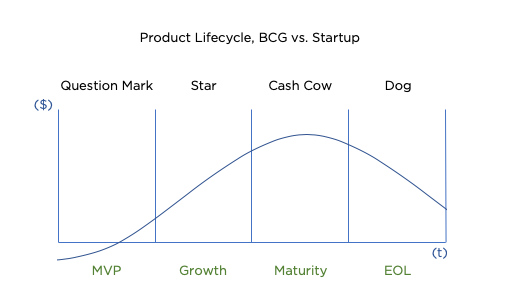
It should be pretty obvious what life stage your product is in. Did you just create your first prototype and raise series A? (Question Mark / MVP stage), or did your product make $30M in revenue from 60,000 users last year (Star / Growth or Cash Cow / Maturity stage)? The mix of investment, maintenance, technical debt, etc. dollars you apply to your product will be different for each.
Here is a visual representation of investment, expected revenue sources, and marketing motions per product maturity phase.
The Startup or MVP Product Roadmap
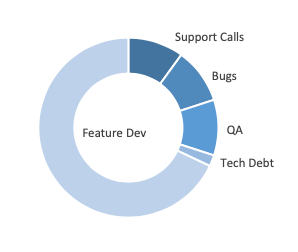
Stage: Startup or MVP
Effort: Aggressive build
Investment Dollars Sources:
- Bootstrap or venture $$$$
- New customers $$
- Sell to install base
- Support $
Marketing
- Growth hacking, organic, friends and family
Note: Build like your life depends on it. Ignore technical debt until later.
The Mature Product Roadmap
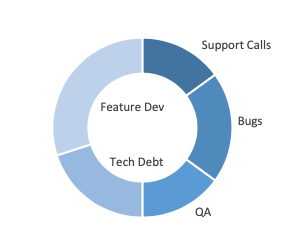
Stage: Mid-life
Effort: Growth, maintenance
Investment Dollars Sources:
- Venture $ or $$$$
- New customers $$$
- Sell to install base $$
- Support $$$
Marketing
- Traditional, demand generation
Note: You've achieved a MVP, you've scaled marketing, you're investing in building, quality, support, and more to deliver a growing and stable product.
The Cash Cow Product Roadmap
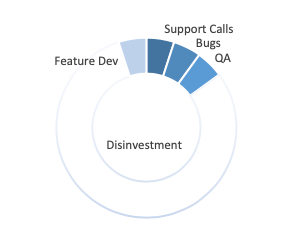
Stage: Cash Cow
Effort: Sustaining, maintenance
Investment Dollars Sources:
- Venture
- New customers $$
- Sell to install base $$$
- Support $$$
Marketing
- Demand generation, brand
Note: This product is very mature, but not EOL. You’re maintaining it and harvesting revenue from a healthy install base and some new customers. You may now be investing core development budget in new MVP or growth products versus this one.
2. Identify Customer and Company Needs
The customer comes first is a good guide. However, you will be pulled in multiple directions by different key stakeholders. To understand what your customers need, I firmly believe PMs must consistently have direct interactions with them. This is because absent direct interaction, you will start to invent customer motivations which might not be true and eventually miss the market. The other reason for direct interaction is primary research. PMs must actively cultivate direct customer relationships for first-hand access to customer voice, opinions, pains, and needs. Secondary research via news, trade publications, competitive research groups, blogs, and other teams is useful and should be leveraged. These augment your primary research knowledge base. You must know your customer directly, however. Don’t outsource your authority by relying on others to know the customer better than you do.
Next you need to understand what your company needs. The process starts at your company’s reason for being alive. What is your core vision of who you are as a company? This may sound trite, but take this example. Freight trucking and Formula 1 racing are both forms of transportation. The extraordinary high speed requirements of Formula 1 have no application to trucking. The disproportionate gross weight requirements for trucking have no application in Formula 1. The direction you head in should align with your reason for being.
After that, what goals do your executives and business unit require? This is a level down from company purpose and more likely to be a business metric. Are you pursuing a new business segment? A revenue target? Volume target? What is your current motivation?
Hopefully your company and organizational goals are already known. Below are abbreviated lists of motivations per key stakeholder. Some will be complementary across groups; others will be relevant to only the group they are listed under.
Customer Motivations
- Save me money
- Make my job easier to do
- Remove my pain
- Reduce employee training costs (OPEX)
- Reduce number of employees needed for the same work (OPEX)
- Reduce tools and infrastructure needed (CAPEX)
- Create magic (hard to define, harder to deliver)
- I want it. This might not be rational or feasible.
- Your competitor has it, so I want it. This might also be irrational.
Company Motivations
- Make money
- Fulfill customer motivations if they lead to the above
- Fulfill customer motivations if they lead to satisfaction and continued usage of product
- Encourage users to advocate your product to others (organic growth)
- Drive customer to buy a multi-year deal (ELA or subscription) to increase dollars upfront at a (sometimes) reduced price in exchange for time value of upfront money. I.e. Lowered cost, but bulk money upfront. Note that money upfront does not equal money on the books (revenue recognition, ratability).
- Deliver shareholder value in the form of stable and growing stock value
Sales Motivations
- Sell enough to make my quota and earn commissions
- Meet my sales goals as a rep
- Solve customer problems
- Push feature prioritization and delivery to PM in order to satisfy the previous three.
- Push any team in order to get the first two.
Note: Sales is hard. If you doubt this, try convincing anyone who isn’t your parent to part with their hard-earned money and see how far you get.
Product Manager Motivations
- Satisfy my customers
- Sell product
- Deliver stable, high quality product
- Satisfy a reasonable number of selected additional stakeholders
- Ship product I can be proud of
- Discover and deliver value
- Deliver the right amount of value at any given time
- Beat the competition to customers’ budget dollars
- Accelerate into problem spaces that customers need before others.
3. Collect Your Data
It’s quite challenging to deliver to all of these motivations. If you don’t know where to begin, talk to your management. Your team or personal goals should point you in a direction. In addition, unless you are starting with a blank canvas (not common), there will undoubtedly be a long backlog of requests and potential features. Review all of them and ask questions. Talk to your predecessor if possible, your engineering team, your SEs, your salespeople, etc. You will get quickly flooded with feedback and asks. Talk to your customers. Start forming an opinion. The more senior you are; especially if you came from the industry previously, you likely have some foundational beliefs and insights to the industry. That will get you started. This background probably helped you get hired. If you’re stuck, use your tool box of frameworks and product analysis methods. E.g. Start with a SWOT analysis.
4. Form Your Opinions and Start Writing
As you speak to all your contributors, you will begin to form your own opinion on what needs to be done. Take out a piece of paper and start by drawing out four quarters. Then pencil in what’s important and serves your strategy and what you believe is right. Ask yourself why any item deserves to be on the roadmap, what problem does it solve, and what the expected outcome is. Outcomes can include revenue, adoption, competitiveness, and more. Customer satisfaction might be a viable outcome. Just don’t BS yourself by overusing squishy goals like satisfaction. When squishy goals are used too often, you probably don’t know why you’re building in a particular direction. Remember that customer asks are cost-free and easy to make. You have to determine what must be done at the expense of everything else. Ensure everything matters and everything is defensible, then write it down. That’s your first draft.
The roadmap as a clean, printed document belies the pressures you’ve been managing and the river of blood you’re standing in from backroom cuts, executive overrides, horse trading, resource losses, and negotiations you’ve battled to get the right product out to your customers at the earliest possible time.
That's it? Perhaps that initial draft exercise sounded too easy. The mental crunching, research, prioritization, fighting, defending, negotiating and moving teams and the company forward is the hard part that never ends.
5. Feedback Loop
Once you’ve built a roadmap, you will continually hone it via customer feedback. This is how you ensure you have the right signal, and that you’ve prioritized the right things. You’ll know you have it mostly right when customers and internal stakeholders 80-90% agree with the roadmap. It’s ok to not get 100% agreement. Individual stakeholders don’t usually see the whole picture that you see. Individuals also don’t always feel the same pain points. Furthermore, reviews are also ideal opportunities for new research and discovery which may end up on a future iteration of your roadmap. It’s also how you can build long-term relationships with key customer influencers who can help you validate new ideas. These close customers are your personal advisory board.
The Finished Document
Your roadmap is never really finished. As each quarter and each year go by, you will be forever updating and reevaluating what deserves to be on the roadmap. The roadmap as a clean, printed document belies the pressures you’ve been managing and the river of blood you’re standing in from backroom cuts, executive overrides, horse trading, resource losses, and negotiations you’ve battled to get the right product out to your customers at the earliest possible time. It’s not easy. Even with the best planning, there are forces always in motion that can hit you hard. Your job as the PM is to anticipate all of these while delivering the best roadmap for customer and company needs AND results that move the revenue, adoption, or your metric of importance.
For a short time, a new start-up can operate on vision alone. As companies get larger and invest in dedicated product management, you need the skills and the tools to coalesce numerous internal and external pressures, requirements, demands, and strategy together in order to move your organization and product forward. The roadmap is one such tool, but by itself it’s just a document. As a PM, ensure you’re investing in the right places at the right time to achieve the outcomes your company need. The roadmap is much more the outcome of a well-trained PM organization than a commanding document. That said, a roadmap is a very useful document for the entire company. A great PM will know how to define, build, defend, and execute a roadmap to make the right stakeholders happy. Get comfortable with the fact that not everyone will be happy and you will also have to manage that too.
ABOUT LUKE
Luke Congdon is a career product manager living and working in Silicon Valley since 2000. His areas of focus include enterprise software, virtualization, and cloud computing. He has built and brought numerous products to market including start-up MVPs and billion-dollar product lines. Luke currently lives in San Francisco. To contact, connect via luke@lukecongdon.com or https://www.linkedin.com/in/lukecongdon/.

THE ROADMAP BATTLE ROYALE
NAVIGATING THE NATURAL TENSION AMONG STAKEHOLDERS
This is the first in a series on product roadmaps. The first post describes why roadmaps matter and who relies upon them. The roadmap is much more than a directive document that tells teams what to do by when. It is ideally a galvanizing document to drive vision, bring teams into alignment and commitment, and lead them and your customers to your future, promised destination. The numerous parties to the roadmap have different motivations and needs which you as the PM must be weighing in order to achieve a higher success probability. The roadmap itself, however, is not an edifice to sit back and admire once built. It's a map that is 85% drawn, with empty space that continues to grow ahead of you as you move forward. The further out towards the horizon you look, the hazier the fidelity of the map.
Battleground
The product roadmap. You own it, but many other teams are gunning to influence it daily. It’s a battle royale to keep your product on plan, on course, and on time while many other interested parties push to get their needs prioritized above others. Sometimes owning the roadmap feels like a survival competition.
If you’re new to product management you might not own a roadmap. Instead you have projects assigned to you by your manager. E.g. Research, define, and build feature X to deliver by December. That is, a roadmap may exist, but you don’t own it. This is normal if you’re in the associate product manager (APM), product manager (PM), and Sr. PM roles. As you progress in your career, you will begin to gain ownership of a set of product features, a product, or a product line. You will begin to prioritize multiple development choices against customer needs, resources, delivery dates, organizational goals, and outcomes within your area. Over time with seniority and success, you will become increasingly responsible for product vision, goal setting, and the product roadmap. For succinctness, I’m not including leadership, management, process, and coordination responsibilities which will also come with more senior roles.
The product roadmap is a critical, in-demand asset because so many people across your entire organization have a material stake in what it includes. These include:
- Engineering - What are they expected to build?
- Management - How do they need to staff?
- Sales - What new, valuable solution can they sell and when?
- Sales Engineering - How does this work and can they learn it quickly?
- Executives - Are you aligned to the goals of the company strategy?
- Marketing - Do they need to update the messaging?
- Partners - Can I make more money?
Defining the Product Roadmap
This roadmap is a document which defines your concrete product goals, usually on a feature or outcome basis, for a defined future time period. In most tech companies I’ve worked for, product teams plan one year at a time, divided into quarters.
A picture perfect roadmap will outline goals for a year. A picture perfect organization will deliver them on time in a year. In neither case have I seen this happen in 15 years. At best a roadmap is valid for six months and gets less certain beyond that. Plans suffer contact with reality, even with good preparation.
How you visualize the roadmap has flexibility, but it must be clear. Slides are popular because you will be sharing that roadmap often in meetings with your internal stakeholders and customers.
Don’t confuse the roadmap for a Gantt chart however. Your product goals and your project tracking are not the same thing, even when you have timelines defined for when you need them released. A good project manager, however, can help you achieve the outcomes of a roadmap.
The most important aspect of the roadmap for a PM is its function to drive shared understanding and agreement. You know your company strategy and high-level goals which were communicated from your leadership team. If you don’t know this, this needs to be resolved immediately as a first order issue. Without vision and goals, your roadmap will only be a collection of best guess or most-requested items which is far from ideal. Your roadmap must support the product vision and goals.
Let’s assume that in addition to good company-level direction, you’re in frequent touch with your customers and understand what they say they need, as well as your other stakeholders. You’ve synthesized it all and produced a roadmap. Guess what? You’re not even close to done. Next you need buy-in from all your stakeholders and some form of ratification. Ratification is either explicit confirmation to agree to the roadmap from the team, or minimally the tacit lack of objections from your key stakeholders. Not everyone must agree with every choice on the roadmap, but you’ll get nowhere if no one agrees and starts building to plan.
The roadmap, therefore, drives agreement to the following:
- Customer and internal outcome goals
- Shared understanding (or the basis on which to build it, and buy-in)
Of course, unsatisfied stakeholders will also let you know without reservation when they don’t like what they see. They’ll also hold you to account when items slip or disappear. To you the roadmap may be a plan. To them it is a promise and a commitment. Tread lightly on not meeting your commitments.
Stakeholder Friction
I refer to the roadmap as a battleground because it is hotly-contested territory among many stakeholders. PM owns the roadmap, but many others contribute to, and live and die by it. Under no circumstances have I ever seen apathy from any stakeholder who has something to gain or lose from the roadmap.
The reasons for this derive from the many stakeholders with differing needs.
- Product Manager: You have goals for your customers and product success. While you are empowered to drive roadmap definition, you ultimately don’t do it alone.
- Customers: They have things they believe are necessary for you to build. Perhaps they already bought your product and now they expect you to keep up with (whatever they think they need at that time). Perhaps they are considering buying your product but won’t do it without feature ‘xyz’. Maybe they’ve hit a bug they’re angry about and expect you to rapidly resolve it.
- Sales: They sell your product and need it to be compelling and solve customers’ pain points to do so. Customers rarely buy what they don’t need. Lipstick on a pig (making something of low quality look attractive) only works for a short while. You will eventually get caught if you do this.
- CEO: Making your numbers to the Street requires you to sell product. If the product is holding back sales, the executive team will have strong opinions on the roadmap. Your CEO has the authority to override your roadmap if necessary. See HiPPO decision-making. The road map must be driving outcomes valuable to the business.
- Support: Think you can only ship new features? Sorry Charlie. Support needs quality and the same engineers that build product also fix product. If you don’t ship quality you soon won’t be shipping at all. Enterprise customers require support. While ‘support’ isn’t on the roadmap as a feature, a percentage of your engineering team is always dedicated to support and maintenance.
- Engineering: This team wants to ship valuable features that matter, but they also need to reserve a portion of development time for technical debt and work on things like infrastructure that customers won’t directly see.
The other reasons for this war zone come from externalities to your product.
- Internal Competition: Given the importance to stakeholders for the features on the roadmap, you will find that there is competition for people outside of PM to get their features on your roadmap. These can come from any of the teams listed above, or may include many others too.
- Time: Your competition in the market is willing, motivated, and may be under the existential threat of death to try and eat your lunch. Life, love, and relationships are not zero sum games, but capitalistic markets are. The enterprise customer with a $2M budget to spend on infrastructure (or insert any product) by June 30th isn’t buying it twice from two vendors. You have time pressure to get to market with viable product, and to do it before your competition gets that customer budget in a PO and locks you out.
- Politics: I won’t dwell on this, but not everyone has your best interests in mind. That can cause bad behavior and can be another zero-sum game.
Roadmap Decay Rate
Conventional wisdom says you will know your market, your customers, and your product needs, which then inform your roadmap. You present this roadmap to your organization, they buy off on it (often after some negotiation), and it becomes a ratified document against which your organization gracefully works toward for a year. This is the textbook scenario.
In reality, the moment your four-quarter roadmap is published and ratified, it begins to decay. Your roadmap items may be correct, but daily friction with reality which will blur its fidelity over time as you reach your third, and especially your fourth quarter. I.e. Add time, internal and external pressures, and your end of year plan will start to fray. The decay rate can vary depending on your organization size, maturity, and product complexity.
Here are a few real-world examples of issues you can run into. I can painfully attest to hitting many of these myself, many times over.
- A critical engineering resource takes a 3-week vacation you were unaware of, starting next Monday.
- Your largest competitor just bought a company that changes customer perceptions, causing a strategic rethink.
- Unplanned attrition means the person building your feature is now gone, and no one else can take up that work anytime soon.
- Your team (and probably you too) have done a poor job of dependency analysis, and now you have something mandatory that was unplanned for, but requires three months to do.
- A layoff takes out a team resource. Now you will be handling this yourself with no timeline changes. Goodbye Saturday.
- Sales inked a deal for a feature that’s only in beta and finance has a revenue recognition SOX compliance issue? That’s now your number one feature regardless of its original priority.
- Your largest customer won’t buy again without feature ‘xyz’? That’s not a strategic way to run a product, but you will feel this pressure.
- A partner team decides to reprioritize and defund two people from a component you needed by June. Your project manager has an updated release date for you.
Some of these are extreme examples. Others are mundane and all too common. Yes, you will experience these and more.
Your roadmap is constantly evolving, like it or not. At best the roadmap remains unchanged but the delivery dates slide out. Of course you can get in front of some issues and plan for some eventualities. All too often however, you have little recourse when three weeks before a final delivery date someone in engineering says, ‘There’s no way we can deliver by that date. Maybe in three months.’ Of course you say, ‘But I’ve been in constant touch with them so this won’t happen.’ People don’t like to disappoint, but it will happen. When the floor drops out with a big, unplanned surprise, your roadmap and product take a hit.
In part two of this series, we’ll discuss how to get started building a roadmap, what goes into that process, and how to get started in practical terms.
ABOUT LUKE
Luke Congdon is a career product manager living and working in Silicon Valley since 2000. His areas of focus include enterprise software, virtualization, and cloud computing. He has built and brought numerous products to market including start-up MVPs and billion-dollar product lines. Luke currently lives in San Francisco. To contact, connect via luke@lukecongdon.com or https://www.linkedin.com/in/lukecongdon/.

HOW TO CRUSH YOUR PRODUCT MANAGEMENT INTERVIEW
UNDERSTANDING BOTH SIDES OF PRODUCT MANAGEMENT HIRING
Over the past 20 years, I have been both a product management job seeker and a hiring manager more than a few times. Having experienced both sides of the hiring process I can now recognize many of the common interview process mistakes. In this post I want to focus on those common hiring mistakes made on the candidate side.
Over the years I've interviewed hundreds of people for product manager (PM) roles. Surprisingly, many candidates take themselves out of the interview funnel by making fundamental mistakes that are completely avoidable. My goal is to help you identify and avoid these common mistakes and help them stay on the interview track. To begin, it helps to understand the motivations and needs of both parties in this transaction. For simplicity, I’m not including the roles of sourcers, and recruiters/search consultants/headhunters.
HOW TO GET INTO THE HIRING MANAGER'S HEAD
As a job seeker, it’s natural to think primarily about your needs when looking for an opportunity. Hiring managers on the other hand, have specific needs in mind when they are searching for candidates that the job seeker might not be aware of. Naturally managers are looking for the following attributes:
- Talent - Are you smart? Fast-learning? Proactive? Insightful?
- Experience - Have you done this before? Where? How? Results?
- Education - Do you have an appropriate educational background?
- Culture Fit - Will be comfortable, happy, and productive here?
- Motivation - Are you excited about this particular role?
These should be obvious since no one wants to hire the opposite of these traits. Finding the right combination of these attributes, matched to the right seniority level for the role, is the challenge a manager must overcome.
The manager’s role also has demands that may be less obvious especially when they are looking for a new professional to join the team. A search begins because the manager is either replacing someone who vacated a role, or they need more PM coverage as a result of product growth and/or expansion. E.g. A new feature set, or a new product. Since hiring is need-based, the manager and team are probably already doing the role themselves in addition to their standard job responsibilities.
To get approval for a new team member, the manager then presents a value/benefit argument to defend a new hire, and works to get a requisition (req) approved. I.e. Approval to hire a person in the company budget. This can take a variable amount of time depending on company budget cycles or yearly operating plan cycle approvals. Requisitions are elusive however. They can appear, get frozen, or disappear overnight as budgets or quarterly earnings shift in unexpected directions, meaning your hiring efforts can go unsatisfied despite months of effort.
YOUR MOTIVATIONS
The job seeker also has a host of motivations ranging from career progression (i.e. wanting a promotion), to needing stable employment, to wanting better compensation. There are many other intangibles in the equation too, including:
- Finding a boss that will mentor you in addition to managing
- Working with a better team or more successful company
- Working with a greater diversity of coworkers
- Working at a preferred location
Perhaps the employer contacted the candidate, in which case this is an opportunity to test the market and evaluate the benefits of the opportunity.
STAYING ON COURSE DURING THE PRODUCT MANAGER INTERVIEW PROCESS
I’ve always liked major metropolitan subway transit maps. In comparison with an interview process, there may be hundreds of route combinations to land on a job, or wrong connections to route you out of the running for a job. Ultimately the job is at a single stop and you needs to stay on course and navigate the right connection points to land there.
E.g. A candidate has applied to a job posting with enough background to match to the role and get an interview or two. I.e. They are broadly a match for the role. They are in a related industry, have a matching background, and meet the basics on experience and education. They are a viable candidate and are already ahead of many others who might also be applying.
In my experience, I’ve seen many key mistakes which have off-ramped initially qualified candidates out of the running. Don’t let these happen to you. I am aware that interviewing is a difficult process, and you don’t always get the job even when you do match many of the qualifications required. I’ve been there myself.
7 COMMON PRODUCT MANAGEMENT INTERVIEWING MISTAKES AND HOW TO AVOID THEM
1. You Don't Show Motivation
Product management jobs are competitive to get. Hiring managers want a candidate who is motivated and strongly interested in the position and product. When a candidate arrives with neutral or disinterested feelings, their body language often shows it. To be clear, you don’t have to behave sycophantically. I want to know that you want the job. In fact, it helps to clearly express that you want the job. Don’t take the interview simply because we emailed you. This is a clear way to get removed from the interview funnel.
The candidate I’m most invested in is someone that can come in and perform the role very well, fit the culture, and enjoy what they are doing. Ideally they will stay for years. Hopefully I won’t need to rehire for the same role in less than two years.
2. You Don't Know What We Do
This happens quite a lot and I find it hard to understand why. I also find this occurs more often with candidates directly out of college or graduate school. A PM is a senior role that has a lot of leverage and fits a unique responsibility. You have to know the customer, the product, and the business. If you arrive for an interview and you can’t clearly communicate what we do as a company, you’ve self-exited the candidate funnel. This shows a lack of preparation and basic research on the company website which is a terminal red flag. In the case where we reached out to you, you may not have been prepared, but you still have time to read up prior to responding to an email or taking a phone screen.
STORY: In the past year I interviewed a business development intern candidate who was just completing business school. This person, even after having interviewed with four other people that morning, could not describe what our company did in even the simplest terms. They managed to repeat a couple of buzz words, but clearly had no idea what we were in business for. While I did not expect the level of industry understanding that a 10-year veteran could provide for an entry-level role, showing zero knowledge told me they hadn't done their homework. "Tell me what you know about our company" is a softball opening question. For a MBA student, this lack of awareness was disappointing.
3. You're Not Prepared
Not knowing what the company you’re interviewing for does is egregious enough to get its own bullet. Not being prepared overall is even worse. The job interview in some ways is a dance with established moves. It starts with, ‘Hello, tell me about yourself’, then moves to qualification and fit questions, then wraps up with, ‘Do you have any questions for me?’. If you’re fresh out of undergraduate school I could understand as you have not had a lot of experience with this dance. In general, PM roles are usually not available at the start of one's career, though some exceptions apply. Given the abundance of free online career advice and online interview education videos available with a few clicks, managers expect candidates to be familiar with a company's business and basic product portfolio. It is an easy routing filter to decide if you will continue to be considered for additional interviews, much less an offer.
STORY: I once made a direct hiring manager recommendation years ago for a friend who expressed interest in a PM role. The friend had deep and highly relevant professional expertise which made them a natural and easy referral. It was no surprise that a recruiter contacted them immediately for a phone screen. The day of the call, I found an hour-old instant message asking me who the key competitors of my company were. They had messaged me while on the call for a quick answer to a fundamental question. They had taken the call with no apparent preparation. The recruiter never scheduled a follow-up interview.
Many product management education and interviewing resources are available freely online. Popular resources include:
- Good PM, Bad PM, Ben Horowitz, David Weiden
- Mind The Product, Martin Eriksson
- How to Hire a Product Manager, Ken Norton
- Cracking the PM Interview, Gayle McDowell
- Breaking Into Technical Product Management, Luke Congdon
4. You Don't Know Our Product
This one is specific to PMs. Product managers are seen as experts in their product and industry. When interviewing for a PM role, you are expected to know the fundamentals of the product we offer. At this point you are not expected to be an expert if you are changing product lines. You are expected to have arrived with knowledge of what it is, what core use cases it addresses, and where and how it fits in the industry. There is no excuse for not taking the time to know these fundamentals. This information is very easy to acquire on the company website, YouTube, news, and blogs. The level of depth will vary with the seniority and responsibility level of the role. The more senior the role, the more I’d expect a candidate to know the product, the business, the selling motion, common objections, the market, etc.
If you are targeting a B2C (business to consumer) product, you can easily differentiate yourself by downloading the trial version of the product, using it, and developing a point of view about it. B2B (business to business) products also often have trial versions. Here you can differentiate by conducting interviews with people in your network who use the product and summarize their feedback with recommendations.
If the role is entry-level, I’m less concerned that all your research and responses are perfect. Getting every question 100% correct is not the minimum bar to meet. Showing that you did your research and came prepared is the minimum. That said, everyone wants the best talent they can get. If you’re personal competition is more prepared than you are, they will advance past you.
Caveat: Some companies like Google won't tell you what the specific product you'll work on as a PM will be. They interview for PM talent, and then let the new hire choose the group they’ll work for via internal pitches from groups that need help. This model is not that common. This is arguably more difficult to prepare for since these companies focus deeply on skills.
STORY: Years back in 2007 I interviewed with VMware. During the interview, the hiring manager asked me how much I knew about the company. While I did not know a lot as an industry outsider, I had read the website and proceeded to describe a product called GSX. He let me finish and smiled. He told me that VMware had stopped selling that product, but that it was still on the website. He was happy that I had done my research and was not concerned that I didn’t know that VMware’s own website was not yet updated. A few interviews later I got an offer which I accepted.
5. You Tell Me You Don’t Want the Job
This one is less common, but surprisingly does occur. Normally you should simply not interview for a role you don't want. I believe this only occurs when a job seeker is testing out his/her options in the market or is searching to find a role that fits them perfectly. While this mistake is somewhat understandable for an entry-level job seeker, it is frowned upon for a senior candidate. Hiring is expensive for companies and consumes many resources of all the people involved in the process. I recognize that some readers will feel that companies do the same thing when asking people to interview them. Remember that once you track into a particular industry, the candidate pool shrinks and hiring managers have long memories. The other way of showing that you don’t want the job is by prioritizing elements unrelated to the job itself. I.e. Any role will do as long as I get xyz satisfied.
STORY: In a recent interview I had a candidate tell me after 30 minutes that, "The only reason I took the interview was because your office is close to my house." This showed real disinterest in the opportunity at hand. I understand that commute time is a real concern to life-work balance. This response however, told me that they did not have an interest in the opportunity itself. This was a hard U-turn taking the candidate out of the hiring funnel.
6. You're Not Selling Me
As I mentioned earlier, PM positions are competitive, professional roles. Part of the role involves positioning and selling product by working with marketing and sales teams. I want to hear why you believe you’re a great fit for the role. During the interview process, you are the product that I’m considering buying. Do you know why you’re the best? Are you confident in your abilities? What differentiates you? What can you bring to the organization that your competition can’t? PMs drive product and teams with informal authority. I.e. No one reports to you. If you can't sell a story, you will not be successful in your role. I assume the best product you know is yourself, and interviews at their core are sales pitches.
7. You're Not Committing
Let’s assume you’ve been interviewing well, keeping on track and you are the real deal. You are smart, motivated, informed and know your capabilities. You get an offer! Congratulations. We’re serious and we want you on our team. Let’s make this happen. There are two ways to not commit which will end the process. The first is to simply not accept the offer. This hurts because we’ve been spending time on interviews and follow-ups because we were working in good faith. By the time we’ve made an offer, we’ve probably parted ways with other candidates too. This can go both ways. I’ve been a candidate to make it past 12 interviews and not get an offer before. Ideally, you’d know well before the offer that you were not truly interested in the role. Hopefully a company representative did not create a terminal red flag for you at the last minute.
The second way to not show commitment is even more painful. You accept the offer but don’t commit to joining the company, or you just never show up. In this case, we’ve both spent a lot of time and resources getting to this point. On the company side, having made a clear decision to make an offer which the candidate accepted, we’ve informed any other candidates who are no longer in the pipeline. An offer means that myself and 3-5 other executives have agreed and signed off on your offer and comp plan. If you provide a verbal ‘yes’ and sign the offer, ServiceNow tickets are auto-generated to get you a place to sit, a computer, an email address, and other day one activities. There is a lot to unwind and start over with a new candidate pipeline which could take months to get back to this point.
STORY: In the past year I found a candidate who was well-spoken, had the right background, knew my industry, and interviewed very well. We ran phone screens and in-person interviews. Everyone involved in the process gave their approval. An offer was made. They let us know they were in-process with two other companies and were weighing options. We improved the total comp plan and updated our offer. They verbally accepted and signed our offer. We were excited to get moving. I emailed them and welcomed them to the team, and asked what start date they had agreed to with recruiting. A week went by with no response. I emailed again. They said they had more questions first. A call was scheduled and I spent an hour responding to validation questions which would normally be answered before you signed an offer. They didn’t give me start date but said they would update me in that week. A week went by. I emailed again. More time went by. Finally I got a response which said they were close and would let me know when they were starting soon. I probably waited too long to take action. After four weeks of this I pulled the offer.
THE ON-RAMP
It might appear to be common sense to avoid these pitfalls, but I run into many of these frequently in interviews. PM roles are highly cross-functional with direct impact on many teams and the business at large. It’s no surprise that PM is a role that is often in the background experience of many start-up founders, executives, and venture capitalists. As a result, a lot is expected from a PM candidate. Hopefully this offers a point of view which will help you land your next dream job.
Of course, sometimes you'll do it all right and still not get selected. We’ve all been there. By avoiding these mistakes you'll put yourself in the best possible position to be selected for the position you're seeking.
ABOUT LUKE
Luke Congdon is a career product manager living and working in Silicon Valley since 2000. His areas of focus include enterprise software, virtualization, and cloud computing. He has built and brought numerous products to market including start-up MVPs and billion-dollar product lines. Luke currently lives in San Francisco. To contact, connect via luke@lukecongdon.com or https://www.linkedin.com/in/lukecongdon/.

BREAKING INTO TECHNICAL PRODUCT MANAGEMENT
DISASSEMBLING COMMON BARRIERS TO ENTRY
For the past few years I've been volunteering on career advice channels including LinkedIn Career Hub and Santa Clara University Network Advisor, answering questions for younger career professionals looking to transition into the PM career track. While also writing on this blog for the past few years, there has been a clear trend among the people who have reached out for guidance. They universally want to know, 'How do I break in?'
This inspired me to reach out to Product School and volunteer to be a featured speaker to share the summarized advice I've been giving on a 1:1 basis. They have a consistent 'Talk Series' of industry speakers which often range among well-known consumer-oriented technology companies. While the focuses of PM can differ slightly between enterprise and consumer, the presentation below applies to either product track.
Update: October 2019: Product School has posted the video from this event which you can watch below.
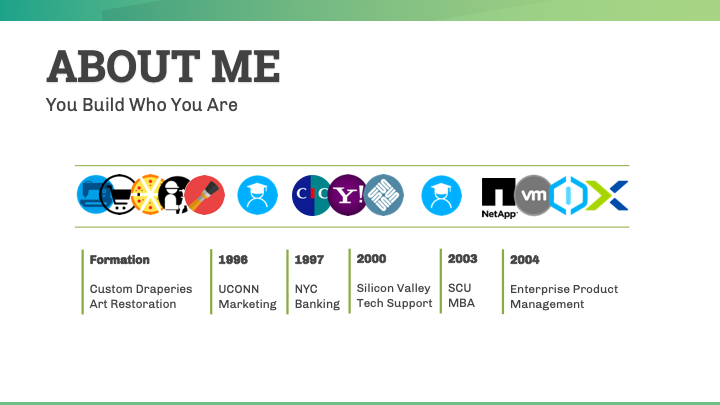
- Everyone's path into product management is different. Use your unique background to build a cohesive story that drives and shapes you.
- You build who you are. Your former experiences will inform your approach to PM whether you are aware of it or not. Lean into your experiences when they help, lean out when they hold you back.
- My path started with family of creative tradespeople running custom drapery and art restoration businesses. PM to me is an industry of creatives leveraging technology to build amazing products.
- Volunteering to help people understand the product management career path revealed that most simply want to know how to get started. This experience motivated me to produce this presentation and share my advice to a broader community.
- Since you're here, you already have an interest in product management. According to the Wall Street Journal, so do many new MBA graduates. Technology PM has become a hot career path.
- As a result, more people are asking how to get in both pre and post MBA, or with no sights on a MBA at all.
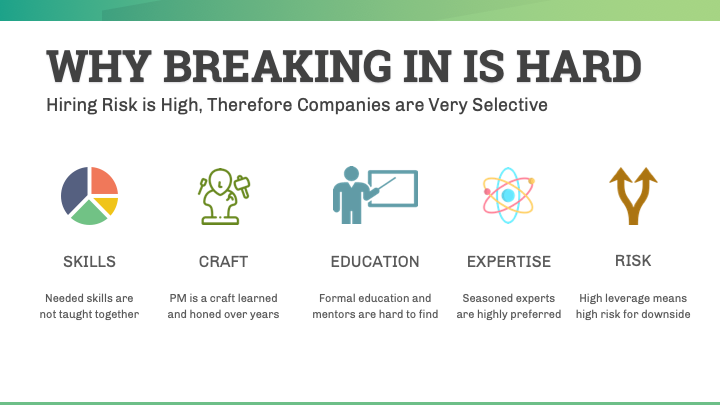
- Getting a chance to enter the PM career path is hard for the following reasons:
- The skills you need to be an effective product manager aren't taught together. No wonder many who complete a vertical university degree still find it hard to get started.
- Being great at PM takes years. You may be born for this, but you still need to become good at it and that takes years.
- The traditional university and graduate school formal education systems normally teach vertically-tracked studies. PMs, however, need broad exposure to several areas of study.
- Expertise is highly valued, which can leave career changers or career starters at a disadvantage.
- PMs have great leverage. That means your decisions can have strong, magnified impact. If your decisions are poor, these choices can still have a strong, magnified, negative impact.
- For these reasons, hiring a PM into an organization is very carefully vetted and considered since the outcome can be several fold positive or negative. Most take great care to avoid the negative outcome via strong vetting.

- With focus, effort, and time, it is possible to enter product management. I did it. This timeline is a high-level view of steps I took since my undergraduate, non-technical degree into a career of deep technology.
- Over the course of years, I studied and applied tech and design learning across private projects, jobs, and additional education.
- This is just one path. Everyone's path will look different, and most will only appear to be an 'ah hah' revelation of certainty when looking backward in history.
- Increasingly, larger, well-established tech companies are hiring associate PMs directly out of college. This is a great training role, but it remains competitive to get them. In addition, these tend to be directed at specific degree holders including engineering.
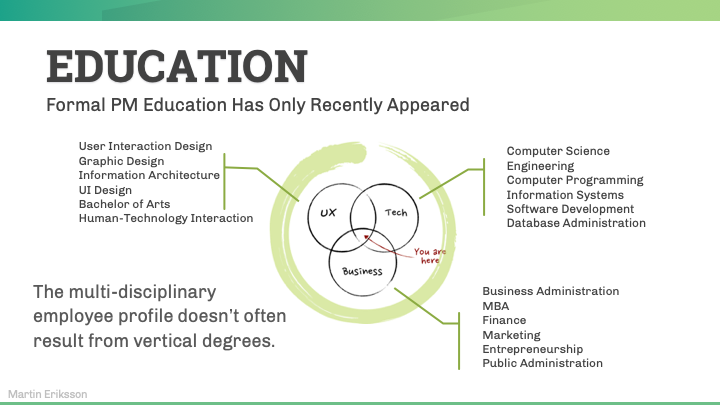
- Martin Eriksson is well-known for this clear Venn Diagram of UX + Tech + Business, which defines PM at its intersection.
- Each area for most individuals represents their educational background choice.
- The challenge for people looking at a career in PM is that most people haven't also studied the other topic areas needed to round out the background that makes for ideal PMs. They are strong in one single area only.
- It is normal for people to have unequal experience in each area. If you are missing an entire focus area, it may be harder to get started in PM. If you are missing two entire focus areas, you will need to create a plan to remedy that deficiency.
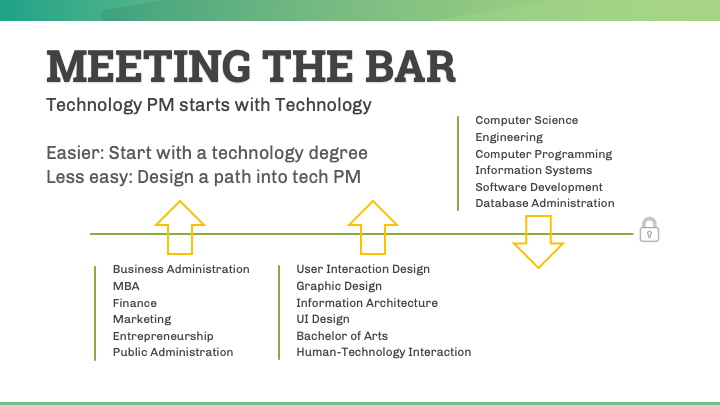
- Because technology product management is focused on technology, there is a clear advantage if you already have a technology education.
- If you are starting with a business or UX/UI education, you likely have more to catch up on than the former.
- In either case, no single path guarantees success by itself.
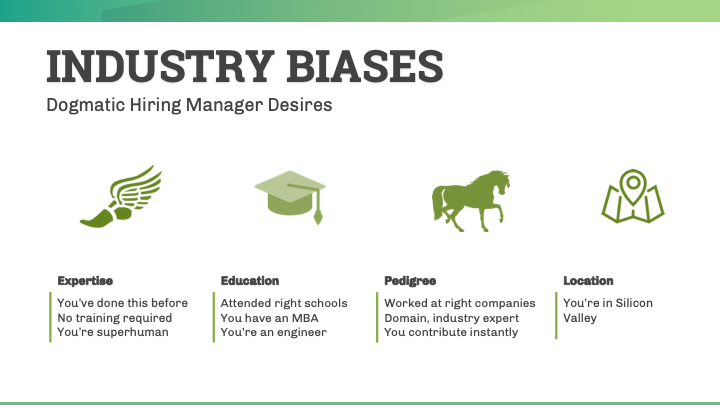
- Given the complexity and risk for hiring a PM is high, it makes sense that hiring managers do look for the best they can find which matches all success criteria. I expect all hiring managers to look for the best.
- That pursuit, however, can lead to some lazy search practices. I.e. 'I want a MIT undergrad with a Wharton MBA and 10 years experience in the role.' That might be a great background, but those people are still not guaranteed to be successful in PM. Furthermore, you will be leaving many great candidates out of your potential sourcing funnel with this approach.
- Furthermore, if you're a young professional looking to transition into PM, you've already completed your undergraduate education and have likely entered the workforce in your first couple roles. You need to understand how to take your personal unique background and shape it into a path into PM which fits you.
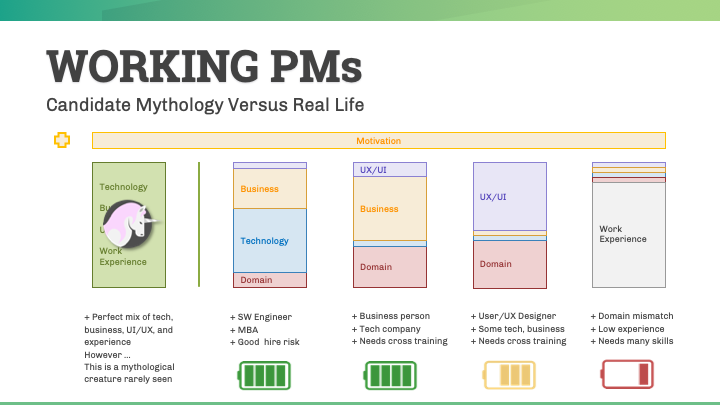
- Given the previous slide's biases, it might appear that a perfect PM has a perfect combination of tech, UX/UI, and business. This is a simplified view and frequently does not reflect reality.
- Many great PM candidates have various, and unequal combinations of each core skill area, plus some level of domain expertise. There's no single perfect combination.
- The fewer of each skill area you have, naturally your fit to the role gets harder to find, in which case you may need more training.
- Like batteries, you can charge up though. This is the good news. Be prepared that the training and charging process is not an overnight process. It could take additional years of formal or informal study.
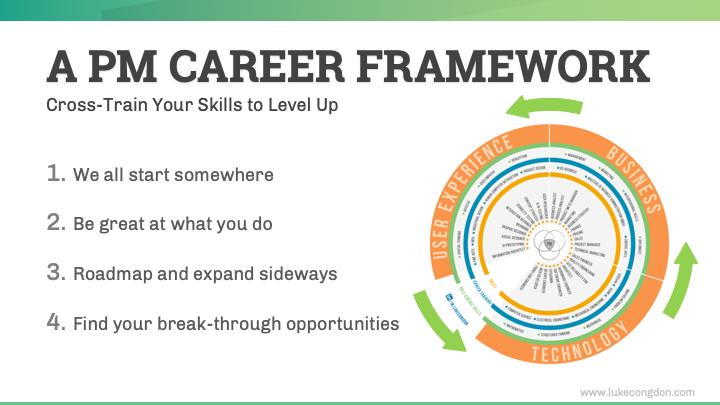
- We all start somewhere. I don't know a single person in my career who equally studied tech, UX/UI, and business. I do know many who got a technology degree, worked in an industry vertical, and then got an MBA. That too, is just one path.
- By starting in one area and becoming great at what you do, you can then plot a personal course to learn more in adjacent areas. This can include study or new jobs. As you learn more adjacencies, you can move closer to the center of the circle where the PM roles are.
- This will take time and determination. It may also take financial investment.
- Product Management Career Decoder Ring (orange, circular graphic explained in detail)
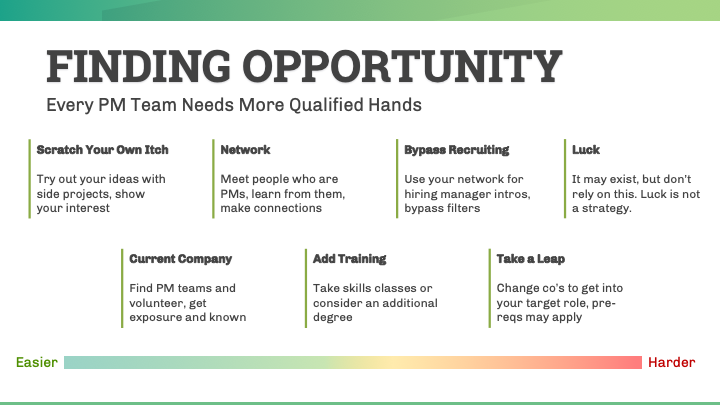
- Now that you have a plan to learn more and gain more skills, you can start to think about finding that opportunity to join PM. Note that this list may not be comprehensive, and that jumping straight to the change companies step without building up your cross-area skills may result in few results.
- The easiest options are listed first. Try something out with a personal project. Anyone can look into a topic that interests them, come up with an idea, and write a PRD and sketch mock-ups. When you do get a chance to network or interview with PMs in your desired space, a personal project gives you assets that speak to your interest, and it shows your commitment.
- Every product team I've ever worked with could use more help. Reach out internally at the company you already work for and offer help in your spare time. Get to know them and add value. That commitment could translate into a job when they need the next hand.
- Add training. You studied engineering and decide to add coursework in UI and UX. This is easily done even after you complete you degree. Perhaps you studied UI/UX and go back to school for a MBA. Many combinations exist.
- Network with your future peers and build a network you can use to get direct hiring manager introductions.
- Take a new job doing the work you're looking for. This isn't always as simple as that, and may require that you have been learning new skills along the way.

- Some companies differentiate the types of PMs they employ. Some don't. Those that don't often include all PM job requirements into the same role. There's a fair amount of variability out there. This is a guide.
- Internal vs. external PM is commonly the difference between a product owner in the Agile framework vs the traditional customer-facing PM.
- Regarding remote PMs, this is something to undertake on advisement only. PM is a contact sport in that you are always working with stakeholders, engineering, executives, marketing, sales, and more. This is very hard to do when you're not in the same location as most of these roles because you have reduced inter-personal influence. I have seen this done successfully, but not often. If your first-time role offer is remote, I advise caution. Effectiveness, visibility and career growth are harder to achieve.
- Many PMs have debated the necessity for a MBA. I have known successful PMs who do not have a MBA. This is not a required degree.
- If, however, you are coming from a degree and career in a single area like technology, with no experience in how a business runs and operates, the MBA can be a good way to invest in your career and cross that hurdle.
- If you're debating getting a MBA, I've written on this topic here which may interest you. Does Your Silicon Valley Career Need a MBA?
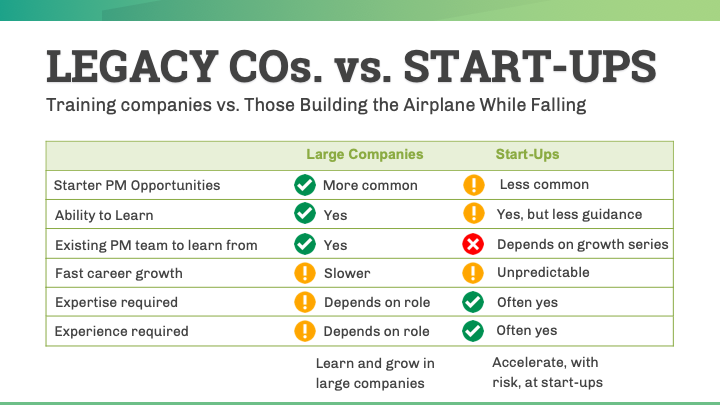
- What you can learn at a large company with processes, teams, resources, and career tracks can be pretty different than a start-up with 5 people. Each represents different opportunity to you as a potential PM hire.
- If you're just starting out, I often recommend going to the large company for several years and learning the craft among a team of others who are already good PMs.
- If you are an experienced PM or a risk-taker, then a start-up can be a fast learning opportunity. This in my opinion if a less optimal choice for a first time PM since there is no team to guide you and a high probability of failure by nature of it being a start-up. Note that before a start-up starts to grow or even scale, your founder is your head of product, not you. For additional context read, How to Succeed as a Series A Product Manager.
- While some paths into technical PM can make the transition easier, you can get in without a technology degree or a MBA. If you feel under skilled, then chart a course to add missing skills. Extra degrees are not always necessary. Don't hold yourself back by creating your own roadblocks. Chart a course and get the first job.
- With an approach of constant learning you will keep adding to your personal skills tool set.
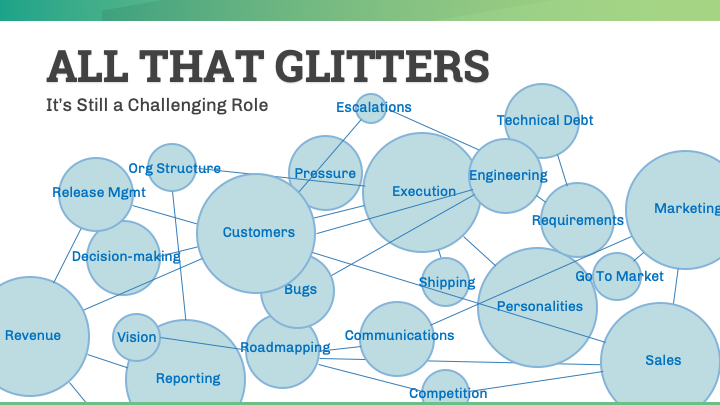
- With all the above recommendations, remember that it's still a challenging, highly cross-functional role.
- Despite the claims by some that you are the CEO of the product, you're not the CEO. Therefore you drive what the product needs via connections, relationships, common purpose, and vision. No one simply does what you tell them regardless of how senior you are.
- Consider for yourself if a highly unstructured role with no direct authority, high ownership and complete responsibility, and an endless uphill battle is the right role for you. When you win with an amazing product and happy customers, it's the greatest. In the meantime, running uphill isn't for everyone.
- If you've read this far, it's probably because you're very interested in product management as a career. Since there are a vast number of products and industries, you should start by deciding which you are aiming for. E.g. Do you love financial transactions and payments, or social media, or drones, or deeply technical control systems? The list of product areas can go on for 200 pages. Without focus, no one will be able to help you land where you want to be, including yourself.
- Determine where your weak areas are and begin to fill them. This does not have to mean new university degrees. It can include projects, courses, reading, etc. This process can take a significant investment of time. Fortunately, getting a starting role does not always require finishing as a prerequisite for starting a PM role. I.e. That technology degree plus being halfway through your third Coursera or Udemy series, or a MBA degree may show enough learning to get the role.
- Start making efforts to find your way in. You may need to get creative while also networking if LinkedIn job applications are not resulting in interviews of offers.
- Most of all, get started. This is a multi-year journey. That shouldn't bother you if this is the career you want.
- Keep learning. Even those of us with the role keep learning. Technology keeps evolving and you must keep learning to stay sharp.
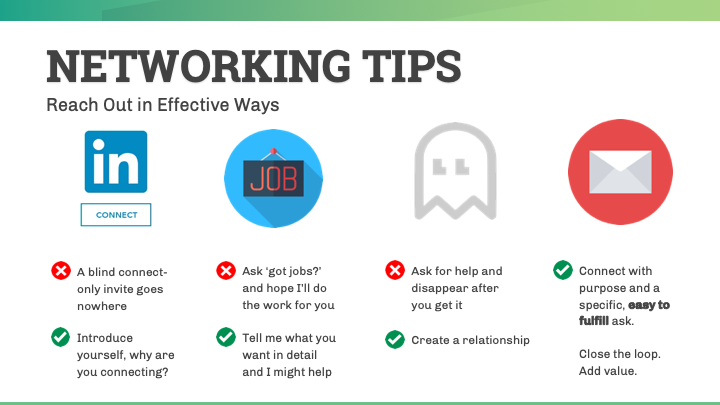
- Networking is important. It's how you can expand the range of people you know professionally, who in turn know more people. That matters when you're looking for help to make introductions for informational interviews and direct hiring managers.
- LinkedIn is a wonderful resource. Most use it terribly however. Blind connection invites don't grow networks, even if someone does accept the invite. It's a worthless 2-click transaction. You click send, I click accept. Use intros and follow-up messages to start building a reason to know each other.
- Do the work of job search, finding leads, and pitching your candidacy. People you've connected to, but who don't actually know you, won't do it for you.
- If you ask for help and you get it, keep your connection alive by thanking your benefactor and keeping them in the loop. If you take someone's assistance and disappear, you might get ignored in return the next time you ask for help.
- The easiest way to get help is to ask great, actionable, easy to fulfill questions to the right person. If you see a posted role and you ask for an introduction or to pass along your resume to the hiring manager at a company, that's something a contact can decide to do. If instead you ask for a connection to some team looking for a PM, that's too wide and lacks focus.
- One of my favorite authors on product management is Ben Horowitz. His guidance is laser-focused based on direct experience and very relevant to me.
- Many other writers, blogs, and organizations also provide great PM guidance. A list is given here. There are surely more which are not in this list.
- Good luck growing into your personal, perfect PM role.

ABOUT LUKE
Luke Congdon is a career product manager living and working in Silicon Valley since 2000. His areas of focus include enterprise software, virtualization, and cloud computing. He has built and brought numerous products to market including start-up MVPs and billion-dollar product lines. Luke currently lives in San Francisco. To contact, connect via luke@lukecongdon.com or https://www.linkedin.com/in/lukecongdon/.

DOES YOUR SILICON VALLEY CAREER NEED A MBA?
THE QUESTION
Should I get a MBA (Masters in Business Administration) degree? Many times over the years in Silicon Valley I've been asked to give advice as to the value of a MBA. Often the person asking is in the first 5-10 or so working years of their career and has reached a decision crossroads, but occasionally they are older. I did this myself, starting when I was about 28, and feel that it has been net positive for my career.
Having recently again shared my insights with a colleague, I decided to summarize an overview from the perspective of a working professional in Silicon Valley who completed a MBA 16 years ago, and has since built a career in high tech companies. My observations are based on the American MBA system, in the context of Silicon Valley and technology companies and startups. If you are evaluating if a MBA degree is a good investment for your career, then this is for you, especially if you live in Silicon Valley or work in high tech.
WHAT YOU GET
The MBA is designed to be a terminal degree, created to provide a comprehensive and final education on the essentials of running of a corporation. It is a graduate level degree that essentially gets you two things. First, you get the degree itself which is comprised of coursework in core disciplines of Finance, Accounting, Management, Marketing, add more. You will have the ability to choose electives that match your interests and drive the focus of your degree. The second key outcome is the network you can build while in school and leverage for years to come. Your network can account for a significant, long-term portion of your MBA's value. Provided you show up and do the work, you will get the degree. There is no guarantee you will get a network. A valuable network is the result of choosing the right school, and more importantly your effort to build that network yourself while you are there.
MOTIVATIONS
So why should you do it? It's a big investment of your time (1.5 - 3 years) and money ($100-200k). In my opinion there are four reasons to get this degree. The best of these in my opinion are for career opportunities. These are as follows:
Acceleration: If you are interested in switching careers, or transitioning into a management or leadership role from a career started focused on a single discipline, the MBA can be a good enabler. E.g. If you're an engineer looking to be a product manager, or a marketer who wants to manage a team or someday be an executive. Learning business foundations can make you more attractive to take on additional responsibilities by adding to your cross-functional skill set.
Price of Entry: Some organizations won't hire or promote you for management roles or high-influence, high-leverage roles without a MBA. This creates an advancement ceiling. I have met many people who were told that the MBA was a requirement for management, or to 'come back after you get your MBA' for product manager roles. This may be a form of unnecessary gate-keeping in some cases. In other cases, organizations are looking for candidates to have a minimum level of education to be good fits for these roles.
Prestige: Some see the degree as a marker of prestige or club membership. I'm not a fan of this. Furthermore, it's a lot of work to simply say you have it. I do have some reason to believe that there is an element to membership when it comes to a prestige school however. Wharton, Stanford, Harvard, etc. have strong brands, strong educations, and strong networks. As such, membership has its benefits including access.
Earning Potential: Some pursue the degree in order to earn more. Depending on your career choices this may or may not actually occur. If you are more qualified you can earn a better income, but it depends on the company and role you choose. Career progress itself may be more strongly correlated to higher income than the MBA degree. There are many careers that can provide good incomes without this degree. If the MBA accelerates or unblocks your career advancement, then this argument makes more sense.
TIMING ROI
If you've decided that your motivation and goals are worth your time and money, there is one more critical consideration. That is timing. A MBA degree at 25 years old and one at 40 years old have very different ROI (return on investment) horizons. In either case you learn the same thing, but the difference is what you can expect to get out of it.
A 25 to 30-year old graduate has a full career ahead of them to see the resulting benefits. A 40-year old who pursues an executive MBA has less time, however that target student has already started and achieved career success which they are building upon. At the executive MBA level, this cohort is transitioning at a career midpoint with the leverage the MBA can give them.
For a traditional 2-year MBA, the common student age range is ~24-34. For an executive 1.5-year MBA, the range is mid-30s to mid-40s. Age and career trajectory are key factors. Choosing among them depends on where you are in your career, your age, and your willingness and ability to invest in it. A 50-year old will likely never do a traditional 2-year MBA since it won't impact the remainder of their career meaningfully.

SELECTION
Deciding where to go to school has a few inputs, only a couple of which you can control. Regardless of where you'd like to go, you have to first ask yourself, 'Where can I get accepted?' MBA schools have competitive entry. The more renowned the school you apply to, the more competitive they can be to get into. Good schools are looking at candidates who are a match for them starting with a student's academic history and GMAT scores. In addition, work history and supplemental school goals are considered.
Next, assuming you're a good fit, you're demonstrably intelligent, and they want you, the next question is, 'Can you afford it?'. The MBA degree is not cheap. Depending on where you go, you'll trade a significant amount of time and the equivalent of a 1-2 luxury cars in cash. Many students take loans out to afford tuition. The lucky few are partially subsidized from their employers or win scholarships.
Next is the quality of the school. My personal opinion is that you should go to the best school you can get into and afford. This may sound elitist but given the cost and time investment, I argue you will want the highest ROI you can get. School brand value matters. Unfortunately, the quality of the school you can get into may already be limited if you don't have a strong academic history. Harvard and Stanford aren’t taking C students.
Lastly, choosing a traditional program or an executive program is a matter of where you are in your career. 22-years olds with little work experience won't be considered for an executive program and 50-year olds won't likely be considered for a full-time, 2-year degree.

MBA DEGREE OPTIONS
There are a few different types of MBAs, broadly categorized by duration and value. Selecting the program for you is a combination of your lifestyle and career needs, and the amount of dedicated time per week you can spend on your education to the exclusion of other activities including work, and cost.
The Full-time Traditional MBA
Duration: 2 years full-time
Cost: Tuition, housing, food, materials
Opportunity Cost: Lost wages and career progress
Getting In: Competitive entry
Perspective: As a younger professional, a work interruption now may have the least impact on your career long term while you invest in yourself. A full-time program may allow you to retain some sanity while providing some time for personal relationships.
The Part/Night Time Traditional MBA
Duration: 3+ years part-time depending on your course load
Cost: Tuition, materials. Food and housing are assumed to be covered by your career role as before.
Opportunity Cost: Significant lost leisure and family time
Getting In: Competitive entry
Perspective: As a working professional this allows you to maintain career and pursue school at the same time. Caveat emptor: Together this will consume all of your time for three years.
The Executive MBA
Duration: 1.5 years part-time
Cost: Tuition, materials
Opportunity Cost: Significant lost leisure and family time
Getting In: Competitive entry, with career milestone prerequisites
Perspective: As an older established professional, you likely already have significant career responsibilities which will remain and possibly grow during this program. You may also have a family who you will be taking time from. The increased burden on your spouse will not be insignificant.
MBA VALUE SPECTRUM
In addition to the general structure of the program you choose above, you must also choose where on the value spectrum you want to go. The higher value, the more expensive and exclusive they can be. Access to your target schools will be primarily gated by your undergraduate GPA, and your GMAT scores. Low scores will automatically exclude you from the best schools. Some high-status institutions also consider intangibles like family legacy, which generally means someone in your nuclear family also graduated from that university.
Prestige MBA
This is a program at an institution with an established, high-value, high-ROI brand. This brand is evidenced in the alumni and where they work, and the high-leverage network opportunity they represent. These schools are active in their alumni programs and invest heavily in them. These schools also invest in highly-qualified faculty and professors. Entry to these institutions is very selective and typically require a strong, proven academic history and GMAT test scores. These schools are often full-time only.
Value MBA
This MBA can be a traditional full-time or a part-time school. Entry is still selective and their reputation is still considered good to very good. They cost a little bit less and the market will still recognize MBAs from these schools well. The investment can still be significant, but lower than a prestige school while still offering a good return.
Bargain MBA
This is a MBA degree from an unbranded or unvalued institution. Does this mean you learned less than a prestige MBA? Yes, likely it does. Your professors are not of the same caliber. Your resulting network may be weak or nonexistent. You may have saved money on this degree, but the return expected is also low. In the worst case, you will get no return on investment and your industry will not perceive you as a more valuable working professional. These degrees may actually give you negative value signaling instead of the career boost you may have wanted.
POST-MBA TRANSITION ZONE: ACHIEVING ROI
You've spent the money, lost hair pulling someone else's weight in your 15 different group projects, spent either all your time for two years, or spent 2 nights plus Saturdays every week for three years in classrooms, lost touch with your friends because you had no time for them, went into debt for tuition, and more. Now what? When do you start getting the return you hoped for? This is the post-MBA transition zone and it warrants discussion. In discussions over the years with one of my oldest friends who also got his MBA when I did, I believe there is a leverage zone of 1-1.5 years after you finish the degree to level up. This includes the new role, better salary, more responsibility, or promotion. I.e. The return for the investment. If in a year or so you don't make your move, you might be seen as the person who already had the MBA and not as the go-getter ready for more. Assuming you pursued the MBA to improve your career, plan to level up long before you graduate to use the leverage and opportunity available to you.
LEVEL UP IN PLACE
Keeping the same job without a plan and just carrying on working will result in low likelihood of change in title, responsibility, or salary. Remaining at the same company isn't bad in itself, but you can't just hope your company notices you finished the degree and appreciate you more. After all they might think, aren't you doing the same thing you did before? Without a plan put in place a year or so in advance this might happen. Create a plan with your boss and management chain, letting them know what you're working on, and how much more qualified you will be to add value to the company as you learn. Get them to plan on using you as a high-value employee early, and let them visibly benefit from your value increase. You might even agree on milestones along the way to improve your work contribution and compensation. If they don't agree that you will be a better company asset, this is a strong signal to leave. Don’t rush though. Stay in place during the MBA to reduce life stress while you also study, and plan to transition to a new company when you finish.
LEVEL UP AND OUT
In my career, my biggest role and compensation changes were always the result of changing companies. Sadly, many companies don't see in-place talent for their market value, or worse, are silently aware that their market value is much higher than their comp scale and hope they remain blissfully unaware. Whether you pursue a full or part-time MBA, get prepared very early for what you will do when you graduate. Finding the right role and the right company take time. Use your network to make connections into target companies, and grow your network at these targets. Networking is not transactional. Relationships take time to grow and mature.
In either case, sometimes you will find that the perception of a MBA is more warmly received when your leadership has a MBA. This is a strange but sometimes true confirmation bias that can work for your benefit.
THE SILICON VALLEY MBA DEBATE
The MBA is designed to give management education fundamentals to early professionals headed into management. As such, it's a good fit for corporations. Curriculum designers have only begun to think about entrepreneurship in the last decade or so. I'd argue upon long reflection that the MBA isn't strongly indicated for entrepreneurs. With the influx of startup incubators, and the long presence of entrepreneurs across time who pursue their dream regardless of education, the MBA might be a distraction of time and resources. At a minimum, if you have strong building skills, desire, and endurance, you don't need to wait for a degree to open the gate for you.
In the tech startup industry, some consider a MBA to be a negative or even a disqualifier. I have mixed feelings on this based on two beliefs. The first belief is, the MBA provides valuable and fundamental business basics that many startups lack. Companies, even startups, require many skills including those that come from business training. Many startups have failed hard due to missing business fundamentals like a viable business model. The second, contrasting belief, is that the MBA itself might not be exactly what a startup needs in its initial pre-seed and series A run. A technology startup has to run with all their effort to create, validate, and build a sustainable idea and hope the market likes it enough to reward it with traction. In the intense, early building phase you need a lot of engineers. Business people can also directly provide value early, but some in the startup ecosystem view them with skepticism. How you feel about this dichotomy may depend on what side of the engineer vs. business person fence you're on, and both have their biases.
MAKING THE DECISION
Any MBA degree is a significant investment of your time and money. During this process, you may suffer stressed and unattended relationships, or career delay by not working. As a post-undergrad who has worked 3-5 years, you might not live with your parents any longer; making coverage for rent, groceries, and student loans difficult. This means more student loans, or working and studying at the same time.
On the plus side, you will learn a lot, forge new relationships, and prepare yourself for your next career stage. The upside in terms of job opportunities, responsibilities, and income can drive career long benefits.
Therefore, if you believe the following, I recommend choosing the highest-value school you can get admitted to and afford.
- You're in the right age range for your target degree (traditional MBA, or executive MBA)
- You believe this is a value-add for your career long-term worthy of investment in yourself
- You believe you can get admitted with your grade history and GMAT score
- You can afford it directly or with financing
If you are unable to get into a value or prestige school based on academics or career, I'd advise you to think carefully if a bargain school will actually give you the benefits you want before taking this option. If you can't afford it, but still believe it's valuable to you, consider a loan. Within a few years of graduating, considering you enter a profession the market values monetarily, and you aren't already swamped with debt, there is a strong likelihood that you will earn enough to pay off the loans within a comfortable number of years.
MY PATH TO MBA
I completed a part-time, value MBA at Santa Clara University in the heart of Silicon Valley in 2003. It is an accredited school and boasts attendance by working professionals deeply embedded in Silicon Valley. A part-time MBA, SCU ranks well nationally and regionally, and is respected by Silicon Valley companies. There are other schools in the region, and several prestige MBAs including the well-known Stanford Graduate School of Business, Wharton San Francisco, and University of California at Berkeley, Haas School of Business. Outside of Silicon Valley there are many more to choose from.
I began to consider a path towards the MBA when I lived in New York City after my undergraduate degree for a couple years. Having moved to NYC from from a small town before having a job, I quickly found temp work to cover my bills. I didn’t have a network for introductions so I worked and searched outside-in for career roles at the same time. During this time I interviewed 30 or so companies. It was 1997 and at this time the Internet barely existed, and it didn’t help much with job search. I remember using Careerpath.com which was nothing more than online reprints of newspaper job listings. I also used the actual newspaper. This sounds amusingly barbaric compared to finding roles in 2019. At the time, many print listings weren’t even from companies it turned out. Placement companies would post roles to collect resumes and test people for basic competency on Microsoft Word and Excel. It was toward the end of this period that I started researching how to make myself more competitive and get into closed doors. My career was not taking off and I was working a dead-end job. Career acceleration and price of entry were my motivations. I began a study course for my GMAT.
Around the same time, I took a position at a French international bank in the corporate banking department. This appeared more promising, although the work was fairly repetitive. I started my first year of MBA part-time on the east coast after work during this job. At the same time during the summer recess, I took some basic HTML courses out of interest. To be honest, I still didn’t know I’d work in technology or what I’d actually get out of the MBA. After one year I took an opportunity to move to Sunnyvale, California. The bank job was rote and didn’t pay much. The real reason to leave, however, was the recognition that this role offered no opportunity to progress in the organization.
In California in 2000, the technology market was booming and my basic HTML, CSS, and FTP skills were just enough to get me a tech support job at Yahoo!. I was lucky to support a product that was complex and allowed for on the job learning. Fun side note, the product was Yahoo! Store, which was the new name for Paul Graham’s Viaweb acquisition. Paul later became even more well-known for launching Y Combinator. No, I never met him. I transferred to Santa Clara University and again worked and studied part-time to finish the MBA with a focus on the software industry and innovation. Being a transfer student, I chose SCU because it was local, had a great reputation, offered a part-time program, and because they let me in. Here I started to see the power in a network when a fellow student made an introduction for me at Sun Microsystems, which landed me an internship role in software project management. To accelerate this story, I progressively leveraged up my technology experience and MBA into progressively more complex roles, moving into product management along the way.
The MBA created an opportunity to work hard, meet a network, and forge my various, vague self-improvement and career interests into a focused set of goals. The experience did open some doors as I had wanted it to. It also accelerated my career by bringing together education, the ability to meet like-minded peers, examples of success models, and more. Over the years, progressively moving to better roles was still not easy. An open door does not mean you will get welcomed to walk through it. That still takes work and industry is competitive.
Ultimately it is challenging to get hard data, even from your own career, to be certain a MBA was worth it. For me, however, I strongly believe it was a valuable investment. Over three years I transitioned from an anonymous, undifferentiated young career seeker with a temp job and no benefits in NYC, to a career in software product management in the cradle of technology in Silicon Valley. The MBA helped enable that transition both materially with the degree, and mentally by creating opportunities for me to see and develop ideas and goals. I started the MBA with a vague idea that it would improve my career, and completed the degree with additional qualifications, a strong local Silicon Valley network, good friends, and a much clearer idea of what I wanted to do next, and in the foreseeable future.
If you are considering this degree investment, I recommend understanding your motivations, then determining where and how it will fit into your life needs with the heavy time investment, and finally assess the value for the price and reputation of the school you are targeting.
ABOUT LUKE
Luke Congdon is a career product manager living and working in Silicon Valley since 2000. His areas of focus include enterprise software, virtualization, and cloud computing. He has built and brought numerous products to market including start-up MVPs and billion-dollar product lines. Luke currently lives in San Francisco. To contact, connect via luke@lukecongdon.com or https://www.linkedin.com/in/lukecongdon/.

THE KEY SKILL FOR SUCCESS IN PRODUCT MANAGEMENT
SUCCESS TAKES TIME
Product Management career entry and long-term success can be challenging. Careers are long and can be filled with ups and downs. Like many, I’ve read the articles and seen the videos of the ten or so genius tech founders we all hear about repeatedly. However these overnight hero stories can hide the long path that many of the rest of us take to build successful and fulfilling careers.
I’ve held product roles for 14 years across 5 companies in Silicon Valley. In that time, I’ve been lucky to work for some of the great technology companies in iteratively better and better roles. Building endurance across each role was the key skill that helped me to develop my career in PM. Pressure, experience, and time all work together to build this skill.
ENDURANCE FOR PRODUCT MANAGERS
Endurance matters when you hit resistance. When things gets tough this competence will help you tremendously. This can be applied to many aspects of life. When it comes to product management, the nature of this role means you’ll need a healthy amount of endurance to persist and succeed.
I had been thinking about career endurance while listening to a podcast featuring Steve Harvey, a comedian with a long history of successes. In the podcast, he described the unseen history of his career challenges. His commitment to pursue a career in comedy lead to homelessness, and he ended up living in a car for three years. Eventually his big opportunity came and he took off from there. He credits his failures on the way to success. Most people give up too early. It takes time and more than a few failures to perfect your craft, teaching you what not to do as you learn.
"You only learn this business when you're failing."
Steve Harvey
I like this Steve Harvey quote because at some point, we all fail or hit hard times. Over a career, you’ll probably experience it several times. Some may be smaller or larger, but at a minimum you will experience friction. Failure teaches you how to get better, and it also builds your endurance. As you build endurance, your ability to move forward and progress improves.
In my product roles, I’ve seen and lived how the sausage gets made within organizations large and small. It’s a messy process getting product out the door with changes in timelines, resources, people, priorities, managers, business climate, customer needs, and more. Endurance is necessary because PM is a challenging role for many reasons.
Firstly finding PM roles can be challenging for reasons of supply and demand. You are competing for a relatively small number of roles. Secondly, building product itself is challenging. You will be faced with the messy challenges of sausage making on a daily basis.
LIMITED SUPPLY REQUIRES HUSTLE
I’ve previously written about how to find your first PM job. That article focused on how to expand your skills, and use your existing company connections to get your foot in the door (because you’re already on the inside of that particular door). This is a common challenge for people looking to make that transition into product management.
What I didn’t focus on was the fundamental challenge presented by the nature of the role. PMs are highly leveraged compared to many other roles. Most companies simply don’t have a lot of them; especially when the company is small. Many companies may only have a single PM per 5-9 or more engineers. When seeking a role, even with years of experience under your belt, you will often not find many listed on company job sites. This can be quite different than engineering or sales roles which are often in steady demand.
To illustrate, here is a quick analysis based on some publicly-available data from Yahoo! Finance and LinkedIn self-reported job titles. Product manager job titles are only 1.76% of the entire employee population on average. If you’re breaking into product management, you will have to hustle to find an open role and match yourself into it.
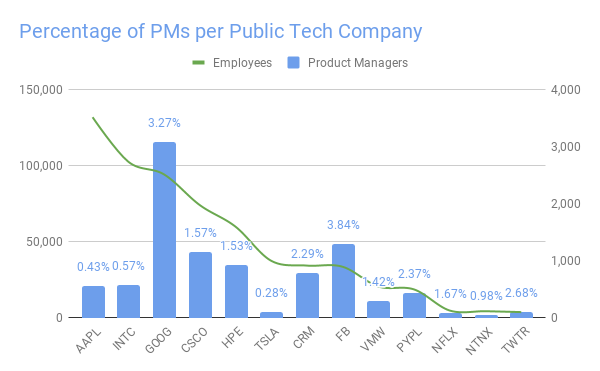
INTERVIEWING IS A MARATHON
One year ago, I landed a great product role with an amazing company. This culminated a one year job search after having been laid off by a startup a year earlier. I decided to share this since professional profiles don’t often reveal the ups and downs we all go through.
Twelve months is a long time to interview. In that year, I applied to 146 roles, interviewed with 71 companies (times multiple people per company), and drank a lot of coffee. Good PMs are data-driven, so I built a Sankey chart of the search activity that year to visualize the process.
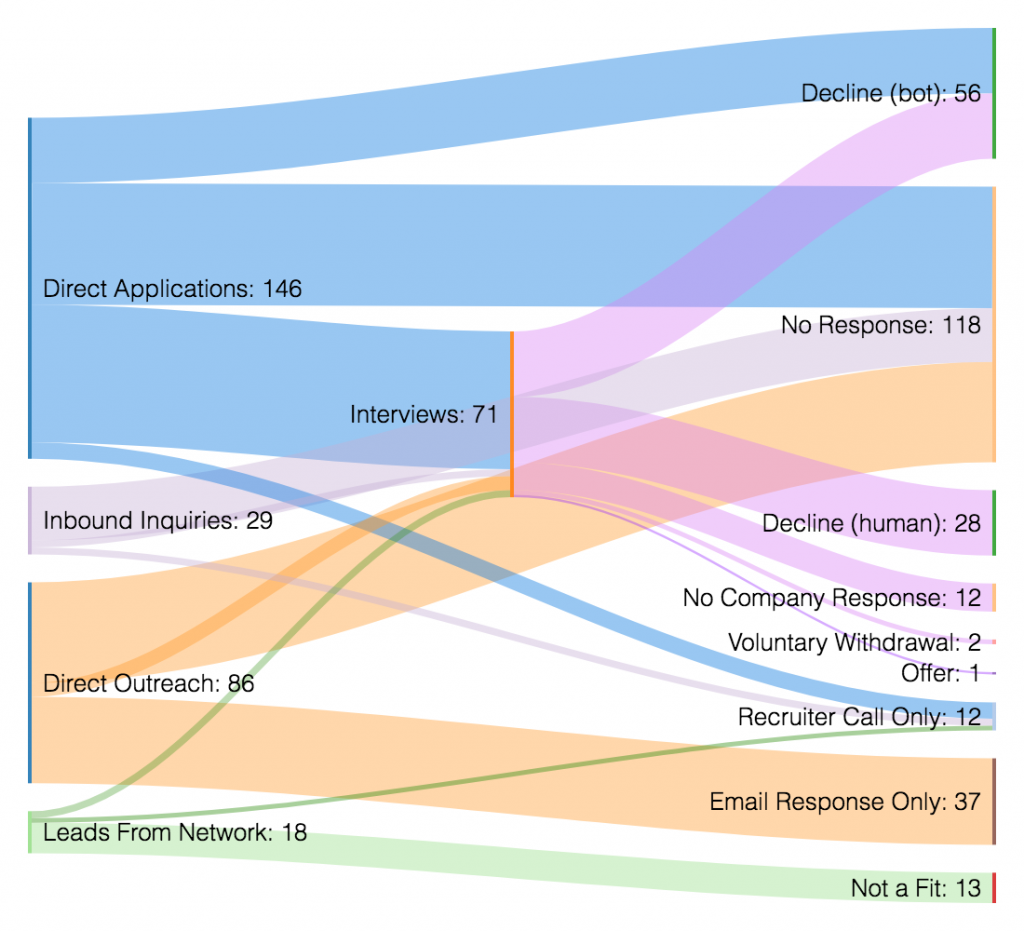
Even with a long history in enterprise product roles, finding the next role was not easy. At the end of the year, I received a single job offer, which I happily accepted because it was the right job for me. Interviewing both requires and builds stamina. You will hear ‘no’, or hear nothing frequently. In all that time, I only declined to continue the interview process with two companies due to poor fit. This left 68 companies I unsuccessfully went through the interview process with. For what it’s worth, the source of the role I accepted was a personal referral for an unlisted position.
Interviewing takes endurance because it can take a long time, but more importantly because every person you speak with in my opinion is an interview. The external recruiter, outbound talent scout, the internal recruiter, the coordinator, the manager, the interview panel, the receptionist. When any single person can put in a bad word on your candidacy, you must always be on your game. It doesn’t matter if it didn’t look like an official interview, or if you’re tired, or if you’ve heard, “so tell me about yourself” for the 12th time this week.
BUILDING CHALLENGES
After you have that PM role, it is still challenging. It takes vision, research, preparation, presentation, and so much more. Your peers, the engineers that work with you, and management won’t always agree with you. You don’t simply decide what to do and tell people to do it. You bring evidence rooted in the direct, primary research of the voice of the customer. You bring second party research. You bring your intuition and experience. With all of this you will still need to advocate for what you believe is the right thing to for your product and your customers. You will face resistance. That resistance will make your decisions better by being confronted with push-back and clarifying questions. You will repeat this process over and over.
BUILDING ENDURANCE
Endurance is the outcome of pressure, experience, and time. That process isn’t always enjoyable, but getting to your career goals isn’t a straightforward path without challenges. The good news is that endurance can be built intentionally, and it does not need to include suffering horrible managers and terrible company cultures. It will mean facing discomfort and working on your weak areas however.
Here are some career-centric ideas to actively develop grit.
- Volunteer for a work task or project outside of your normal comfort zone. Do what it takes to learn that area and deliver work you’re proud of. Build up the breadth of your comfort range.
- Do something (safe) that terrifies you. E.g. Public speaking or public singing. You don’t have to be good at it to benefit from it. The experience will build that muscle. Do it more than once until you lose that feeling of nervousness. It might take many attempts to start feeling comfortable.
E.g. Five years ago I met my wife at a Beatles karaoke night in San Francisco. I grew up on that music and know most of the songs by heart. I had zero intention to ever sing and did not do so that night. A month later we again went to this show, and I anxiously bolstered the nerve to do a song to make an impression. It was my first ever song behind a microphone, and it was shaky. I was very happy to get it over with.
Five years later we still go and enjoy this show. The point is, it terrified me for over a year and a half, but I kept giving it a try nearly each time we went because I love the music. It was only after three years that I reached a level of comfort where I felt fine to simply jump up and do a song. I did get better over time, and I do still occasionally pick a song out of my range and mangle it. These days, I am comfortable behind a microphone. This has also been very helpful for me professionally since I do speak in front of customer and partner groups frequently.
- Develop a new feature idea for your product that wasn’t assigned to you. Do the research, develop a point of view, validate the ideas, tune the proposal, and present it to your team. Hear the positive and negative feedback. Learn to hear ‘no’ and keep going, iterate, back up your ideas, and if necessary, accept that the feedback may be correct. In a long career, you will hear ‘no’ a lot. Keep going if you’re still convinced this is the right thing to do.
- Take a job at a startup with fewer than 20 employees. Leave the comfort of the big company with support staff, known customers, known growth trajectories, clear processes, wifi buses, etc. You will have to figure it out and make it happen every day. Startups are risky, so this is an extreme example.
Having worked for two <10 person startups, I can confirm that these are unwieldy, high-pressure experiences. You will grow faster and go grey faster at the same time.
SUCCESS IS NOT THE OPPOSITE OF FAILURE
Success is the result of failures and achievements over years. Those who keep iterating and don’t give up are more likely to reach their definition of success. For me, product management is a very satisfying career. Despite the challenges in the role, I love creating products and teams that solve problems and make customers’ lives easier. The value in endurance is that while you will face friction, challenges, and setbacks in your career, this will help you keep going so you can develop your way to success.
References
(1) Oprah's Master Class: Steve Harvey, http://www.oprah.com/own-master-class/steve-harvey
(2) Ken Norton, A Certain Ratio, https://www.kennorton.com/newsletter/2017-03-27-bringing-the-donuts.html
(3) SankeyMATIC by Steve Bogart, http://sankeymatic.com/build/
ABOUT LUKE
Luke Congdon is a career product manager living and working in Silicon Valley since 2000. His areas of focus include enterprise software, virtualization, and cloud computing. He has built and brought numerous products to market including start-up MVPs and billion-dollar product lines. Luke currently lives in San Francisco. To contact, connect via luke@lukecongdon.com or https://www.linkedin.com/in/lukecongdon/.