
BREAKING INTO TECHNICAL PRODUCT MANAGEMENT
DISASSEMBLING COMMON BARRIERS TO ENTRY
For the past few years I’ve been volunteering on career advice channels including LinkedIn Career Hub and Santa Clara University Network Advisor, answering questions for younger career professionals looking to transition into the PM career track. While also writing on this blog for the past few years, there has been a clear trend among the people who have reached out for guidance. They universally want to know, ‘How do I break in?’
This inspired me to reach out to Product School and volunteer to be a featured speaker to share the summarized advice I’ve been giving on a 1:1 basis. They have a consistent ‘Talk Series’ of industry speakers which often range among well-known consumer-oriented technology companies. While the focuses of PM can differ slightly between enterprise and consumer, the presentation below applies to either product track.
Update: October 2019: Product School has posted the video from this event which you can watch below.
- Everyone’s path into product management is different. Use your unique background to build a cohesive story that drives and shapes you.
- You build who you are. Your former experiences will inform your approach to PM whether you are aware of it or not. Lean into your experiences when they help, lean out when they hold you back.
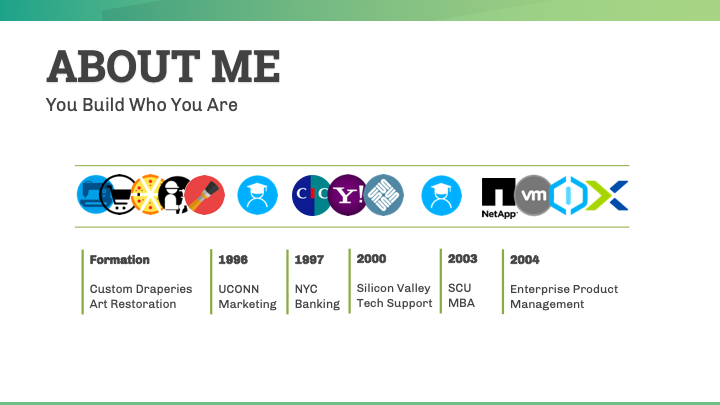
- My path started with family of creative tradespeople running custom drapery and art restoration businesses. PM to me is an industry of creatives leveraging technology to build amazing products.
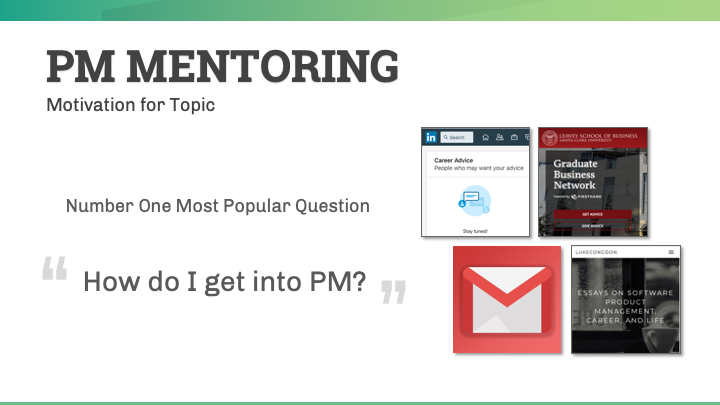
- Volunteering to help people understand the product management career path revealed that most simply want to know how to get started. This experience motivated me to produce this presentation and share my advice to a broader community.
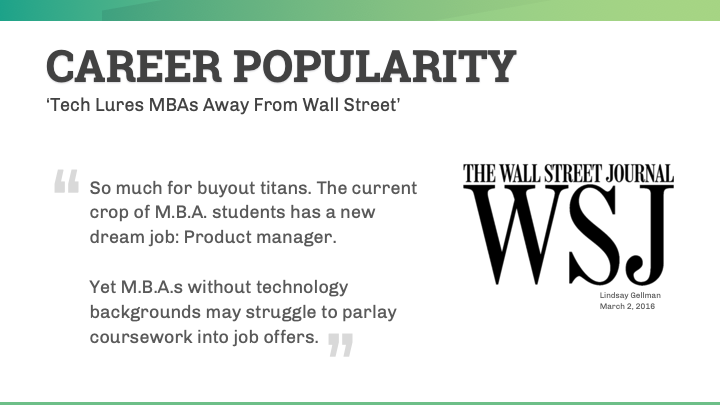
- Since you’re here, you already have an interest in product management. According to the Wall Street Journal, so do many new MBA graduates. Technology PM has become a hot career path.
- As a result, more people are asking how to get in both pre and post MBA, or with no sights on a MBA at all.
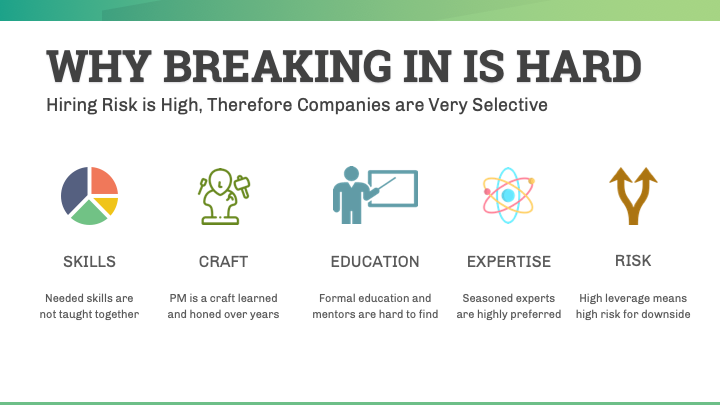
- Getting a chance to enter the PM career path is hard for the following reasons:
- The skills you need to be an effective product manager aren’t taught together. No wonder many who complete a vertical university degree still find it hard to get started.
- Being great at PM takes years. You may be born for this, but you still need to become good at it and that takes years.
- The traditional university and graduate school formal education systems normally teach vertically-tracked studies. PMs, however, need broad exposure to several areas of study.
- Expertise is highly valued, which can leave career changers or career starters at a disadvantage.
- PMs have great leverage. That means your decisions can have strong, magnified impact. If your decisions are poor, these choices can still have a strong, magnified, negative impact.
- For these reasons, hiring a PM into an organization is very carefully vetted and considered since the outcome can be several fold positive or negative. Most take great care to avoid the negative outcome via strong vetting.

- With focus, effort, and time, it is possible to enter product management. I did it. This timeline is a high-level view of steps I took since my undergraduate, non-technical degree into a career of deep technology.
- Over the course of years, I studied and applied tech and design learning across private projects, jobs, and additional education.
- This is just one path. Everyone’s path will look different, and most will only appear to be an ‘ah hah’ revelation of certainty when looking backward in history.
- Increasingly, larger, well-established tech companies are hiring associate PMs directly out of college. This is a great training role, but it remains competitive to get them. In addition, these tend to be directed at specific degree holders including engineering.
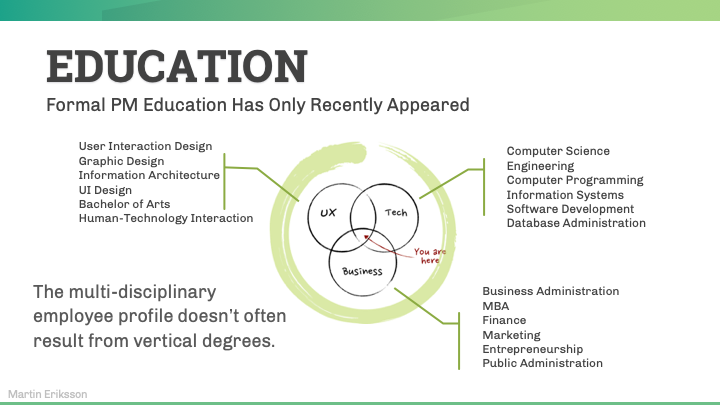
- Martin Eriksson is well-known for this clear Venn Diagram of UX + Tech + Business, which defines PM at its intersection.
- Each area for most individuals represents their educational background choice.
- The challenge for people looking at a career in PM is that most people haven’t also studied the other topic areas needed to round out the background that makes for ideal PMs. They are strong in one single area only.
- It is normal for people to have unequal experience in each area. If you are missing an entire focus area, it may be harder to get started in PM. If you are missing two entire focus areas, you will need to create a plan to remedy that deficiency.
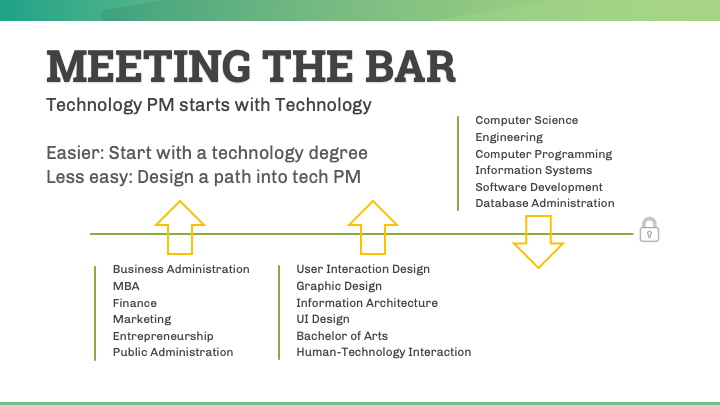
- Because technology product management is focused on technology, there is a clear advantage if you already have a technology education.
- If you are starting with a business or UX/UI education, you likely have more to catch up on than the former.
- In either case, no single path guarantees success by itself.
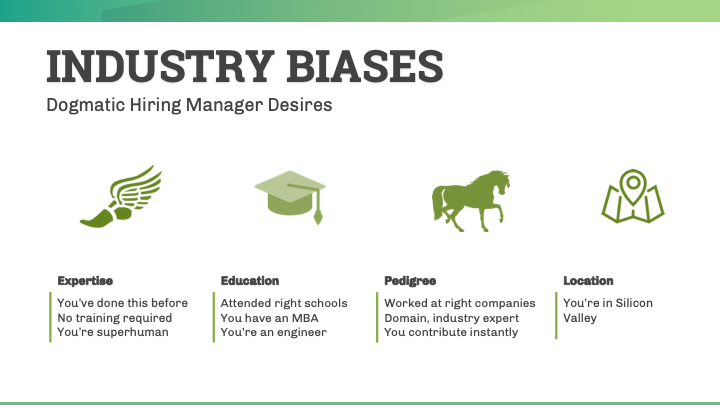
- Given the complexity and risk for hiring a PM is high, it makes sense that hiring managers do look for the best they can find which matches all success criteria. I expect all hiring managers to look for the best.
- That pursuit, however, can lead to some lazy search practices. I.e. ‘I want a MIT undergrad with a Wharton MBA and 10 years experience in the role.’ That might be a great background, but those people are still not guaranteed to be successful in PM. Furthermore, you will be leaving many great candidates out of your potential sourcing funnel with this approach.
- Furthermore, if you’re a young professional looking to transition into PM, you’ve already completed your undergraduate education and have likely entered the workforce in your first couple roles. You need to understand how to take your personal unique background and shape it into a path into PM which fits you.
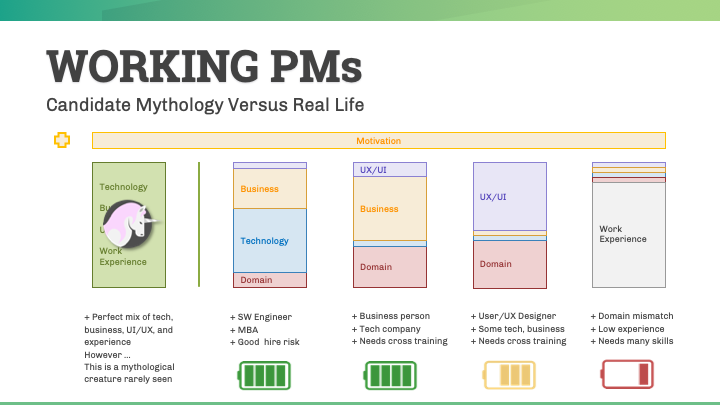
- Given the previous slide’s biases, it might appear that a perfect PM has a perfect combination of tech, UX/UI, and business. This is a simplified view and frequently does not reflect reality.
- Many great PM candidates have various, and unequal combinations of each core skill area, plus some level of domain expertise. There’s no single perfect combination.
- The fewer of each skill area you have, naturally your fit to the role gets harder to find, in which case you may need more training.
- Like batteries, you can charge up though. This is the good news. Be prepared that the training and charging process is not an overnight process. It could take additional years of formal or informal study.
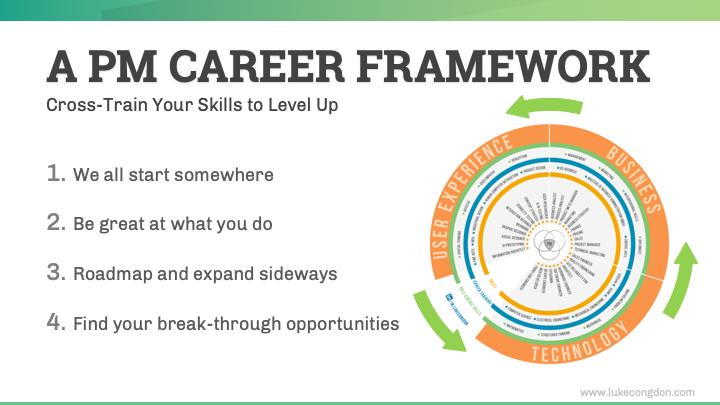
- We all start somewhere. I don’t know a single person in my career who equally studied tech, UX/UI, and business. I do know many who got a technology degree, worked in an industry vertical, and then got an MBA. That too, is just one path.
- By starting in one area and becoming great at what you do, you can then plot a personal course to learn more in adjacent areas. This can include study or new jobs. As you learn more adjacencies, you can move closer to the center of the circle where the PM roles are.
- This will take time and determination. It may also take financial investment.
- Product Management Career Decoder Ring (orange, circular graphic explained in detail)
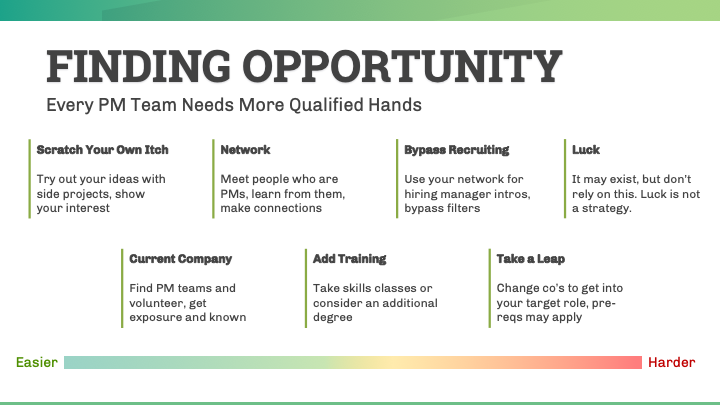
- Now that you have a plan to learn more and gain more skills, you can start to think about finding that opportunity to join PM. Note that this list may not be comprehensive, and that jumping straight to the change companies step without building up your cross-area skills may result in few results.
- The easiest options are listed first. Try something out with a personal project. Anyone can look into a topic that interests them, come up with an idea, and write a PRD and sketch mock-ups. When you do get a chance to network or interview with PMs in your desired space, a personal project gives you assets that speak to your interest, and it shows your commitment.
- Every product team I’ve ever worked with could use more help. Reach out internally at the company you already work for and offer help in your spare time. Get to know them and add value. That commitment could translate into a job when they need the next hand.
- Add training. You studied engineering and decide to add coursework in UI and UX. This is easily done even after you complete you degree. Perhaps you studied UI/UX and go back to school for a MBA. Many combinations exist.
- Network with your future peers and build a network you can use to get direct hiring manager introductions.
- Take a new job doing the work you’re looking for. This isn’t always as simple as that, and may require that you have been learning new skills along the way.

- Some companies differentiate the types of PMs they employ. Some don’t. Those that don’t often include all PM job requirements into the same role. There’s a fair amount of variability out there. This is a guide.
- Internal vs. external PM is commonly the difference between a product owner in the Agile framework vs the traditional customer-facing PM.
- Regarding remote PMs, this is something to undertake on advisement only. PM is a contact sport in that you are always working with stakeholders, engineering, executives, marketing, sales, and more. This is very hard to do when you’re not in the same location as most of these roles because you have reduced inter-personal influence. I have seen this done successfully, but not often. If your first-time role offer is remote, I advise caution. Effectiveness, visibility and career growth are harder to achieve.
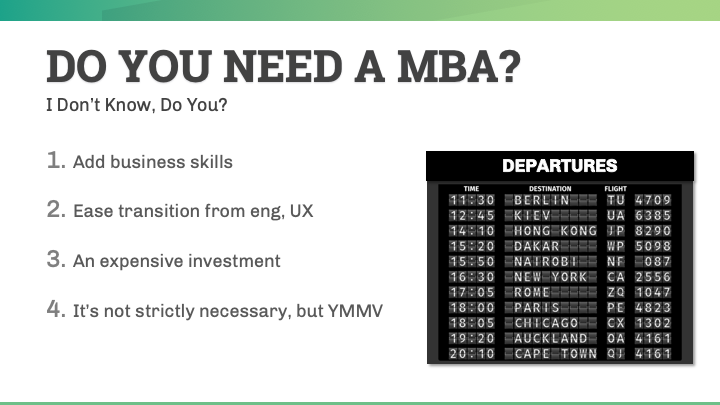
- Many PMs have debated the necessity for a MBA. I have known successful PMs who do not have a MBA. This is not a required degree.
- If, however, you are coming from a degree and career in a single area like technology, with no experience in how a business runs and operates, the MBA can be a good way to invest in your career and cross that hurdle.
- If you’re debating getting a MBA, I’ve written on this topic here which may interest you. Does Your Silicon Valley Career Need a MBA?
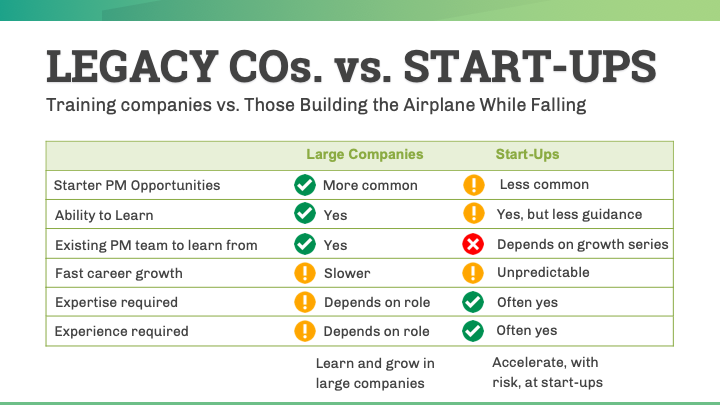
- What you can learn at a large company with processes, teams, resources, and career tracks can be pretty different than a start-up with 5 people. Each represents different opportunity to you as a potential PM hire.
- If you’re just starting out, I often recommend going to the large company for several years and learning the craft among a team of others who are already good PMs.
- If you are an experienced PM or a risk-taker, then a start-up can be a fast learning opportunity. This in my opinion if a less optimal choice for a first time PM since there is no team to guide you and a high probability of failure by nature of it being a start-up. Note that before a start-up starts to grow or even scale, your founder is your head of product, not you. For additional context read, How to Succeed as a Series A Product Manager.
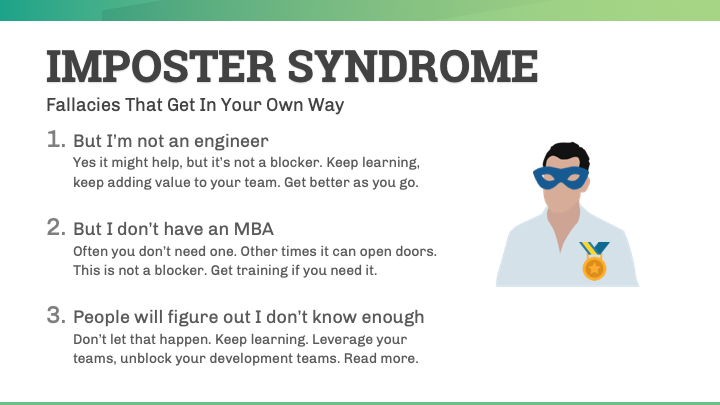
- While some paths into technical PM can make the transition easier, you can get in without a technology degree or a MBA. If you feel under skilled, then chart a course to add missing skills. Extra degrees are not always necessary. Don’t hold yourself back by creating your own roadblocks. Chart a course and get the first job.
- With an approach of constant learning you will keep adding to your personal skills tool set.
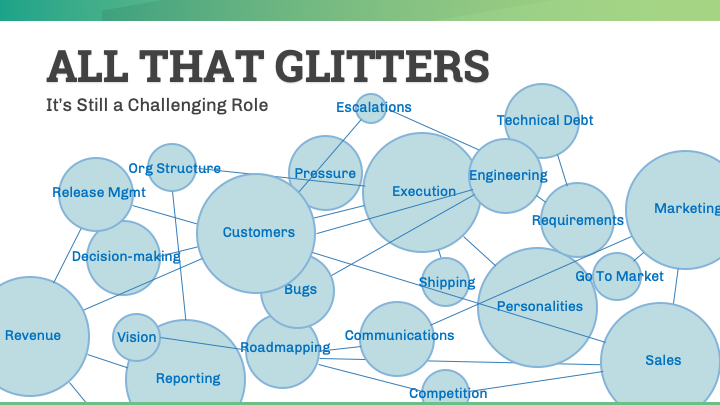
- With all the above recommendations, remember that it’s still a challenging, highly cross-functional role.
- Despite the claims by some that you are the CEO of the product, you’re not the CEO. Therefore you drive what the product needs via connections, relationships, common purpose, and vision. No one simply does what you tell them regardless of how senior you are.
- Consider for yourself if a highly unstructured role with no direct authority, high ownership and complete responsibility, and an endless uphill battle is the right role for you. When you win with an amazing product and happy customers, it’s the greatest. In the meantime, running uphill isn’t for everyone.
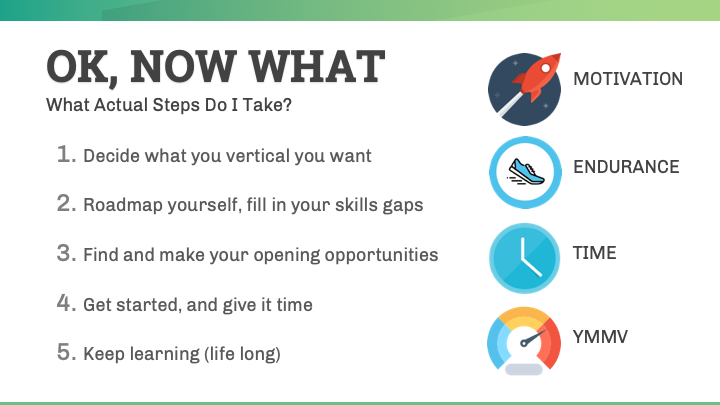
- If you’ve read this far, it’s probably because you’re very interested in product management as a career. Since there are a vast number of products and industries, you should start by deciding which you are aiming for. E.g. Do you love financial transactions and payments, or social media, or drones, or deeply technical control systems? The list of product areas can go on for 200 pages. Without focus, no one will be able to help you land where you want to be, including yourself.
- Determine where your weak areas are and begin to fill them. This does not have to mean new university degrees. It can include projects, courses, reading, etc. This process can take a significant investment of time. Fortunately, getting a starting role does not always require finishing as a prerequisite for starting a PM role. I.e. That technology degree plus being halfway through your third Coursera or Udemy series, or a MBA degree may show enough learning to get the role.
- Start making efforts to find your way in. You may need to get creative while also networking if LinkedIn job applications are not resulting in interviews of offers.
- Most of all, get started. This is a multi-year journey. That shouldn’t bother you if this is the career you want.
- Keep learning. Even those of us with the role keep learning. Technology keeps evolving and you must keep learning to stay sharp.
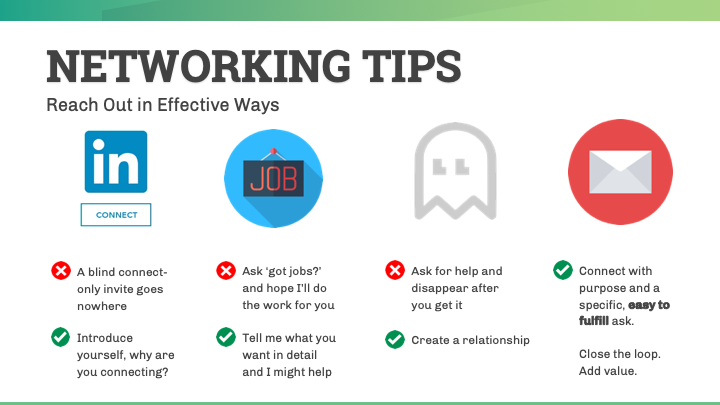
- Networking is important. It’s how you can expand the range of people you know professionally, who in turn know more people. That matters when you’re looking for help to make introductions for informational interviews and direct hiring managers.
- LinkedIn is a wonderful resource. Most use it terribly however. Blind connection invites don’t grow networks, even if someone does accept the invite. It’s a worthless 2-click transaction. You click send, I click accept. Use intros and follow-up messages to start building a reason to know each other.
- Do the work of job search, finding leads, and pitching your candidacy. People you’ve connected to, but who don’t actually know you, won’t do it for you.
- If you ask for help and you get it, keep your connection alive by thanking your benefactor and keeping them in the loop. If you take someone’s assistance and disappear, you might get ignored in return the next time you ask for help.
- The easiest way to get help is to ask great, actionable, easy to fulfill questions to the right person. If you see a posted role and you ask for an introduction or to pass along your resume to the hiring manager at a company, that’s something a contact can decide to do. If instead you ask for a connection to some team looking for a PM, that’s too wide and lacks focus.
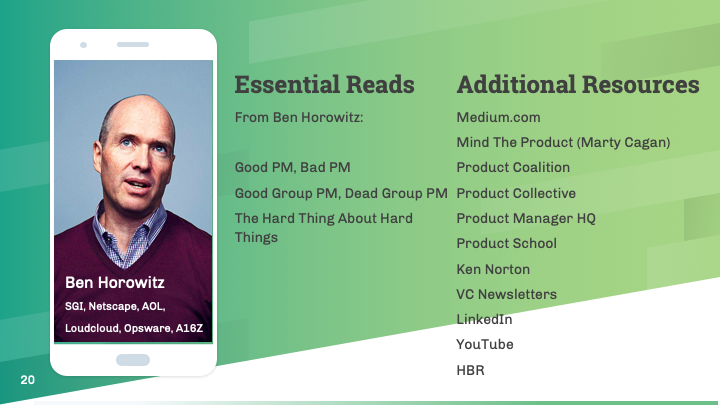
- One of my favorite authors on product management is Ben Horowitz. His guidance is laser-focused based on direct experience and very relevant to me.
- Many other writers, blogs, and organizations also provide great PM guidance. A list is given here. There are surely more which are not in this list.
- Good luck growing into your personal, perfect PM role.

ABOUT LUKE
Luke Congdon is a career product manager living and working in Silicon Valley since 2000. His areas of focus include enterprise software, virtualization, and cloud computing. He has built and brought numerous products to market including start-up MVPs and billion-dollar product lines. Luke currently lives in San Francisco. To contact, connect via luke@lukecongdon.com or https://www.linkedin.com/in/lukecongdon/.