
SHARPENING THE KNIFE; THE PRODUCT OF YOU
I really enjoy cooking both because I enjoy a great meal and because I enjoy learning how things are made. Many a good meal has resulted in me sometime later discovering and deconstructing how to recreate it. Across the years as a result I’ve also come to appreciate the value of a great chef’s knife and keeping it sharp. I routinely use a sharpening steel on knives before I start preparing meals. It only takes a few seconds and the results are noticeable.
People are a bit like knives too. Career skills need sharpening on a semi-regular basis. I most certainly did not know everything I needed to get to where I am today after I finished my undergraduate degree. At that point of time I thought I’d have a marketing career. I moved to New York City, tried a few things, and after a few years began a MBA to add skills and sharpen a bit more. In between I added some extracurricular classes on basic web page coding. These opened a low-paid door to a technical support job at Yahoo! In 2000. Mid-MBA I got another chance to walk in through a door which eventually lead to product management, and so on.
Over the years I’ve taken PMP project management certification courses, Javascript courses, LinkedIn Learning and company-offered courses. I’ve watched hundreds of YouTube videos for learning things from how to make a Genovese pasta sauce (delicious by the way) to Kubernetes. The industry and career articles I’ve read or skimmed probably number over a couple thousand.
This month I completed a week-long executive leadership education course at Harvard Business School designed for people who had reached director-level roles or above and had been working for 20 or more years. It’s been 18 years since I finished my MBA at SCU. I felt this was a great opportunity to resharpen my thoughts on leadership, management, and organizations at a leading school. I was quite impressed with the faculty, the students, and the level of preparation that was present. Originally intended as an in-person training week, this was transitioned to online format given the COVID pandemic. Though I was looking forward to an in-person format, the faculty operated Zoom, multiple input formats, chalkboards, breakout rooms, video playback, and polls with ease and polish. After an intense year of online-only work, I was highly impressed at the level of command they had with the tools. It was seamless. As an aside, I’d love to see people in the corporate world use Zoom as fluidly.
One big reason I wanted to take this course was because a lot has evolved in 18 years. I’ve grown across several different companies, 1-2 new generations are now in the work force, and globalization has continued its rapid expand-contract pace. While in MBA school I was not yet building formal teams, not directly managing people, not charting product and business line futures. Those all came with time and growth, which made this program a great way to reassess if there are ways to be a better leader with up-to-date training and experience.
The Product of You
I believe that self-investment is very important for anyone. For PMs in a fast-moving industry, keeping up-to-date can be a challenge. In the high-tech industry so many people are racing to build all kinds of things. Some will win; some will fail; many will just evolve slowly for years doing neither. As a PM you’ll always be the go-to person to answer questions related to your product and things that impact your product. That means the Internet, Wikipedia, product web sites, books and more will be your go-to resources. You’ll always be supplementing what you need to know.
In medical career fields, many types of practitioners are actually required to keep learning in order to remain certified or board-approved. Therefore every few years they have to prove they’ve attended continuing education units (CEUs). This makes perfect sense. After all, would you want to go to a doctor that didn’t learn anything new since the day they graduated 30 years ago? I for one would not.
Over the years I’ve evolved the books, feeds, podcasts, and materials I keep up with. Some sources became less interesting over time, or I’ve added new ones as needed. Ask and listen for recommendations. It’s a great way to discover content.
One ‘hidden’ resource I love is RSS feeds. These are still super useful despite the announcements of its death 10 years ago. Many news and blog web sites still support these even if they don’t advertise it. Feedly is a good, free to use RSS aggregator you can use.
Newsletters are also very good and have been having a resurgence in the past couple years. I subscribe to several venture capital newsletter and industry news feeds. In my view you only need a handful. They tend to repeat one another from similar sources of news and funding announcements.
Build Your Career Team
In addition to finding good mentors, I recommend finding people to help you. Some of them may help you because they like you. In other cases, pay for expertise. These include recruiting experts, consultants, and even the occasional resume writer. You may have to get creative when looking for them, but I feel this isn’t as challenging as it used to be. LinkedIn and task-oriented services sites can help you find them. Perhaps the best manager or recruiter you knew at your last company would help you or offers consulting. I am not a recruiter and I don’t have that expertise, though I’ve learned a lot as a hiring manager. Liz Bronson Consulting is my go-to expert when I want personal career and recruiting guidance, and she’s worth the investment. She and Kat Troyer also have a great podcast called Real Job Talk I enjoy.
I’ve also subscribed for over 10 years to Ramit Sethi’s newsletter. HIs blog marries psychology with personal finance and entrepreneurship. He has a great set of perspectives on identifying the possible in you.
One idea I really like but can’t take any credit for is the unofficial mentor. It’s hard to find an official mentor where you both want, agree, and accept the mentor:mentee relationship. In a book I read about Andy Grove in recent years, I believe it was Ben Horowitz who wrote that Andy was his mentor even though they never met (at that time). He admired Andy from afar and used what he modeled to influence his career. I think that’s a great model. I’ll add that terrible managers can also be helpful by taking note of what you didn’t like. This can help you model the person or professional you don’t want to be and guide your behavior. I’ve had a couple of these myself. Even better, you can have an unlimited number of unofficial mentors.
- Caveat: Though I’ve bought services from people referenced above, any career investment decisions you make are purely your own. Choose wisely.
Take-aways:
In the spirit of leaving you with some actionable tips, here are a few recommendations for sharpening your own PM skills.
- Invest in your own career, even if your company is unable to subsidize it. This may include a meaningful financial investment depending on the type and depth of training you seek. Depending on your employer, they may or may not help you with this. In my case, I invested in this opportunity I described above myself. For what it’s worth, this applies to secondary education too. E.g. A master’s degree or MBA. Many MOOCs and online content are free or very cost effective.
- Don’t be afraid to ask for help. During the application for HBS, I reached out directly to my CEO to request his sponsorship. I had spoken to him on a few, but not numerous, occasions while working at Nutanix. He quickly replied that he’d be happy to support me which I greatly appreciated.
- Determine which skills you need to hone and go work on those. Prior to the course I took above, I took a career skills self-assessment exam that included participation from 12 of my current reports and peers. On the area of team coaching and mentorship skills I scored well, but I also saw that they scored me lower than my self-assessment. I thought I was doing a better job than they did. This therefore, is a skill for me to invest more time on in order to be more effective and helpful to my team.
- Keep reading. I really enjoyed the case study approach that HBS uses. SCU during my MBA also used case studies. Honestly anything you read can be a case study. The success and failure stories in business and beyond can get you thinking. How might they apply to you? What would you have done? What do you do when both options have downsides?
- Help someone else as they try getting in or growing in a PM career. In the medical training industry, doctors are taught in a ’See one, Do one, Teach one’ methodology for simple procedures. I’m not a doctor so I can only relate what I’ve heard. I doubt open heart surgery is as quick as this. The point, however, is that you don’t need to study for a year first. Try things out. If you’re in PM, help others by letting them watch you ‘do one’. You can also help simply answer questions and point them to resources like this one.
THIS IS STILL A KNIFE
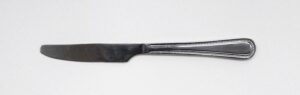
For what it’s worth, blunt knives do still cut. They’re just less safe in the context of cooking. As far as careers go, if you’re getting started in PM or any career and you could use some sharpening, get started anyway. You can still do great work. With time you’ll get better. With sharpening you’ll get (deadly) good. In my opinion the product career is a journeyman career. You start as an apprentice. That name isn’t used for PMs but the beginner ‘Product Manager’ or occasionally ‘Associate or Junior Product Manager’ title is used. Take that opportunity and run with it. Learn from others around you by being curious and open to learning and training. You can go far.
ABOUT LUKE
Luke Congdon is a career product manager living and working in Silicon Valley since 2000. His areas of focus include enterprise software, virtualization, and cloud computing. He has built and brought numerous products to market including start-up MVPs and billion-dollar product lines. Luke currently lives in San Francisco. To contact, connect via luke@lukecongdon.com or https://www.linkedin.com/in/lukecongdon/.