
INCREASE UX FRICTION TO INCREASE QUALITY
CONNECTION REQUESTS SPAM
This year I’ve noticed an increase in the amount of LinkedIn connection requests hitting my inbox from people I don’t know, never met, and who seemingly have no identifiable education or work history overlap with me. This is not a new phenomenon, but it seems to be on the rise, making most of my LinkedIn requests spam. These generic invitations include no introduction or description of why someone would want to connect with me. As a result, I ignore these requests most of the time. This is unfortunate, because I really do like meeting and helping people.
Since I joined LinkedIn in 2004, I’ve found it to be a valuable tool for finding people and job opportunities. Over time I’ve grown a large network and enjoyed seeing the successes of my peers as they grow in their careers. As a product manager, I've used it to find people to validate product ideas with, learn more about industry trends, and see what people are talking about. It surprises me then, how ineffectively many people use LinkedIn to make connections. Giving this some thought, I believe the core issue is the LinkedIn user experience (UX) for requesting connections.
THE UX PROBLEM
The real culprit behind these generic connection requests is LinkedIn. Both the web and the mobile UI interfaces are optimized for fast, frictionless, 1-click connection requests. Since connecting people is what LinkedIn does, they want to ensure you do that simply. This makes sense when I already know the person who is sending the request. When I don’t know you, however, a 1-click connection request with zero context or introduction is spam.
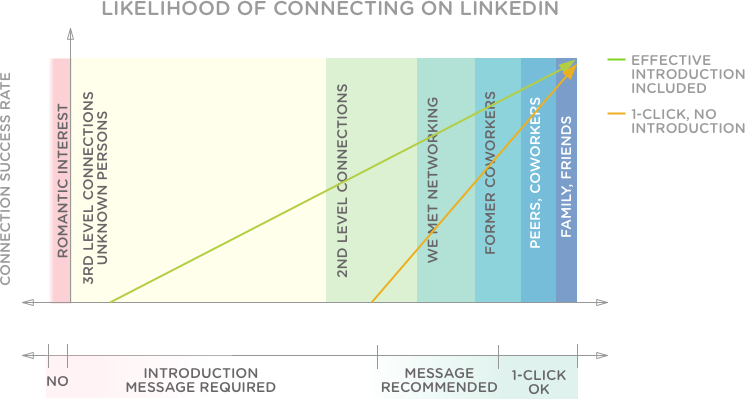
Once you join LinkedIn and add connections, an address book, or a calendar, they know a lot about you and your connections, even if you’re not connected on LinkedIn. Every user adds data to their social graph database. Facebook works the same way. That is, LinkedIn often already knows if someone contacting you is likely to be a 1st degree contact (existing connection), 2nd degree loose connection or association, or 3rd degree stranger (or even further away based on users' node distance to you). Their UX treats all connection levels equally however, which prioritizes speed over quality. In the absence of LinkedIn helping you by creating better connection flows based on connection distance, there is a more effective, though slightly slower method. I.e. Accept invitation workflow friction to increase engagement. To be fair, the LinkedIn desktop flow does include a brief message to include a personal note which people mostly ignore.
Even if you don’t give Facebook access to your own contact book, it can learn a lot about you by looking through other people's contact books.
Kashmir Hill, 'People You May Know:' A Controversial Facebook Feature's 10-Year History, Gizmodo
THE OPTIONAL INTRO MESSAGE
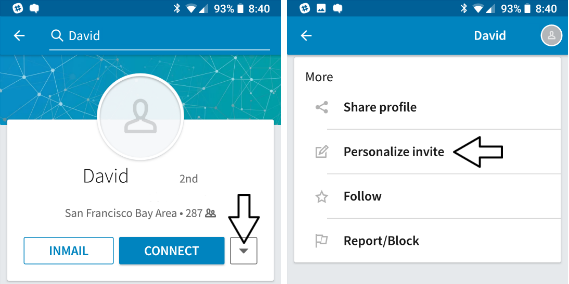
The most underutilized feature in the LinkedIn invite flow is the optional message. I use this all the time. On the desktop it's called “Add a note” and it's easy to see after clicking "Connect". On mobile, however, it is effectively hidden under an arrow menu and called “Personalize invite”.
If you reach out to someone, let them know why you want to connect, or what you hope to gain from it. Are you looking for help? Offering help or services? Looking for career advice? Since this is buried on the mobile interface it appears not to exist which is surely a cause for its lack of use. Mobile browsing exceeds desktop which is why I believe this UX results in so many ineffective invitations.
Now, I'll admit that there are exceptions to adding an introduction. For example, are you a recruiter/talent agent/headhunter? I'll probably connect with you. I'm not looking for a job, but perhaps one day we will find the right opportunity to speak. The second exception is the rare case that some I really want to know pops up and sends me an invite. This is unexpected and frankly uncommon, but if for example Ben Horowitz from A16Z sent me a blind invite, I'd say yes. Anytime Ben ;)
Silliness aside, connecting is easy when we already know one another. The less that's the case, however, it's critical to sell the connection. This doesn't require an essay. Keep it short but effective. The smallest amount of voluntary friction in the invite process can really pay off. Of course, some of your invitations will still go unanswered. That’s life.
Ditch the spam and accelerate your connections success using short, personalized invites to reach and connect with your target contacts. This adds a small amount of additional effort, but those are the people I want to meet.
ABOUT LUKE
Luke Congdon is a career product manager living and working in Silicon Valley since 2000. His areas of focus include enterprise software, virtualization, and cloud computing. He has built and brought numerous products to market including start-up MVPs and billion-dollar product lines. Luke currently lives in San Francisco. To contact, connect via luke@lukecongdon.com or https://www.linkedin.com/in/lukecongdon/.

COMPANY CULTURE STARTS AT DAY ZERO
I've been giving some thought to company culture and a recent discovery made me connect some observations I've been having separately for years. I live in San Francisco in the Mission District neighborhood close to Calle 24 (24th Street). Over the years I've noted several city layout oddities in my neighborhood. As a neighborhood built on a grid layout, I'm always curious about seemingly inefficient uses of space that appear well-established. Here are some examples which I see frequently.
- A strangely narrow industrial storage building only ~6' deep on one end
- A children's park in the shape of a triangle (Parque Niños Unidos)
- An apartment building built diagonally through a residential block
- A triangular car park built directly on the high street of the neighborhood
- And many more

These all left me with a lingering curiosity over the years since it struck me that you could do more with these spaces. One day recently, I used Google Maps to scan the neighborhood from above. My discovery was that all these diagonals and triangles all line up perfectly from overhead. With a little more investigation, I found that 74 years ago, a line of the now defunct San Francisco-San Jose railroad curved off of Harrison Street at 22nd Street towards Mission Street and 24th Street. In fact, you can actually trace the architectural artifacts of this line all the way to Dolores Street quite easily from above. The buildings and houses that existed at the time are still shaped as though they’re built up against a railroad track. The empty remaining spaces were filled in with parks, houses, and parking lots.

Image comparison, 74 years apart. At left is a period map of Southern Pacific Railroad showing in bold maroon the path of two major railway lines in the SOMA, Mission, and Potrero neighborhoods in San Francisco. At right is a modern Google Maps aerial view of the section highlighted in the bright red outline. If you zoom in and keep dragging the map southwesterly you can easily see additional architectural reminders of the former railway.
EMPLOYEE 0
This struck me as an apt metaphor for company culture. I.e. The marks and patterns created early never really go away, you can only try to fill them in or make them look better. I've worked at many companies big and small in my career and each of them had their own culture. I recently started a new role. However, while interviewing up to this new role across many companies, I had the opportunity to speak to dozens of internal and external recruiters, head hunters, and talent scouts. I found that this initial touch point as a candidate leaves the initial footprint of that company’s culture.
'Customer 0' is a term sometimes used to describe the experience your first user at a company has with your product. In the best case, customer 0 loves your product and informs many others inside that company about it, virally encouraging a network effect to broaden your user base. This can increase the stickiness and success of your product with that customer company.
I’d like to coin a new term, “Employee 0’. The people in your team who talk to your candidates are your Employee 0. They set the first cultural cornerstone for every new employee. How they communicate during sourcing and recruiting, how they treat you, if they close the loop whether they do or don't hire, etc. all form the initial impression of the company to the candidate.
If your recruiter Employee 0 is external to your company, e.g. a contract recruiter or retained search company, it’s even more important to ensure they fit your intended cultural values. Do they represent your company the way you want? Are they respectful with your time and investment? Are they helpful? Are they dismissive? Your candidate will notice. This extends to your interview team. While it’s critical for candidates to do their homework, be professional and prepared, I found it amazing how many recruiters and interviewers arrived quite unprepared. Worse were those who didn’t even want to be there.
BEFORE SAYING YES
A job search can be a challenging activity for candidates and recruiters alike. As you spend time interviewing and evaluating, you may feel urgency to say yes when presented with an offer. Before doing so, it’s critical to take stock of your experience up to this point. I have many times seen actions that speak volumes towards company or team culture that surface before getting a job offer. In my opinion, company culture does not take long to surface. What’s good for you may be different than what’s good for someone else, but prior to saying yes, reflect upon your interactions. Joining a company with a poor culture fit will dramatically affect your job satisfaction and performance. It’s also highly likely that you’ll leave within a year. As you evaluate, I recommend the following:
- Check your gut. Does it feel right? Outside of basic fit, i.e. you have the skills and experience for the role? Will you be intellectually challenged to remain interested and healthy? Is it a good fit for your career goals? Most importantly, do you find yourself rationalizing why you should say yes? If so, double-click and ask yourself why.
- Is the company enthusiastic to hire you? This isn’t about wild adulation or receiving exclusive facetime with famous venture capitalist board members. Do they want you in particular or do they need a body? Listen for tone.
- Was their process respectful? By this I don’t mean, was it fast and easy? Here are some examples of what this can look like. Did they let you know where you stood during the process? Were the interviews structured with outcomes per question? Did they respond thoughtfully to your questions? Did they bring you in for a defined role? Did they ask for your questions and respond with clarity?
Things that may feel annoying, but aren’t necessarily culture red flags.
- Response delays. E.g. You’ve had great phone calls or interviews that generated company interest, but you’re not hearing back on next steps as quickly as you wish and you’re anxious. Working people are busy and recruiters and managers are very busy too. When a manager has an open req, it’s highly likely that they are doing their day job, handling the needs of the open role, and also trying to work a funnel of new candidates. A week can pass by like a day. Follow-up after a week, or if a timeframe they set has passed. And be patient.
- Numerous interviews. Meeting several people shows ongoing interest provided they are getting new information to determine you’re the guy or girl for them. Are you meeting more direct team members? Engineers you’ll work directly with? The management team? Hang tight and be the awesome person you are.
- Rescheduling. Breathe deeply and roll with it with a smile on your face. I have personally rescheduled normal work meetings several times over to manage time zones, holidays, escalations, and unexpected emergencies. It happens. Show that you’re a professional by having a great attitude. It’s not personal. If you think that it is, that’s a red flag and maybe you have your answer.
THE FLIP SIDE
Culture is a deep topic, but in this case I’m focused on the pre-employment phase and signalling that your interactions with Employee 0 reveal. Out of scope, but worth recognizing as well, is that while you are meeting companies, they are meeting and learning about you too. You reveal who you are in your words, actions, and facial expressions. How you present yourself to recruiters tells companies who you are from moment 0 too.
Company culture continues after hire too of course. It can head in many directions. This is a guide to consider what you see before saying yes. Pay attention to the signals, marks in the road, and patterns early. Like tracks long removed, the impression they leave may be the ones you live with for years post-hire.
ABOUT LUKE
Luke Congdon is a career product manager living and working in Silicon Valley since 2000. His areas of focus include enterprise software, virtualization, and cloud computing. He has built and brought numerous products to market including start-up MVPs and billion-dollar product lines. Luke currently lives in San Francisco. To contact, connect via luke@lukecongdon.com or https://www.linkedin.com/in/lukecongdon/.

THE PRODUCT MANAGEMENT CAREER DECODER RING
DECODING HOW TO GET INTO HIGH TECH PRODUCT MANAGEMENT
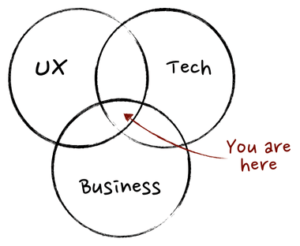
Product management is a role often described as the skills intersection of Business, Technology, and User Experience (1). The profession of product management can be challenging to enter, and secondary education sources are only starting to offer specialized training for PM in the last few years. There is much written about what we actually do, and how to become a better PM, but I’ve realized that there is not much guidance for becoming a product manager. It is a career that is usually self-selected into after working for a few years, and does not have any university training degrees to support it just yet (2). This leaves the question: As a career spanning three overlapping skills areas, where do you start?
MY PATH INTO PRODUCT MANAGEMENT
My career started with a business undergraduate degree in marketing. I worked in New York City in pharmacy and banking as I explored industries. In 2000 I moved to Silicon Valley (Sunnyvale) and lucked into a tech support role at Yahoo!. I taught myself HTML and CSS in my spare time and built a few web sites for myself and for friends’ weddings. Upon finishing a MBA, I pursued a job in project management. Shortly thereafter, I self-initiated an expansion of my role to include full product ownership of a storage analytics SaaS product. I’ve since worked at large enterprise companies and tiny start-ups releasing billion dollar product suites, finding initial product market fit, launching business models, forging partnerships, building teams and mentoring new hires, among many other aspects within product.
HOW YOU CAN DO IT: THE PM DECODER RING
It’s important to understand that PMs are not born, they’re developed. This is key to understanding how to get into PM. Each person usually comes to PM from one of the three core areas (Business, Technology/Engineering, or UX). This often corresponds to their undergraduate area of study, but I’ve met PMs from various backgrounds too. Often they will work for a few years cementing their core skills, then gain an interest in PM. At this point, they might have little or no experience in the other two skills areas. To make the transition they need to learn more. This is why getting to that role at the center of the Venn diagram above is hard. You don’t need to be equally great at all three areas to succeed (3), but you do need to have exposure and learn about them.
MAKING THE TRANSITION
As I thought about how to add clarity beyond Business, Technology, and UX, I expanded upon the Venn diagram concept to create the infographic below to include career roles, education, and skills (4).
The Product Management Career Decoder Ring

This decoder attempts to describe the many career starting and expansion points I often see. These of course are just a few of the many possible starting roles. Making the transition from a single functional role into product management often translates into expanding your knowledge of the career focus areas to your left and right on the wheel. E.g. If you are a software developer, you could expand your knowledge of business and UX. While this may sound daunting, it does not have to be. There are many ways to do this I describe below. In addition, there are many ‘overlapping’ roles across focus areas. E.g. A technologist could try out technical marketing or sales engineering which brings them closer to business needs. A business marketing manager could try interviewing users to understand UX needs. A designer could get involved with information architecture to understand technical implications. This decoder can help you identify what you need to know to start crossing over.
I believe PM attracts people that are eager to learn and absorb additional skills in new knowledge areas. So while the perfect PM skills zone appears to be equal measures in the center of these three areas, in reality many PMs are lop-sided at the start of their career (3). Becoming a great PM then, means identifying and filling in the areas you are weak in. As you get better, or even excel in your career, you might never perfectly fill in each skills area. This is OK. Depending on your target industry segment, you may find that a certain area requires focus in one area more than another.

There are many paths to gaining the additional training and experience you need. Looking at the infographic, conceptually you will need to go sideways via training or new roles, in order to gain the skills you need. There are many topics and paths fortunately, and you get to choose your own adventure. Here are some concrete methods I and many others have used:
Internal Opportunities
If you are already working and have a supportive boss or internal mentor, getting exposure into a new area may be as easy as asking for an opportunity and showing strong interest. Some companies really support this. It may mean more work for you if you need to also cover your existing role. This is one of the best methods since people that already know your work and trust you are far more likely to give you opportunities into an area you have no expertise in. Find someone who believes in you.
Side Projects
Another way to show interest and commitment is to work on a side project. This can be inside a company, or completely separate. E.g. Want to learn coding? Take a class or learn from a book, work on a simple project and make it visible on Github. Or design or wireframe a thoughtful new UI for your company’s product that addresses a challenge you see. Maybe it will never get used, but it shows interest and initiative which can get the attention of people in your interest area. Side projects may require your personal time outside of work.
Education
Are you committed enough to get a second degree? A certificate? Take a series of classes? This approach can be time-intensive and potentially expensive, but it can also open up opportunities. These days there are many online options, MOOCs, and specialized training schools. Some people look into transition degree programs like getting a MBA. This commitment might even require a break from work for a year or two. It is understandably expensive in terms of time and cost so you should weigh the costs and benefits beforehand.
Luck
Sometimes you simply need to let people know you want it. Most places do not have enough people to do the amount of work needed. Start-ups can be fertile ground for this. When an unsatisfied need exists, simply raising your hand can make you the UI designer, or let you help out in marketing, or help sales with demos, allowing you to gain cross-functional experience.
In recent years, some companies are hiring PMs directly out of college. This is great. If you are still in college and this interests you, do your research on the types of companies which offer this and what they are looking for. E.g. This might only be an option to computer science graduates if the target company is a high tech firm.
THE EXTERNAL JUMP
If you find that you can’t make the transition internally, it might be time to find your next role at a new company. Perhaps you’ve maximized your learning opportunities and a role isn’t open for you. Perhaps your manager isn’t supportive of having you leave for another team. Finding a position at a new company may offer an opportunity to try a new role, or an expanded role which offers you more growth.
Transition planning needs to include skills planning. Level up before you jump so you bring more than your former functional role experience to the table, making you more valuable. If training or cross-functional experiences are not available in your current role, use your free time to take classes and work on projects. It may be worth staying at your current company for the time it takes to do so. Your opinion on this strategy may be very different if you’re 25 years old versus 45 years old based on risk profile. Either way, start looking while building your skills. You don’t need to be perfect to make solid contributions at a new company. Product managers are always learning.
NETWORKING
If this career path is for you, great! We need people like you. Product management is challenging, but so satisfying when you build and release products that people use and love. Making the transition can be hard too, but if you’re willing to do the work you can get in.
Don’t forget to get to know people in your current and target industries along the way. I love meeting new people. If you are a PM or an aspiring PM, I’d love to hear about your experiences. You can connect with me at https://www.linkedin.com/in/lukecongdon/
References
(1) Martin Erikksson, 2011, http://bit.ly/WhatIsaPM
(2) CMU has announced a master’s degree in product management (Jan 2018), http://bit.ly/CmuOffersMastersPmDegree
(3) Ellen Chisa, Sep 2016, http://bit.ly/LearningInProduct
(4) Infographic artist, Nandita, https://www.behance.net/nandita23
ABOUT LUKE
Luke Congdon is a career product manager living and working in Silicon Valley since 2000. His areas of focus include enterprise software, virtualization, and cloud computing. He has built and brought numerous products to market including start-up MVPs and billion-dollar product lines. Luke currently lives in San Francisco. To contact, connect via luke@lukecongdon.com or https://www.linkedin.com/in/lukecongdon/.

HOW TO SUCCEED AS A SERIES A PRODUCT MANAGER
You’re a smart and motivated product manager who’s been running with the PM role for a while, and you’re considering making the plunge to work for an early, pre-PMF (product market fit) startup. Perhaps you’re considering a change from corporate life where you got started. The abundance of successful startup stories has created a halo effect that startups are fun, exciting, and profitable. As a result, many believe that working for a startup sounds desirable. In my experience, this is true. There are pitfalls however. Keeping your sanity may depend on ensuring you’re a good match for this exciting career path before you make any rash decisions. The following traits can help you determine your likelihood for success before joining a pre-PMF company in a product role.
TIMING
The stage of a startup company’s lifecycle matters when looking for product manager roles. A startup’s founder is the default first product manager. They provide the vision, assemble the core team, and drive development based on their knowledge and intuitions of the chosen market space. At this point, the entire team might fit in a garage or living room. With growth and hopefully early success, however, the founder CEO becomes increasingly busy running the company. E.g. Recruiting, fundraising, finding office space, managing the board, and much more. This opens demand for a dedicated product manager. This generally becomes necessary once you exceed 15+ engineers and the founder can no longer multitask between being the CEO and the PM effectively. This probably won’t happen until after the Seed round, and possibly not until after the Series A round.
At this time, team size may still be minimal, the product may still be pre-PMF, revenue and processes may be non-existent, and every employee besides you might be an engineer. This brings up an important point. If a startup needs you among their first 10 or 20 employees, they need what you bring to the table on day one. At a minimum this includes product management experience, but may include operational experience in roles including business analysis, engineering/computer science, or product marketing. It may also include domain-specific expertise which can take years to build. E.g. Enterprise technology.
The product manager role is a critical hire to drive product leadership, direction, customer and competitive research, positioning, and ultimately product and company success. This is by no means a comprehensive list of responsibilities. To ultimately be successful at an early stage company before you start, you should also ensure you have the right motivations and constitution.
MOTIVATION
Startups move fast; especially in the early days. There is so much to do, and from the product management perspective, you are the go-to person for everything. Above all, align your motivations with your reason to join. As an early PM, there are many positive reasons to take this role. The best reason in my opinion is accelerated professional education. In a high-responsibility role at a fast-moving company, you will own all things product while also being required to provide coverage in not-yet-hired domains like marketing, sales engineering, technical writing, business and partnership development, and more. This cross-domain work creates a pace of learning far greater than traditional PM roles at large companies.
You will also have the opportunity to define and build a product that will grow a successful company and outlast you. You will see your direct effort pay off with happy customers. You might even change an industry and leave a legacy. Even if your results are not as large as this, working on it can be great fun and very satisfying. If being a founder is in your future, this also gives you a front-row seat to building a business.
Don’t do it for the money however. Given startup pay scales the rate of startup failure, you stand a much greater chance of earning outsized money in a more mature technology company. Read, How to get rich in tech, guaranteed for an easier path to financial gain.
AMBIGUITY THRESHOLD
If you are a person who needs structure in your work life to be successful, an early startup may not be for you. In fact, you may need to unlearn some of the habits you gained while working for that big corporate company. Your ability to work within ambiguous circumstances and rapidly shifting sands while still making progress is what can set you apart for joining a startup. Startups start bare bones with little more than a vision. Everything else is built by you and your fellow team members. The pace and opportunity cost do not afford time to train for skills and provide high management overhead in the early days.
GRIT
This one cannot be overstated. Startups are bumpy ventures with high highs and low lows. You will face many pressures internal and external; most of which only get more intense over time. In the early days, you need to find users and customers while building product with imperfect information. Your unknown CoolName.io company name alone won’t get your outbound inquiries replied to nearly as easily as your BigCompany name did. Getting traction is an uphill battle.
Once you pass funding milestones, your investors and your board’s expectations rise as well. Sales and revenue expectations are codified, measured, and tracked weekly. Your VP of Sales and CEO don’t want to hear how the product is hindering sales. The engineering team and company is looking for direction, customer intelligence, and the answers. Your job could be on the line. Grit does not solve these problems, but it sure helps you be resilient. You will need that to apply the effort and diligence in turbulent times to get to better times. Grit and callouses have much in common.
RISK
Early, pre-MVP, year one startups are inherently risky. This is well known. If considering joining a startup, you must decide if this is acceptable to you. Can you deal with a company flame-out emotionally and financially? Can you afford to not work for several months post-detonation? If no to either of these, think hard before pulling the trigger. Consider as well, that startups at Series B and later have significantly less risk while still being very interesting places to work and grow. I recommend looking at the ‘Decreasing risk of failure’ and ‘Increasing company value’ curves in this article from Dee DiPietro. This may help you visualize which lifecycle stage of a startup best fits your risk profile.
MAKING THE DECISION
If these descriptions sound like you and you’re looking for the ride of your life, I challenge you to take the leap. You don’t need to be the very first PM and the startup does not need to be as early as Series A. Join an ambitious company in the early years and you will find out if you really can withstand the ambiguity, the difficulty reading the market and finding product market fit, and fighting to grow your business. You will gain skills you never possessed and learn a ton which will benefit your career for years to come. You will have difficult days and weeks, but in the long run you will not regret it. You never know, you might also get an outsized return for your investment. YMMV.
Incredible additional resources: The Hard Thing About Hard Things, AVC, Recode Decode, SaaStr, 20VC, a16z, Acquired, plus so many others.
Image credit: https://unsplash.com/@oliverthomasklein
ABOUT LUKE
Luke Congdon is a career product manager living and working in Silicon Valley since 2000. His areas of focus include enterprise software, virtualization, and cloud computing. He has built and brought numerous products to market including start-up MVPs and billion-dollar product lines. Luke currently lives in San Francisco. To contact, connect via luke@lukecongdon.com or https://www.linkedin.com/in/lukecongdon/.

THE WEDDING MVP
You’re the product, they’re the customers. Getting the wedding MVP right.
Three weeks ago I married my girlfriend of three years. The fancy dress, locations, and people gathered were amazing, and I’m told everyone had a great time — we certainly did. During planning, I found that a wedding is as much a product as any high tech solution I’ve created, starting with what to build, who to build it for, and what problems to solve for.
Customer Requirements
From the moment you get engaged, your mind may start rushing to imagine all the great things you want in high definition. I can attest that I saw a lot of Pinterest activity on my fiancée’s laptop. With all that excitement, I think it’s fair to say that people don’t think of a wedding as solving for problems. For us, most conversations revolved around our dreams and visions of the event.
You’d still have a wedding if you stopped there, but it’s worth pausing to realize that for all your guests, you’re the product. They are coming to see you. The great party is just part of the celebration and enjoyment. Your invited families and friends are the customers. This can lead to an additional set of unexpected requirements beyond what you imagined in your dream wedding (brace yourself), but this too can be mitigated by identifying who the key stakeholders are. E.g. Your parents.
Defining the MVP
Popular TV will show you that weddings can get out of control pretty quickly. At its core though, the MVP requirements of a wedding are pretty straightforward. (2) people get legally married, which minimally requires (1) witness and (1) officiant. Sounds easy doesn’t it? I have only personally known one couple, however, who actually had a wedding this compact.
Key Problems to Solve
Great products solve customer pain points. We had our vision, but the customer problems to solve for were a little different. These included making sure certain people got invited (relationships, respect), ensuring seating for aged relatives and tired feet (safety, comfort), representing and blending cultural traditions (identity, tradition, representation), family interaction health (reunion, relationship stress), selecting good catering (satisfaction, edibility), and of course, having fun (enjoyment, memorability). There were probably others I’m not remembering.
Back to the MVP
Speaking with married friends, many feel graduate level calculus is needed to determine what goes in the MVP. Working with brilliant engineers for years, I’m tempted to simplify the challenge in engineering terms. Thanks to Alex Jacobs for helping me with a humorous example solution. Feel free to skip this if code is not your thing.
<script>
var couple = {dreams: “a, b, c”};
var attendees = {dreams: “w, t, f”};
var dreams = [ couple.dreams, attendees.dreams ]; // >= 2 values
var goals = (dreams[0] === dreams[1]); // ensure majority agreement on this value for best results
var customers = (Math.floor(Math.random() * 30)); // wildly unstable, results non-deterministic
var greatWeddingLocation = TheKnotSaidSo(); // highly subjective
if (goals === false){
console.log(“Revisit this. I hope you don’t have plans for your next few weekends.”);
} else {
console.log(greatWeddingLocation.chooseThisPath[customers] );
}
</script>
Oh boy.
Product Market Fit (PMF)
Unlike many products, this one only gets used once. If it’s terrible and doesn’t meet customer requirements, you might hear about it for years (and years). If it’s a success, there will be a fantastic party and wonderful memories. In this sense, it’s not your common multiple-use product. As product development goes, this is a waterfall release so you want to get it right.
In the end, the wedding was great. Everyone had a great time and we did too. Thinking about this experience as a product manager, I can recommend the following.
Take-Aways
- Drive a vision. Define your dream MVP as a team and refer back to it periodically (vision, focus).
- Interview customers. Get your current and future family involved early (requirements, validation).
- Ignore Pinterest. This might feel like competitive analysis, but it rapidly leads to gold-plating (focus, minimum+viable).
- Pay for QA. A waterfall product can’t wait until release day to test for correctness. Get a coordinator (quality, goals alignment, sanity).
Pro Tips
- Black suits, with matching ties you provide, make superb, inexpensive tuxedo replacements for your groomsmen.
- If something goes sideways and only you and/or your partner notice, it never happened if you don’t point it out. Roll with it and have a great time.
Image credit: www.emilymerrillweddings.com
ABOUT LUKE
Luke Congdon is a career product manager living and working in Silicon Valley since 2000. His areas of focus include enterprise software, virtualization, and cloud computing. He has built and brought numerous products to market including start-up MVPs and billion-dollar product lines. Luke currently lives in San Francisco. To contact, connect via luke@lukecongdon.com or https://www.linkedin.com/in/lukecongdon/.

PLATFORM EFFECTIVENESS, NETWORK EFFECT, AND ENTERPRISE
A few weeks ago I finally threw in the towel on Yahoo! Mail after 16 years of use as my core email platform. I adopted Yahoo! Mail in 1999 prior to moving to Silicon Valley from New York City since my only email account at the time was employer-based. At the time, Gmail was still 5 years from release as an invite-only service. My online choices included Hotmail, AOL, and Yahoo!. I chose Yahoo! because at the time it had the best consumer ratings. I needed something portable to keep in touch with my friends. Yahoo! fit the bill and I was pretty satisfied with it. Web email clients got better with the years, and though many migrated to Gmail, the feature differences were minor and didn’t drive me to switch.
So why the sudden change? Yahoo! and Google are pretty much the same when it comes to email. Yahoo! has folders, Gmail has tags. Both are just fine for email use. The reason wasn’t the email client. The main reason for switching was for visibility of multiple shared calendars across work and personal accounts. This was painful enough to make a change.
Productivity Erosion
As a product manager and business person, I live off of my calendar. Every week includes meetings, customer engagements, deadlines, phone calls, etc. I check my work and personal calendars to know how to start my day and if I can fit in the gym before the day begins. Add to this my fiancée’s schedule and things we want and need to do together and each week gets quite full. In the context of a full day, I need to evaluate both my work and personal calendars. Working off of three calendars is untenable if they can’t be viewed as one. I needed a better solution. This was also highly relevant when looking for calendar data on my phone.
Platform Integration
I work at a start-up that uses Google Apps. This places me in Gmail, Google Calendar, and many other Google properties on a daily (and nightly) basis for work. The majority of my calendar needs are work-based, however, I can also add and edit personal events, or view my fiancée’s while on my work calendar view. This platform integration, combined with easy overlay of personal calendars, makes a win for me. It also works well enough on the phone. This integration of work and personal mail and calendaring makes changing email clients valuable enough to overcome the switching cost. This platform play has driven enough critical mass between personal and business Google use where integration matters and adds value. In fact, TechCrunch reported in November 2015 that 2M paid businesses and 3M free users are on Google Apps. That’s pretty significant, despite some very large, but shrinking legacy Outlook market share numbers.
Product Manager Perspectives
- Email is a very sticky product, partially due to network inertia. Actual switching cost may be 0, but friction is high. I’m sure I’ll continue to get email at my Yahoo! address for years as a result. POP3 to the rescue.
- Solving for life-work integration with appropriate visibility and privacy separation by permissions addresses overlapping personal/ fiancée/work calendar use cases, all of which apply to me. The integration matters by making the solution relatively simple and effective. Low friction, high value.
- Product focus. I know web email is free, and for that price, I accept advertising. I don’t, however, have to like it. Google does a much better job of not glaringly placing these all over the UI. Yahoo! Mail still feels like the year 2000 Internet with graphical left and right pane banner ads, and obvious graphical sponsored emails. I had forgotten about this by using Yahoo! Mail Plus since grad school which eliminated ads, but a clean UI isn’t a feature worth paying money for any longer.
- Network effect. Google has done a good job promoting Gmail personal use and corporate Google Apps use to the extent that enough people use it to make it a viable integrated calendar solution. That is, if my fiancée and work weren’t using them, I’d have much less incentive to move towards Gmail myself.
- This has the lowest immediate value to me, but Google does allow some platform access to third party productivity tools. I currently use the GoToMeeting plug-in with Google Calendar which is nice. I also use WebEx which does not have a vendor-provided plug-in. This is too bad since one does exist for Outlook.
Remaining Productivity Hazards
- Cross-vendor calendar interoperability is still quite poor, and this is an industry problem. This is still a common issue; especially at work. Large businesses use tend to use Exchange/Outlook. Mac users have iCal, others have Google calendars. Many of these just don’t work well together. Calendar invites to/from any vendor need to be understood and usable by all. This is a significant work productivity issue.
- The Google Calendar UI won’t give me the location of an event without opening the event. This isn’t efficient as I look at the main calendar view since I must open appointments to get simple location or conference room details.
- Message multi-tasking with web email is a mess. Web mail just doesn’t work for me that well as a business person. I am perpetually comparing multiple documents, messages, content as I work to get create clear messaging and output. A single message web mail UI isn’t that effective and opening multiple tabs to accomplish this isn’t that helpful either. As a result, I still use Outlook as the front end of Gmail with Google Apps Sync. It’s not awesome, but it’s better. This is not a concern for my personal email inbox.
Email Disruption
- Some might argue that email is dead or dying, but in my experience it is alive and well despite major shifts to mobile away from desktop. I am fascinated by Slack, HipChat, Yammer, etc. however. I do think these tools will further disrupt email, but I don’t believe email is going anywhere soon. Harvard Business Review even claims that Millennials check email more than any other age group. They just do it in bed via mobile.
- WhatsApp and Facebook Messenger, or WeChat and Twitter for that matter, appear to be more disruptive for short form communications, but I still don’t think these will replace the length and multimedia attachments space email occupies when it’s needed.
- Mobile is a greater disruptor, but it is only a change of client, not a real disruptor of email. However, mobile + instant short form messaging apps together may continue to eat into email’s dominance.
In the weeks since mapping Yahoo! Mail via POP3 and using Gmail, I’ve found the transition to be quite easy. It only took a day or two to adjust to tags. I was already using multiple Google Calendar accounts as one for three years, but now I’m not losing social invites from friends and family which wouldn’t open in Yahoo! Calendar and got stranded in my inbox. Arguably, Yahoo! Mail and Calendar could have accomplished the same thing as Google. They have a large install base, but lack of enterprise focus, strong Gmail adoption trends among Gen X, Gen Y, and Millennials, and lack of multi-user calendar visibility left them behind. I’d still like to see Google and other calendar vendors support seamless interoperability to the extent that it no longer matters what product another user is sending me a calendar invite from. Ultimately as a personal and work email and calendar consumer, product integration and platform matter which is why I decided to transition fully to Google.
ABOUT LUKE
Luke Congdon is a career product manager living and working in Silicon Valley since 2000. His areas of focus include enterprise software, virtualization, and cloud computing. He has built and brought numerous products to market including start-up MVPs and billion-dollar product lines. Luke currently lives in San Francisco. To contact, connect via luke@lukecongdon.com or https://www.linkedin.com/in/lukecongdon/.