
THE BEAUTIFUL LIES YOU’LL HEAR AS A PM
In a product management career you’ll see and hear a mountain of assertions without data, opinions stated as facts, and artfully constructed outright lies. These are generally shortcuts to get you to do something someone wants.
As PM, you are a gatekeeper between a mountain range of ideas and feature requests, and a narrow, single wagon passage where a small number of them get through to engineering. Many people have reasons to get you to do what they want which serve them, not you.
Why are they beautiful? Because the world will be green, lush and serene if you believe them. Others will get what they want and you will be blissfully unaware that they may be holding you back.
Now, PM is not a job of saying no. It’s the job of using research, strategy, intelligence and business acumen to say yes to the very small number of correct things you’ll work to build by tooth and nail. Do this right and the product grows and sells.
Here are some of my favorite beautiful lies. For each I provide a translation of what is really being said so you can recognize and avoid them. You might not be able to avoid all of these, and you might get pressured to do some with eyes wide open.
“I need you to join an ‘Art of the Possible conversation’ with my customer.”
Translation: I have no idea how to position our product or what the customer needs. I need a PM to save my ass and lead this conversation for me. I’ll introduce you and you take it from there while I hide.
This one is the worst of the group because it’s framed as aspirational. It’s not. It’s failure wrapped up in a pretty bow, which if you believe the BS, is framed to make you think you’re a hero. You’ll usually hear this from an account manager.
“We’re only going to borrow your engineering for a short project.”
Translation: We’re taking your resources forever. We’re telling you it’s short term so you or your manager agree. Once we have them they are ours. Don’t ask me about them again. This is usually driven from an engineering executive.
“I need feature ‘xyz’ to close a deal with a customer.”
Translation: I can’t close a deal, and I want to make it your fault, not mine. It may be true that you’re missing a feature, and that enhancement would help sell the product.
It’s not likely that a single feature will kill a deal, though it’s appropriate for you to hear the feedback. You will usually hear this from an account manager.
“You’re the best person to represent our company at event xyz.”
Translation: No one else knows this product as well as you do. Our marketing team never bothered to learn this. Your time isn’t valuable to me and I have a slot to fill. This could come from all manner of organizations. If it’s an event, it’s probably from marketing.
“We need to prioritize something else to get built first.”
Translation: I don’t care about your roadmap. Or at a minimum, my feature comes first if there is an engineering resource conflict. Even if you do hear this, a PM worth their salt finds a way to get their feature started by someone, even if you deploy an intern to do it. You will hear this one from other PM leaders who are more experienced at getting what they want than you.
“Do you have five minutes?”
Translation: I am going to waste your time for at least 38 minutes. This could have been a Slack or an email. I don’t understand the question or the answer I need so instead I’ll burn your time in a call.
Don’t worry, when it comes time to describe this to the customer I’ll ask for your time again because I still don’t understand it. This comes from all over the organization.
“Can I get on a call with you to understand your PM career?”
This usually comes from LinkedIn, but not always. Translation: I am looking for career advice, and you look interesting. I haven’t defined my questions, I just want to hear from someone smart with experience. I will stay on the phone as long as you let me.
Also, I won’t follow-up with a simple expression of thanks, or follow any advice I asked you for. Young job seekers are notorious for this. I think they get taught in school to ask for virtual coffees with experts in the field. I don’t even respond to these anymore.
“It’s a small feature.”
Translation: I need it and I have no idea how large it is and I don’t care. I know nothing about how it gets built. I also don’t realize that nothing is small when it comes to the define, build, QA, and ship cycle.
Furthermore any time that gets spent on some bullshit, zero value add feature is time not spent on the highly strategic, revenue generating feature that propels your business forward. Again lots of people use this lie.
“Can you explain the product positioning, the competitive positioning, and the messaging for this feature or product.”
Translation: You can do it more easily than I can, I don’t want to do it, so I’d love it if you handled it for me. Marketing and competitive teams should own these. The truth is, great PMs can do these things with one hand tied behind their back. That doesn’t make it their job or a good use of their time.
“Everyone needs this feature.”
Translation: I want this feature. Whenever you hear this, rest assured, the speaker has no idea who needs it or why. Maybe one person complained and they still don’t know if it matters or not to a sale.
When someone, including another PM, can’t qualify with data or a specific set of anecdotes from named companies and people, they are expressing an opinion. If you don’t ask for details or tell them to go pound sand, you will get stuck building some BS that no one wants, with zero success criteria.
“The feature is on-time for the release.”
Translation: This is what I want you to hear, to stop asking me for the details of engineering progress. This one is one of my favorites because it’s hard for you to validate its veracity. If engineering tells you this, and you have a great track record with this team, you can trust it. If they have a poor track record, you can’t trust it.
The cost of failing to ship in a release rarely falls on engineering. It falls on you the product manager, who has to tell customers and executives why you (yes, you) failed to get it released on time. You often hear this from engineering. You might also hear it from project managers.
“You need a computer science degree, or a MBA, to be considered for this PM job.”
Translation: We’re not about to train you to do this job so you must hit the ground running. This one isn’t always a lie, but this level of qualification is probably overinflated.
It may mean, we don’t want to hire people with no technical background or business skills for this job. If you’re a beginner PM you should start somewhere else.
This can also mean, I don’t really know what this job needs so instead we’ll just list a bunch of degrees as prerequisites. Managers who don’t know what they really need use these catch-all certification criteria.
If you over-hire, but fail to give this employee challenging work, they will be gone in a year. I once left a misrepresented dead end job in four months, after two months of searching.
“Yes, I’d buy that.”
Translation: A customer can say whatever they want to be agreeable or get you to stop pitching your product with zero intent of following through. This one is fun because most PMs have never been salespeople. When you are researching and doing customer discovery, you are looking for pain points in order to solve the right problem.
You’re also looking for signal of interest and propensity to buy as a prioritization input. If a customer tells you they’d buy or adopt your product if you just added feature xyz, you can’t take much stock in this beyond a mild signal of interest. This is because someone who hasn’t given you any money can say anything they want with impunity.
Until you see the money in your company’s bank account, i.e. a PO has arrived, any statements of interest are not bankable. Therefore, it’s easy for you a PM to over weight the idea that this feature will have great outcomes. Instead, keep getting strong measures on the level of pain more customers have. Solving real pain will get you to product adoption.
MORE LIES, THIS TIME FROM YOU
Let’s be honest. We lie sometimes too. Here are a few lies you will tell others as a PM. I know you’re not a bad person. Sometimes we say things to protect ourselves.
“I’ve added your product request to the JIRA backlog.”
Translation: Ok maybe I did, but this will never see the light of day. I have 10,000 other JIRA tickets already. If I’m lucky I can get 20 of them built this year. In reality I’ll get 11 built. Your idea will wallow in digital hell because it’s not fully formed, I’ve never heard a single customer ask for it, and it doesn’t fit our product strategy.
“Here’s a link or a document explaining your question.”
Translation: The answer you want is probably truly in that document. I’m not evil. I know you probably won’t read it though. I just want you to go away. Going into more detail is a waste of time. See, “Do you have five minutes?” above.
“I didn’t see your question.”
Translation: I ignored your question. In a world where you’re inundated hourly with questions from email, Slack, web forms, drive by questions and more, great PMs must self-enforce time for focus and real work. It’s easy to get sideswiped by someone who doesn’t respect your time and doesn’t want to do a simple email or Slack search.
Instead they just throw a question over the wall to you. After all, if you answer it, they get what they want, and you get 10 minutes or more of wasted, duplicate effort because you’re already answered this 100 times in the past quarter. When you see low-quality questions, let them slide by. Someone else will answer them for you.
SELF-PRESERVATION
The task list for PM is unending. Don’t get sidetracked on fools’ errands. While the job requires great focus to be successful, you will effectively say no to the things that waste your time and don’t contribute to the best possible product you can deliver.
Being the best possible PM isn’t making everyone around you happy all the time. It’s getting the best possible product built and shipped. When the product sells, people will be happy, and so will you.
ABOUT LUKE
Luke Congdon is a career product manager living and working in Silicon Valley since 2000. His areas of focus include enterprise software, virtualization, cloud computing, and Generative AI. He has built and brought numerous products to market including start-up MVPs and billion-dollar product lines. Luke currently lives in San Francisco. To contact, connect via luke@lukecongdon.com or https://www.linkedin.com/in/lukecongdon/.

GO ZERO TO ONE BY ACTING LIKE THE CPO
Last month I just completed a 0 to 1 product release which consumed the last 15 months of my time and effort. It was an exciting opportunity for my company to build a unique, net new product line to provide a software-based infrastructure product to let customers deploy and power generative AI-based applications.
As a product management leader of 18 years who has been building and guiding PM teams for the last decade, it had been a while since I was personally tapped to define and lead the creation of a brand-new product vs. growing a product. Building features and product lines are one thing, building up a 0-1 product is something completely different. This was effectively a start-up inside an established company. This required rolling up my sleeves and getting my hands dirty.
Every few years PM authors like to refer back to the notion of the PM being the CEO of the product. I do like this idea, but it is flawed. You need to be the CPO (Chief Product Officer) of your product instead. CEOs drive companies. As a product leader you need to do everything in your power to get your product out successfully across all contributing and involved teams at the company. Almost all of these teams don’t report to you and it doesn’t matter. As the PM/CPO you are the conductor. You must masterfully conduct the orchestra all the way to the final note.
In my case, this opportunity knocked a year and a half ago. Only six months prior, ChatGPT from OpenAI was released and it swept across all industries as people and companies realized this would transform all software product lines, increasing competition. In some cases companies will lose too. E.g. Chegg, a company which rents university books and creates study guides, has been annihilated by ChatGPT. Their stock is down 99%. We stepped up to respond to the ChatGPT moment for private infrastructure and data.
I initially resisted a little. I was already running a strategically important and busy product line. At the same time, I was also wrapping up the merging of two additional overlapping product lines, and in the middle of pitching the acquisition of a company to my employer which we bought in December 2023. I was maxed out but also quickly realized this was a great opportunity.
BE THE CPO
This post will focus on being the CPO of your product. I’ll cover how you go from zero to one and bring the entire company along with you. First and foremost you need to start here and answer these questions for yourself: Are you hungry and willing to run an uphill marathon to make this happen? If the answer is no, please don’t put yourself through this. If you believe the vision and the opportunity, and you have the skills and mettle, you might be the CPO of your new product idea.
Remember, the CPO is the conductor of the company-wide, cross-functional product orchestra for the entire company. You need to intimately understand how to build product (via direct hands-on experience), how to work the body of the entire organization across all teams (influence), and how to share the vision and compel your company to deliver the right product (vision, leadership), to the right customers (correctness), and ship at the right time to meet the market opportunity (timeliness). Furthermore, the resulting product must matter to the company (revenue, customer growth).
THE OPPORTUNITY
There must be a reason that you will work hard and drive your company to take this journey with you. Are the vision and opportunity sufficiently large? Can you win? Can you drive large and meaningful revenue to your company? Deciding you’re excited is not enough here. It must matter to your customers and your company. Are you panning for gold (a risky and hopeful aspiration with a tiny probability of success) or are you selling shovels (providing tools that every person panning for gold needs and buys)? In our case the world did not need another LLM model, another model hub, or another cloud-based AI solution. Our customers need data privacy and safe generative AI on-premises where their data resided. We built high-value universal and safe shovels for enterprise.
GETTING STARTED
Creating a new product line inside an existing company is an act of intrapreneurship. I.e. You must approach this like you’re starting a VC-funded new company. You’re an entrepreneur, but you’re inside a company. You have many of the same concerns as a founder in many ways with some notable exceptions concerning personal family financial risk.
As an intrepreneur, your CEO is your VC. They are taking a bet on you and your product and providing you with series A funding. You still have time to market pressure, funding pressure, execution pressure, etc.
The very first thing you need after you’ve sold your idea is a handful of stellar engineers. If you have a great idea and mediocre engineers, pack up and go back to your day job. You must have a focused, excellent, and motivated team of builders to get this done. Among that team, you need a technical cofounder. This is your CTO who will drive your technical team with vision and leadership. As the product manager, you need to be the chief product officer.
If you have a great idea and mediocre engineers, pack up and go back to your day job. You must have a focused, excellent, and motivated team of builders to get this done.
Generative AI was new to me so I spent a deep dive week reading everything I could and watching YouTube videos to do an initial load of the topic area. I took about 30 pages of notes in a Google doc for myself. I spent time with my technical co-founder to learn as well. Here I formed a view of the GenAI space and opportunity. This was rapid, however, it was also supported by 20+ years of enterprise infrastructure experience.
From here we raced to create a prototype. Given my company already has a full datacenter operating system product, we were able to propose an ugly solution that customers could use and try with the help of services. As some have said for years, you should be embarrassed by the first version. Ship it anyway. Time is not on your side in a fast-moving, competitive industry.
This first version gave us the opportunity to put our point of view out in the market as quickly as possible and test the response. From there I had hundreds of inbound requests for more information. Absolutely nothing could have been better for market validation, customer pain validation, and fine-tuning the concept.
PROTOTYPE, FEEDBACK, BUILD
Now we knew something about the market which not many others knew. I moved on to develop the actual product requirements. We had our company and personal career experience, our learned expertise from the feedback of hundreds of customers, partners, and analysts.
The requirements phase also helped get buy-in from our small engineering team. This is critical because we were about to proceed at breakneck pace to build.
COMPETITION
You must know who you’re up against so you can understand how you will be compared. Educated buyers always want to know how you’re unique, so they can decide if it’s enough to base a purchase decision on. As the CPO this is your job. Spend time early and document this completely. Everyone will ask for this including your investors.
Our learned understanding and customer feedback gave us a key insight. Data is precious and requires protection, and without the confidence that you can protect data, customer GenAI initiatives will stop cold. Companies wanted the value of GenAI located where their data securely resided. They did not want to expose their data to a cloud inference service. I.e. They wanted us to bring GenAI in-house to them, not vice versa as many cloud providers offered.
The competition wanted you to open your on-premises doors to the cloud where they were. Enterprise customers don’t want this. The risk of data loss and exposure is far too high.
GETTING FUNDED
As an intrapreneur, you have an idea, but you also have a day job. To get funding, you have to pitch an idea to your leaders to get investment. The funding you want won’t come in the form of actual dollars, and you won’t get a term sheet.
If you can sell your leadership on the idea that they should invest in you, they will invest by giving you time and people. To the company, this still equals dollars. You’re still an employee so they are giving you a green light to use the time of people including yourself to get something built. You still have a time to market rush and you still need to acquire customers and revenue.
As an intrapreneur you won’t get stock options other than what you already have as an employee. You will get oversight and you will have to report up to the leaders that funded you. They are your VCs and board. You will report to them frequently and this will take more time than you want it to. Keeping them happy means keeping your new enterprise healthy and funded.
Doing a great job means you will create something new. Doing a poor job may tarnish your reputation and limit your future opportunities at this company. Doing a terrible job may lose you your day job.
Your upside as an intrapreneur is opportunity and visible results. It’s not often that any PM gets to work on a net new product in any form which matters to the company. Anyone can work on something new and meaningless. These do not move the needle for company or your career. New and meaningful is rare. It’s a risk worth taking. Making a success on this type of effort pays off in new, larger opportunities. It may also pay off with opportunities for career growth which could also come with higher levels of compensation.
BUILDING A KILLER TEAM
The team you need will be built in stages based on the development progress of your product. As mentioned, you need a handful of great engineers, a technical leader (acting CTO), and a great product leader (acting CPO). This is your starting set.
A weak or insufficient team won’t overcome the challenges of getting something built on a timeline and MVP scope that will matter to customers. Worse, a weak team might build something that is incomplete, poorly built, unsustainable, or riddled with bugs to the point of uselessness. Getting this initial team built is your first challenge. If you can’t do this, do not pass Go, do not collect $200.
If you do have that great initial technical team, you will invest in them first. From you they need requirements and a direct line to the voice of the customer. Though you are in the loading phase of product development, this is actually somewhat easier because of the intense focus you will have. There are many other groups to come which will require your time in the following phases. You don’t need all your team members at once.
Post-funding, you may feel you have succeeded in convincing the company with your vision. As the CPO, however, you will repeatedly sell the opportunity to interested current and future stakeholders for the entire build phase and beyond. You will endlessly answer questions. After all, you’re the product person who knows the “why” and you defined the goals. Few will pay as much attention as you do. Be aware of this and continually keep everyone in line with the vision so they support you when you need them.
STAGE THE TEAMS YOU NEED
How long it takes to go from idea to validation, to requirements, to dev kickoff, to delivery are dependent on the product and scope. Therefore I won’t attempt to create a timeline.
You will start with eng and PM as I mentioned. Your cross-functional team will also include marketing, sales, services, business development, pricing, and legal. This is only a high-level view. Even more point stakeholders will be involved at specific times. Keep all stakeholders involved and engage them when needed to get to GA.
Marketing, documentation, analysts, PR, and patents will come towards the end of the process. Sales and SE will be critical inputs to pricing and packaging as they validate how they can actually sell your product. If you need partnerships, business development will engage in the middle to understand and build the right alliance partners. There are many small variations on these including exceptions. This is where you must understand the entire body of your organization to succeed.
THINGS LEARNED
-
In conceiving a full 0-1 product you will forget something at the outset. Lean on your team but also expect this. You will have some room to adjust. In other cases, assess critically if what you forgot can wait for version 1.1. Many times it can wait. Some opportunities or forgotten items must be included. This may mean something else you intended to do goes to version 1.1. In either case, be ready to ship on time. Your market can’t wait.
-
Industry timing to influential trade shows can be critical to the impact of your product in market. These can also be forcing functions for driving timely delivery for your cross-functional teams. Know which events are the most important at the start.
-
Get personally involved with selling before GA. That’s when you find out if your product has wings and what’s going to get traction or not. Customers don’t spend money on things they don’t believe will meaningfully help them. They can be direct and harsh when they don’t believe you’re worth it. You need to hear this first hand so you can make your product better and worth customer purchase.
-
Leverage every opportunity to speak internally and externally. Remember as the CPO you are constantly selling the merit of your idea and investment to your customers and your sellers. Shipping is not enough. They will not just come if you build it. You must sell the message repeatedly. If the message and product are right, selling will be far easier.
-
Money does not grow on trees. As an intrapreneurship product at a successful company you may believe there is plenty of money to go around if you need more. It does not work this way. Team have budgets and budgets get set once a year. If you need more money, you have to get someone’s budget dollars assigned to you. Trust me, no one has budget that is unaccounted for, even if it’s not spent yet. You must know and plan for budget cycles. Adjustments can always be made, but mid-year, this money always comes from someone who will fight against you to keep their dollars.
-
Keep your executive team informed proactively. They have the ability to unfund you as quickly as they funded you. Keep them informed and on your side. They know nothing goes perfectly all the time. They will also keep you accountable for being on-time and on-budget.
-
Stay on target, even though the world will ask you for another 100 things that you did not plan for. This is PM 101. Always start with first principles.
-
Keep your investors (your CEO and their staff) close and appropriately informed. These are your VCs. Regular updates and assessments will help align them to your goals. Remember it’s their money (the company) which is on the line, not yours. Iterative product success and C-level hygiene can also help you get your B round to keep going.
THE CPO IS NOT THE CEO
CEOs have several major responsibilities, and numerous additional ones too. They set company direction, implement strategy, represent the company to external stakeholders. Their scope of responsibilities is wide and includes many more items.
CPOs also have a lot of responsibilities, but they are not the CEO. They set product vision, represent product to the C-staff, get products developed, run market analysis, manage budgets, and more. They often have teams reporting to them to execute many of these responsibilities.
As a PM intrapraneur, you need to act like you are the CPO of your new product line. A new product is not a feature, and it’s not an evolution of a product that already exists.
If you treat your role like a CPO, you will be applying maximum depth and acumen to your product, giving it the best chance of success. You will drive vision through execution, orchestrate the efforts of others to drive outcomes you need, and align all to the maximum result possible.
While acting like the CEO isn’t a terrible comparison, it’s too grand and doesn’t capture the right scope. You don’t own the company direction, you don’t work with the board, and the success of the entire company is not on your shoulders.
The CPO is the ideal fit to align yourself to as you build your product journey. The CPO is a company executive, they fully own the success of building product, and ensure that the product is financially successful (that sales can sell it), and they orchestrate the entire company to ensure the product vision gets to the world with the right scope and right time.
Next, if your product is for sale, it’s time to start thinking like you’re the General Manager.
ABOUT LUKE
Luke Congdon is a career product manager living and working in Silicon Valley since 2000. His areas of focus include enterprise software, virtualization, cloud computing, and AI/ML. He has built and brought numerous products to market including start-up MVPs and billion-dollar product lines. Luke currently lives in San Francisco. To contact, connect via luke@lukecongdon.com or https://www.linkedin.com/in/lukecongdon/.

GUEST POST: UP-DOWN-UP DIRECTIONS OF MANAGEMENT
Careers are primarily formed in three long arcs:
-
Learning.
-
Managing.
-
Leading.
In each phase, how you work with your manager and team will change.
As a new employee in the workforce, you’re in the learning phase. You will be responsible for managing up to your manager, and they will have the most direct influence on your direction, growth, and opportunities. This phase can last from a few to many years.
Once you cross the threshold of being a manager yourself, you start to manage down and up at the same time. This arc can last a long time, on the order of decades. This arc is challenging because you will lead your team as well as manage up to your own manager.
Once you reach Director and above, you start a new career arc into leadership. You will still have a large personal workload, but now you’re leading an organization with trusted managers to lean on and support you. In this phase, you will start to lead and principally manage up to the VPs and CxOs above you, and you will do a lot more managing up than managing down.
Takeaway: Understand what your manager and your team need at each phase of your career. This will help you manage up and down appropriately, and help you succeed and grow at a faster rate.
NOTE: This is an excerpt of this deep dive article. To keep reading the entire article jump over the LEVEL UP by Ethan Evans: https://levelupwithethanevans.substack.com/p/up-down-up-directions-of-management
ABOUT LUKE
Luke Congdon is a career product manager living and working in Silicon Valley since 2000. His areas of focus include enterprise software, virtualization, cloud computing, and AI/ML. He has built and brought numerous products to market including start-up MVPs and billion-dollar product lines. Luke currently lives in San Francisco. To contact, connect via luke@lukecongdon.com or https://www.linkedin.com/in/lukecongdon/.

SHIPPING IS THE OUTCOME THAT MATTERS
Lately I’ve been preparing for an all-team, in-person PM event for my organization. My extended team attending is internationally based with people in India, Belgium, France, England, Germany, and the east and west coasts of the United States. It’s been years since we’ve all met in person at the same time. Some are newer to the company and haven’t met anyone in person yet. In preparation, my managers and I have been building a multi-day event where we will take the opportunity to build camaraderie, educate with skills training, have some fun, and converse with our PMs. I share this because in my career, explicit and developed PM training was never given. That may surprise you, but I still feel this is incredibly common.
As I’ve been developing the materials, I’ve been thinking about which one particular skill is actually the most important for PMs to possess. I.e. If you walked away with one single take-away from this event, what should it be? It’s a challenging question because PMs cover so much ground; especially as they get more senior. It’s also perilous to say that one thing is the most important for the same reason. Any one thing can be overly focused on to the detriment of the PM role at large.
Here’s the one thing: PMs must be able to get product shipped.
This is an oversimplification but it speaks to knowing how to take assignments and get them through the system and out to customers. This may sound simple to an experienced PM, but I find that it’s a real challenge for some. Shipping requires mastery, or at least functional comfort, of several parts of company machinery.
First you must know how to get started. Can you take an assignment, or a customer pain point and turn it into a concrete business defense with clean, accurate, and relevant requirements? You must be careful you’re not making up something you feel like doing and instead have something that matters to customers which they will actually pay for. You need to make a convincing argument based on facts, direct customer research, competitive analysis, and informed opinion. You can change the order of this, but always put opinion last. Your opinion doesn’t matter if you don’t have valid research and customer discovery done first. I can’t count the number of times a PM has wanted to do something based on their opinion alone. These are usually bad ideas.
Once started, you must know how to make it into the engineering work stream and through the other side with enough parts of the intended product still correct, built to spec, and in working order that customers get what they said they needed in their pain statements. This is harder than it sounds. First, how does your company actually work? In most companies engineering is already solidly booked working on prior assignments and not available for new things for perhaps half a year. What is the prioritization mechanism your company uses? How do you get your product effort prioritized? If your company is medium or large-sized, you will be competing with 5, 10, maybe 20 other PMs for engineering time. PMs with more clout, better brands, and more wins under their belt will get you edged out because they are trusted and have a track record of delivering results. They know the processes, the people, and the overall game.
I hope you didn’t forget that your product team isn’t just engineering. It also consists of UX, UI, marketing, sometimes technical marketing, sales (sometimes), QA, and if you’re lucky, a project manager.
When I was a young PM at a large company over 18 years ago, a manager of mine stated that the company we were in was a meritocracy. I believe he meant well and I think he believed it was true. Years later I believe that the myth of meritocracy is for people who are unaware of the game being played around them. Exceptional players work at a level which understands this. They can be professional and friendly at the same time, but they are super effective. They know who to pre-sell on ideas. They know who are the gatekeepers and who are the resources to line up ahead of time. They sell great ideas and get executive buy-in early. And they know how to work harder and smarter to make it a reality.
Last, even after engineering builds the thing you asked for, you still need to get it pushed out. This is more involved than getting code bits published into a public AWS repository. E.g. As a PM you aren’t directly responsible for the marketing that will get done for your product. However, the marketing team will come to you in advance for a complete breakdown of the product, features, positioning, and understanding. While you might not write the final marketing copy, you will be heavily involved.
Sales and SEs will also ask you for your direct help with positioning, explaining technical details, and putting you in front of customers. It will take far longer than you may think for field sellers to be comfortable selling your solution. They will lean on you to do it for them. You will need to help get enablement delivered (which you will probably have to build) to get you off the hook for sales calls. E.g. Intro decks, FAQs, positioning statements. If it seems like marketing should own this, see the paragraph above. Even after this, big accounts and large deals will still pull you in. Customers who write big checks want to hear from PMs directly. This is actually a good thing. Great PMs love hearing from customers and testing their assumptions.
EFFORT VS. OUTCOMES
If you’re having trouble getting past the requirements stage to getting something built, sent to customer, marketed, and adopted, you might be stuck in the effort vs. outcomes conundrum. It goes like this: Effort is necessary, but outcomes are the only things that count.
The challenge here is that effort is a critical input but you can get stuck in a cycle of ‘working on stuff’ that never results in what’s important. The trickier part is that effort feels like valuable work, and it might be useful, but without finishing and shipping, effort alone isn’t that valuable. Examples of effort without return are email, Slack, Teams, Zoom, meetings, talking to other smart people around the cubes, etc. Put another way, if you spend all day on email and Slack, but haven’t spoken to customers or moved your product forward, you haven’t tangibly gotten closer to an outcome.
Good PMs ship. Shipping can be difficult and it comes with refining your requirements, making battleground gut-wrenching compromises, pushing teams to finish on time, escalating when teams aren’t meeting their outcomes, working late now and then to get someone unblocked, revalidating an assumption, fighting off teams that want to steal your resources, and more. During the course of all of that, you will also have emails, Slack, and meetings with teams. Good PMs keep all that under control while focusing on getting their products built, shipped, and fit for market. It’s harder than it looks. It’s why exceptional PMs are worth their weight on gold.
ABOUT LUKE
Luke Congdon is a career product manager living and working in Silicon Valley since 2000. His areas of focus include enterprise software, virtualization, cloud computing, and AI/ML. He has built and brought numerous products to market including start-up MVPs and billion-dollar product lines. Luke currently lives in San Francisco. To contact, connect via luke@lukecongdon.com or https://www.linkedin.com/in/lukecongdon/.

YOUR PERFECTLY IMPERFECT PM BRAND
Product managers are required to be proficient at a great number of skills in order to do their jobs at maximum effectiveness. Business acumen, financial analysis, market analysis, organizational skills, and more. One of the most important skills is who you build yourself to be, or simply who you are. Charisma is the term used when your charm appears natural and effortless. Brand is the you that others interact with and experience. That could be the character which you build, or the genuine you. How you perceive yourself and how others think of you are not the same thing.
As they say around the water cooler, when nothing repeatedly goes right, it might be you. This is why brand is so important. It can color everything. While this post is aimed at the career PM, it’s equally applicable to anyone in their personal life.
WHY BRAND MATTERS
Why does brand matter? If you’re already in a job, your brand can open or close doors and opportunities to you. If you’re changing jobs, it can be the difference between a good recommendation, a tepid recommendation, or a poor one. It can even make the difference inside a company for other peoples’ decisions to decide to get involved with anything you’re involved in. Team is everything. Without a good team you’re a solo operator. You might be ok with that but growth comes with teams and exposure to projects and opportunities which give you the space to shine and stretch. These opportunities are rarely individual contributor roles. The best ones expect cross-functional efforts. Growth into PM leadership requires great skill at working with other PMs and other teams or business units. Brand matters because a poor brand limits your opportunities and access to high-quality people inside your company who can help you succeed. A players aren’t looking for C players to drag along and slow them down for half the credit. People with a terrible brand will at best get C players to work with them or people that can’t say no to a project once assigned. That is not the path to greatness.
FAULTY CORRELATION
I love a good 2x2 matrix. Maybe it was my exposure to consultants early in my career. When they work they can make a very clear point. Unfortunately I can’t use one here. I’d love to create a chart that illustrates how people with great brand have the most successful outcomes. In some cases that might be true. The truth is, however, that highly dysfunctional people can also be very effective. No one may like them, and you may not want to work with them, but they can still get things done. Obnoxious PMs can still get people to finish projects. The trouble with that is, people will still dislike them and may never want to work with them (again). This can also cause strong people on your teams to shadow quit (i.e. never work with you again), or actually quit. Long-term effectiveness may be severely impacted. A high-calibre PM will always be grooming A and B players to be in their stable for future projects. It helps the PM and it helps the player employees with visibility and evidence of impact for future recognition and promotions. This is a virtuous cycle for both you and your team. Success breeds success.
UNCOMFORTABLE TRUTH
While many people posture to be seen in certain ways for their benefit, hiding who you are is actually difficult because it takes constant effort to not be yourself. The uncomfortable truth is, everyone is watching you; especially as a product manager. It’s because a PM is a leader of projects and products who carries the authority of the customer voice. This is true even as an IC PM. It’s also human nature. Since you lead you are a leader and people are watching you. There’s no escaping. This makes brand especially important. Are you collaborative? Are you effective? Or are you a taker and a spotlight hoarder? Are you a leader and the go-to person for any customer doubts? Or are you someone to be feared and not questioned? Remember you can help define your brand but you don’t own it. What other people interpret you to be is what your brand is. “Your brand is what other people say about you when you're not in the room.” (Jeff Bezos) If you don’t like what you’re hearing, work to change it. You build or erode your brand on a daily basis.
A hot mess of a person won’t be fixed with a button up shirt.
I value authenticity. I also respect people I don’t always agree with and aren’t always the most jolly people to be around. It’s because these people are authentic and deliver results. I don’t have to always agree with you to be your colleague and respect your brand. Some of the best people I’ve ever worked with had peculier combinations of habits, senses of humor, sociability, fashion sense, etc. What they had in common was commitment to excellence, respect for work and colleagues, and the ability to work with others. If you need to you can shape your personal brand, but please do it authentically. You can only sustain being unauthentic for a short period of time.
THE DRESS FOR THE JOB YOU WANT FALLACY
There’s nothing wrong with wearing clean, work-appropriate clothes, or dressing up a bit more than necessary. That alone won’t change anything unless your only weakness was your dress code which is pretty unlikely. Brand comprises who you are, what you say and don’t say, your actions and more. A hot mess of a person won’t be fixed with a button up shirt.
FACETS OF BRAND
Let’s get more specific. What are some of the specific facets people mean when they say brand? There are quite a few. Remember that while there are many, brand from other people’s mouths can be as simple as, “She’s great”, or “He’s unreliable”.
Here are a few different examples that brand can be attached to. These are a mix of what I’d consider positive and negative brand attributes to consider.
* Baseline skills. Do you know your core work domain? Do you know the market? Do you know how it all fits together? Are you listlessly floating waiting for someone else to tell you what to do?
* Work demeanor. Do you show up to meetings on time? Do you pay attention and ask relevant questions? When called on do you always need to have the question restated because you weren’t actually paying attention? Do you never turn on your videos or speak out loud?
* Work outputs. Do you deliver quality results? Are they on time? Do you have excuses for why you don’t have quality work?
* Customer knowledge. Do you know your customers intimately? Do you know a handful by name with detailed understanding of their environments and needs? Do you generalize what other people say instead? Do you have a list of evergreen questions you can ask any customer at any time if you run into them? Do you document and share your learnings with peers and engineering?
* Attitude. Do you create, test, and validate new ideas? Do you tear down other people’s ideas? Are you positive? Are you passive? Do you arrive at work ready to try?
* Working style. Are you proactive or reactive? Do you respond or ignore requests for action? Do you make yourself available to help others?
* Information flow. Are you an information source or dead-end? Do you inform, share, or hide information helpful to others?
* Business acumen. Do you know how your entire company operates, at least with respect to your product? I’m not saying you should also be an accountant or HR expert. Do you know the business model and how your company actually makes money?
THE ONE WORD BRAND
People can be harshly efficient with their assessments of you. It may be unfair, I understand. It can also be informative. While you may wish people would take the time to get to know the real you, this simply won’t happen. Everyone is busy and most are simply not invested in getting to know the real you. Your brand is the shortcut to public perception of you. Ask those you trust to tell you your one-word brand. Hopefully you’ll hear something like Dependable, Trustworthy, Reliable, or Hard-working. If you hear something altogether opposite or negative, you may want to work on the source of those within yourself.
YOUR IMPERFECTLY PERFECT BRAND
Fortunately real people aren’t perfect. You don’t need to be every positive attribute in the dictionary to be a great work colleague and asset (and person). As a PM, you want people to follow your lead and trust that you’re taking them in the right future direction. In some ways their success depends on you. In more ways, your product success depends very much on your ability to get the right team assembled to help you realize your vision. A core component to getting people onboard is you, and your brand is the shortcut to what they can expect out of you. That is why it’s so important. Long term, your brand is the lubricant or the sand in the gears to opportunities for growth opportunities and promotions.
Not all brands will sound like a holiday movie and that’s ok. I’m not suggesting you should try to be a naive children’s cartoon character. People are complicated in real life. Also, you don’t need to be popular to have a strong positive brand.
E.g. “Jerry is demanding but always delivers” is not a bad brand. Now maybe Jerry isn’t the most pleasant and you will probably work hard if you’re on a team with him, but he delivers successful outcomes. If I was a young PM I would want to be on a team known for successful products so I could become associated with success.
E.g. “Padmashree isn’t warm and friendly but she’s always on time and her work is unparalled.” This is someone I’d be very happy to have on my team. Geat work is hard to come by. I don’t need to be everybody’s best friend, but at work I do need high quality. I’d take this any day.
Brand is ultimately the expression about how people feel about you. If you’re getting brand feedback you don’t like, think deeply as to what you’re hearing. You might not be comfortable hearing it but working on it will help you. Differentiate as well what can be changed and what cannot. If you’re a serious person, you will probably never become a bubbly socialite. This isn’t a career stopper. If you’re known for being late and unprepared, this is a career inhibitor. You can work on this. You can actively change your brand, and a great brand is an accelerant to a great career.
ABOUT LUKE
Luke Congdon is a career product manager living and working in Silicon Valley since 2000. His areas of focus include enterprise software, virtualization, and cloud computing. He has built and brought numerous products to market including start-up MVPs and billion-dollar product lines. Luke currently lives in San Francisco. To contact, connect via luke@lukecongdon.com or https://www.linkedin.com/in/lukecongdon/.

WHAT PMs CAN LEARN FROM TAYLOR SWIFT
I love music and have a lot of great songs and albums I’d happily listen to for years to come. Songs have a powerful place in many peoples’ lives. Sometimes a song is so great, even the artist distances themselves from the feeling of ownership on a song and it becomes implicitly owned by culture at large. The perfection of a great song transcends the originator. E.g. “God Only Knows”, “Here, There, And Everywhere”, or perhaps even“The Last Great American Dynasty”. What great songs have in common with product management is this; at some origin point of history there was nothing. A vision was conceived, and the effort to create it began. We don’t even know if the artist’s vision was actually achieved to their satisfaction. We just know the result.
It is easy to take for granted that amazing products and works of art simply exist. For example, I have no idea how many takes Brian Wilson took before the final recording for God Only Knows was perfected. I only know the final song. For a technology example, I’m certain that people today simply accept that all phones have color and video-oriented screens that do everything from stream music and videos, deliver news, play games, text, and occasionally make phone calls. As consumers we often don’t get to see the creation process before the end result.
Musicians and PMs have this in common. We each start with a blank page and an idea. I’m sure other career paths have this parallel too including artists, architects, authors, and more. The spark of an idea can sometimes come in a moment. Other times it is developed across time and built bit by bit. However you do it, I find the creative quality to create something from nothing to be quite rare. PMs, musicians, and artists must all envision the future before it is made real. The vision comes first, followed by the effort to bring it to life. Making it real can take significant effort. That process can take months or years. I think the follow through to build the vision through politics, funding gaps, skills gaps, attrition, detractors, and sheer perseverance is even more rare. This is where exceptional PMs and artists shine.
LEARNING FROM OTHERS
I’ve always enjoyed the creation story of great works. I enjoy these because they can show an insight into the creators after the great idea, and before they completed it. Rick Rubin has a podcast where he interviews accomplished musicians. He asks them about inspiration, specific songs, mindsets, and how they got to the end result of their work. I’ve enjoyed learning how songs were created including the techniques, the instruments, the recording team, the equipment and more all contributed in unexpected ways. Sometimes a famous song started as a tiny idea, and it’s the work of a team that really created what we enjoy today. These stories are illuminating and inspiring for me. I’m confident Taylor Swift has an amazing team. I’m also confident that she’s the inspiration behind every song idea long before anyone else contributes to its creation.
APPLIED TO SOFTWARE
Software product managers can learn from this. Celebrated technology products also get created in very similar ways. Multiple people and ideas come together to create the final product. Often products you may think of as perfect were certainly not perfect when they were released, but became great later. The iPhone is a great product, but even it didn't have copy and paste or an app store when it first came out. Those got added later.
Great products also take teams. Software teams have members that span many roles. While learning about the core problems to consider solving they have customers, sales engineers, sales, analysts, news articles, and their own observations. While building products they have engineering, UX, UI, support, QA, system test, and more. While releasing products they have marketing, public relations, press, analyst relations, blogs, videos, demos, trade shows, advertising, etc. In each phase the PM is involved to varying degrees. Sometimes they do a lot. Other times they guide. In large organizations with hundreds of people each role may have dedicated teams. In a startup, most of that might be you alone, or with only one to two others to help you.
Great PMs guide their teams to build the right thing, do it efficiently, and do only as much as it needed to succeed. Sometimes this is done in the face of great resistance but they do what it takes to get it done. E.g. You don’t have funding to get a great idea done? Build a pitch deck and sell it internally to your executives. Or, assemble an informal skunkworks team to build a truly minimal MVP. Perhaps you need to reassess your roadmap and find space for it. Are you willing to bump another feature and make someone unhappy to get a more valuable solution built?
Be aware as the final PM owner. What gets shaved off in the bumpy process to GA might never, ever come back.
Great PMs also have endurance. In my career some of the best solutions took over two years to define, get in the queue, get built, get released, and marketed. Some of them took three years. You need endurance to keep up the steady pressure to see it through. If you take your attention off, distraction and internal resistance will erase parts of your solution. Sometimes that is done in the name of compromise or collaboration. Sometimes other teams have ulterior motives and want your developers. Be aware as the final PM owner. What gets shaved off in the bumpy process to GA might never, ever come back. People, leaders, funding, attention, strategy, priorities, etc. can all change. When a big effort takes a couple years, the world you live in will be different in some material manner by the time you are done.
TURNING INSPIRATION INTO PRODUCT
Turning a great idea into a great product requires a team. If you are a PM and you have a great customer idea, you may be the person in front of the blank sheet of paper.
Next you need to determine who is on your team. Unlike Taylor Swift today, you won’t get to choose and hire your hand-picked team of industry veterans and experts however. The engineers, product marketers, UX and UI team members, etc. are already at your company. They will get assigned to your effort by other vertical managers if it gets greenlit. You will need to show a compelling vision, influence, use soft skills, use data, encouragement and more at every level to build your vision together. This is not always easy but as the PM you need to inspire, drive, and support your team to get to your vision.
Try hard to keep as much of your vision which is relevant to your product MVP in scope, but not more. Getting through the process from idea to finish is bumpy and full of product risk. You might get another shot to iterate on your release, but you might not. An amazing team will help you execute the vision the first time through.
ABOUT LUKE
Luke Congdon is a career product manager living and working in Silicon Valley since 2000. His areas of focus include enterprise software, virtualization, and cloud computing. He has built and brought numerous products to market including start-up MVPs and billion-dollar product lines. Luke currently lives in Atlanta, Georgia. To contact, connect via luke@lukecongdon.com or https://www.linkedin.com/in/lukecongdon/.

WHEN TO RECONSIDER CHOOSING A PM CAREER
Since you’re reading this post you know that I love the career of product management. Yes, it’s a crazy work lifestyle with highs and lows. I love talking to customers even though they can be at various times confusing, irrational, distracted, and demanding. They are also amazing, inspirational, helpful, and surprising. I enjoy doing the long, unseen, demanding work of getting the right product built which can take months and years, in order to get to that fun day of public announcement. Hearing the collective sigh of relief from customers when you solved their problems is very satisfying.
Over the last 15 years, the career role of PM has become increasingly popular. This has brought many bright and motivated young professionals to the career. As a hiring manager this is great news. Unfortunately, popularity paired with a misunderstanding of the role also brings bright and motivated people who are not a fit for the role. This can lead to job dissatisfaction and poor results. Ultimately this can also lead to early attrition. In my experience with hundreds of PMs over the years, I believe that there are some common misunderstandings of the role among many new entrants. If you are considering a career in PM, we do need great talent. It is worth your time to also understand what the role really entails before you choose to take the plunge. Below are my observations about what the job of PM is really comprised of. If you read this and decide you’re all in, I hope to see you begin an amazing career.
MYTHS VS REALITY
With popularity comes a story that becomes myth about how awesome the job of PM is. I agree that it’s a great job. I also frequently say that the job of PM is much harder than it looks. The myth describes in overly grand terms all the great parts of the role. E.g. “You’re the CEO of the product”, “You get to make important, company impacting decisions”, “You’re the product visionary”. In some ways these statements are true within boundaries, yet these statements are vastly overstated. You do get to make decisions. You do get to lead. You do get to paint a picture of the future. What you also have to do is convince teams and leaders to agree with you. They won’t always agree, and often they will try to instead impose their view of the future on you. When your plan makes contact with reality, the plan changes and pieces go flying off at great velocity. Below are some of the great misconceptions I have seen and witnessed newer PMs struggle with.
CONTROL FALLACY
New PMs will often be assigned a handful of product features to own. Ownership means you will observe and improve this feature area. If you are brand new, what you are expected to do will be outright assigned to you. You will have a goal, and be guided to deliver on some improvement. You will exercise ownership of the problem area to fully understand it and develop what is the best and most effective but minimal way to solve it. Some think that ownership means that no one else will touch or question your work. This is not true. To be successful you need to work with a team of engineers, marketing, and other PMs and build positive contribution. Positive impact and influence is far more valuable than this idea of product ownership and it will get you to success faster too.
GETTING EVERYTHING OVER PROGRESS
PMs work to get picture perfect requirements and fully understand what needs to be built to satisfy customers. They then hand those over to engineering to get the product built. The problem with that is reality. Even in stable, healthy organizations you have some small amount of silent, latent chaos that impacts everything in subtle ways. In the best of times you will never get everything you want all at once. It’s not that people in the organization want to underdeliver either. Timelines, attrition, priorities, escalations, changes in strategy, changes in leadership, unforeseen bugs, poor quality, and more are always occurring. These take scope off of your product effort. You need to hit an important date no matter what and some combination of the above happens? Get ready to decide how minimal your product delivery can be. Like it or not you will have these choices to make.
If you’ve joined PM for glory, you’ll quickly find that it’s in very short supply.
The most important thing for a PM to understand and work towards is how to make positive, meaningful progress on the product effort despite all this. You will not avoid that latent chaos. Some quarters may be easier than others, but it still exists. Even the loss of a single QA engineer can bump your project off the timeline. What? All your code was ready and tested well in unit test by core development? Your company doesn’t care. No one ships untested code to mission critical enterprise customer environments. You must figure out how to deliver the best with what you have. If something didn’t get built in time and it remains important, you can get it shipped in the next cycle. Yes, sometimes that means waiting another half a year or more.
GRIT NOT GLORY
Shipping features and announcing them internally, in press releases, at conferences, on LinkedIn, and more are very fun and satisfying. That only comprises about <1% of all of your time as a PM. Furthermore, when you do announce, you give the credit of the achievement to everyone else. And yes, this is the right thing to do.
That means the other 99% of your time is the hard work of getting the product done. In addition to the unforeseen issues above, there is also budget planning, irrational teammates, people trying to get your resources for their projects, and simple, straightforward product work. I.e. Interviewing customers, building decks, pitching your product to customers, working with engineering, UX, UI development, marketing, etc. Most of your work is generally unseen yet still critical. If you’ve joined PM for glory, you’ll quickly find that it’s in very short supply. With a multi-year run at delivering great product, trust me you will be known for being awesome and successful. You won’t get a quick turnaround on admiration for your work. If praise is your primary motivator, you might not like PM. The work comes first, and that might mean 6, 9, or 12 months before you announce anything. You will lay a lot of bricks before you see a wall emerge.
YOU CAN’T HIDE
I don’t want to make PM sound like a job without success or enjoyment. I get both in spades. An important element of PM, however, is that you can’t hide. You’ve taken a role that sits squarely between customers, partners, SEs, salespeople, engineering, and more. To use a computing analogy, you’re the message bus. When people want something, they come to you. When something doesn’t work, they go to support, until they realize it just doesn’t exist the way they want it, then they come to you. When engineering doesn’t have customer answers, they come to you. When something critical to land a deal is missing, SEs come to you. They all know who you are. You get the picture.
You may quickly realize that the demands for features quickly outweigh your time and ability to build them well. Welcome to prioritization. This means you decide when things get built, and most importantly, what not to ever build (ever). That also means that people with earnest requests just got told by you that they won’t get them soon or ever. They will not be happy with you. You will need to have good rationale, and you have to live with it. Conversely, strong conviction with solid rationale behind your choice, delivered without delay to stakeholders can actually make them appreciate you. If you deliver unwelcome news, smart people will grumble but get to move on and help their customers with alternative approaches. Maybe much later in the future, the time and situation will be right to revisit that decision. Either way, you own the decision and everyone knows who you are.
PLEASE AND THANKS MATTER MORE THAN BITS AND BYTES
This will sound squishy but here goes. Technology products usually require technically strong PMs. Though it’s not always a strict requirement, most PMs in tech companies have strong technical backgrounds in development or computer science. More important in my opinion than hard tech skills are human soft skills. You need human soft skills first, backed by hard skills in that order. I’ve met many ineffective PMs with deep technical skills. I’ve also met friendly PMs who couldn’t get anything done. This makes hiring difficult. You need both sets of skills.
What is unusual about the hiring process is that resume searches on LinkedIn or other sites start backwards with educational and job background first. This is because this is easily searchable in data. Soft skills can’t really be searched. This is where you need to assess a person during interviews. This can be thought of as fit, but fit is shorthand for likability. Effective human skills like communication, negotiation, and emotions management are more important than likability and are difficult to measure.
GET COMFORTABLE BEING UNCOMFORTABLE
All the easy problems were already solved decades ago. If you are working for a company trying to own a market, defeat a major incumbent, or fight for its life, you will have real challenges to face. If you want an easier role it’s out there, but it’s probably not product management. The hard questions don’t have easy answers. What do you do when all your choices have downsides? Which beautiful and valid product ideas do you kill because you can only execute one thing this year? How about when you simply don’t know the answer but have to figure something out in order to survive? These questions are common to founders and to larger companies too. You got hired because your company believes you can help answer the really hard questions. Being on point to handle and respond to hard questions can be uncomfortable. Even if you like this challenge, you will need to learn to be alert and vigilant while remaining perpetually somewhat uncomfortable. In fact, if you find yourself too comfortable, you’re probably missing something important.
DAILY EDUCATION
Most industries move fast in tech. To keep up, you will endlessly be Googling topics for details, competitive analysis, and news updates. Keeping up and constantly learning requires a growth mindset. I’ll be the first to admit it. It can be tiring. But it’s how the job is done. Engineers are constantly Googling for technical details, answers to coding language syntax questions, code samples, open source efforts, etc.
If this is not for you, you simply won’t have the will to do it and keep it up. As a PM, you will be asked questions you don’t now the answer to, but are expected to know. Welcome Google. You can also ask others, but you are expected to do as much searching as you can first. This is a career and a life skill.
ENERGY CONSERVATION
Being a PM is a marathon. Sometimes you sprint, and sometimes you jog. Other times you set the pace and meter your energy. Perseverance is key. Often things don’t happen as quickly as you hoped they would. You must learn how to keep the pressure consistently on without burning yourself out.
An important element of energy and emotional control is deciding when and how to fight. In this context I don’t literally mean fighting with coworkers. In the course of working however, some will agitate you, try to deprioritize your features over theirs, or simply fail to deliver. In addition to exercising influence as a first approach, sometimes you need to confront a situation. Ideally you do this professionally. Sometimes you need to escalate to a managerial level. This should also be done professionally and dispassionately with data.
Sometimes, people will try to pull you into a fight you don’t need at all. Who knows why this happens. The best action is to clearly know if something that comes to you matters to you or not. Maybe it doesn’t and it’s simply not your fight. Maybe you have nothing to win or to prove. Conserve your energy and don’t get involved in trifles. One of my colleagues likes to repeat a platitude her mother shared years ago. ‘You don’t have to go to every party you’re invited to.’ These parties also apply to conflicts. Avoid wastes of time and effort.
BECOME IMMUNE TO CRITICISM
If people find your product important enough to complain about, you will hear complaints. Conversely, if people don’t care about your product you won’t hear a thing. That’s far worse because you could be spending your career life on something meaningless. Critical feedback is a gift. You should seek it out because customers will tell you precisely what they don’t like or what they need if you ask them. As a PM you need to learn to separate product feedback from personal feedback.
Don’t take product feedback as a personal attack. If you do you may miss the learning and discovery that comes from it. Do take it professionally however. Customers are sharing because they believe they need something. They might believe you under-delivered. I’ve been in customer briefings where some customers do try to make it personal. I’ve had customers tell me just how much better a competitor is. I’ve had them pull up our stock performance chart and outright tell me our company stock would be doing better if we did x, y, or z. I’ve had them ask if the entire team is asleep at the wheel. With time and perspective you learn not to take all this personally, and get to the heart of what they really want. That’s owning the pulse of the feedback while sidestepping the emotional outburst.
SHOW UP FOR CUSTOMERS
I recently heard a PM ask how they were expected to work before 10am on a daily basis. I found this very funny for its lack of awareness. A 10am start in the tech industry is known as ‘engineering hours’. It’s often paired with a 6 or 7pm stop. The best thing about tech is the general ability to choose your own hours within reason. What is not reasonable in a PM role is to think that the world meets your hours. Unlike when I started my career in the late 90s, the world is much more highly interconnected. The large companies I have worked for in the last decade have all had offices on three continents or more. That means your colleagues are in different time zones. If your product line is global in nature, this also means your customers are in every time zone.
So what do you do when a major Wall Street bank wants to talk to you at their 9am and you’re in California? You are Zoom-ready at 6am with a smile. When a major European manufacturer wants to talk to you in their early afternoon you are alert and ready at 7am. Your schedule does not matter to a salesperson who finally got a meeting with a Fortune 100 company. I once had to do a product pitch at 4am for a Latvian company. I did it and answered questions, then went back to bed. This also applies to critical internal meetings. For example, when your team in India needs you, you have to take a 9pm call. Fortunately, this isn’t every day in most cases. You show up for your customers when they need you. You can still manage your schedule to be reasonable, but understanding your role is important to knowing when you need to show up. If you are unable to operate before 10am on a daily basis, PM is not for you.
EFFORT ORIENTATION
PMs work ahead of the rest of the organization since we’re planning for what’s next. Sometimes that’s on the order of six months to two years. We’re not the only ones who do this, but many teams work more closely to real time. PMs often get pushed and pulled between the needs of today and the needs of tomorrow. Today’s needs are decisions for engineering, feedback to UX, response to escalations, pitches to current and prospective customers, email, Slack, Teams, meetings, and more. Tomorrow’s needs are customer research, industry research, strategic planning, planning with other teams, and requirements documentation and reviews.
It is very easy to react only to the needs of today. Worse, perhaps what you’re reacting to are other peoples’ needs for today. I.e. These aren’t even the things that are important to you and your customers. If you are reactive only, you will never get what you need done for the future. This will impact your ability to be a great PM. You won’t get there. PMs must plan and work towards the future while balancing the work of today. No one will carve out your day for you, but you will get measured on your ability to do both effectively.
DETERMINING YOUR FIT FOR PM
As the message bus between customers and numerous internal teams, you will find that PM gets a ton of questions, the occasional escalation, disagreements sent your way, requests for changes, and more, while trying to do the daily job of building product and planning for next year. It’s a lot all at once and it can be pressurizing. Don’t forget the latent chaos that seems to pull the bolts out of the wings of your plane while you’re trying to bring it in for a safe landing. That door that just fell off into the Pacific Ocean during some turbulence? Maybe you can add it back on in the next sprint or two. It can be ugly, rocky, stressful, and a whole lot of fun.
If you’re deciding if it’s a career for you consider this. What is your comfort level with ambiguity? Can you manage to work with sometimes irrational and unreasonable people? Can you maintain a vision in the face of a hail storm of issues that’s breaking the windows and chipping the paint off your brand new Porsche 911? Can you maintain the determination to get the best possible product out after all of this, then line up to do it again? If you know that this is not a personality fit for you, there are many other great careers out there. If it is for you and you are excited by this, welcome to PM.
ABOUT LUKE
Luke Congdon is a career product manager living and working in Silicon Valley since 2000. His areas of focus include enterprise software, virtualization, and cloud computing. He has built and brought numerous products to market including start-up MVPs and billion-dollar product lines. Luke currently lives in San Francisco. To contact, connect via luke@lukecongdon.com or https://www.linkedin.com/in/lukecongdon/.

TO LEAD YOUR IDEAS MUST BE HEARD
Stepping into a people and product leadership role is a significant career transition. Unlike your early days of being a PM individual contributor (IC), you are now responsible for more products or an expanded product line, and to the people who perform the front line PM roles you used to have. As you grow, you may even manage additional managers with teams of their own. Not only is the job larger and different, most managers are untrained in people management. In my ~25 year career in technology, I have found that there is a dirty secret in tech companies. Next to no tech companies actually teach management as a professional career skill. For what it’s worth, MBA schools don’t really teach it either, but they try. They include classes on teamwork, leadership foundations, and communications. The challenge is that you must do it to get better at it. You can’t just learn management without the experience.
While leading in a product organization, you are still a PM in every sense, but now you must also manage others too. Over time the proportion of time you spend leading people and ideas will increase while the amount of time spent directly contributing to hands-on product evolution will decrease. I.e. In time you won’t write feature level requirements anymore. For a while you will read them and help improve them with feedback. As you grow, however, you will need to ensure you train your team and your managers on the skills to be an excellent PM. As a people leader your principal product is your team. As a PM leader, however, you still need to ensure the product meets customer and company needs too. To help illuminate the progression, a PM of 2 years experience will not be setting the company strategic product direction, and a chief product officer won’t be writing individual feature PRDs. The transition from one role to the other is slow and built year by year with increasing responsibilities and experience.
What I personally feel is critical in a PM leadership role is the formation, distillation, and broad dissemination of product ideas. All PMs think about their product and customers. Fewer widely share their thinking and vision to show thought leadership for consumption, examination, and challenge however. As a leader of a PM organization or even a single team, you must step out in front to lead by sharing your product vision and exposing it to criticism.
Taking a step forward to write down and share your vision for your PM organization is inherently risky. Your CEO, your manager, your peers, your reports will ask you questions about it and challenge your thinking. This may happen on a reply-all thread or in a meeting and it might be uncomfortable. Leading means taking the risk to be visible. You can’t lead with personal emotional safety as your first priority.
In case you’re worried about making your ideas public, let me assure you, you will take the slings and arrows of the crowd. I.e. Leading is a contact sport and you will not escape the critiques and examination of others. People can be unruly and you need to know this going in and manage the feedback without malice. Some are simply armchair critics who won’t step forward themselves. It is your job to get out in front and lead your organization. Taking arrows and sharp feedback is part of the process. Even the CEOs of the most successful companies get roundly criticized internally and externally on a regular basis.
Defining product vision and strategy is not for the faint of heart. Your ideas won’t flourish in a vacuum. In the face of feedback, the ideas themselves will develop with peer inspection and revision. For this reason, sharing early thoughts and drafts can also help. Just as you would speak to multiple customers on a product feature, multiple points of view from various stakeholders will inform and shape the end result. This is also a good way to give your team and peers input and involve them in the process. Ultimately as a leader, you’ll find that your team desires clear thinking and direction which they understand and be motivated from.
Fortunately there are many ways to share your ideas. Given the nature of product futures and planning, these will usually be internal to your company. Emails to your organization, presentations, open documents, or internal public speaking are all methods. Publicly you can blog or speak at a trade show. Ultimately, writing helps you form and sharpen your ideas, and sharing helps others understand what you think and believe. Not only will you become a better leader, you will build resilience to the early discomfort you may experience as you put your foot forward.
ABOUT LUKE
Luke Congdon is a career product manager living and working in Silicon Valley since 2000. His areas of focus include enterprise software, virtualization, and cloud computing. He has built and brought numerous products to market including start-up MVPs and billion-dollar product lines. Luke currently lives in San Francisco. To contact, connect via luke@lukecongdon.com or https://www.linkedin.com/in/lukecongdon/.

THE SIDE DOOR INTO VC: PRODUCT MANAGEMENT
Over the course of working in Silicon Valley for 20+ years I’ve met numerous VCs and known many PMs who have transitioned into VC careers. Product management has always struck me as one of the optimal backgrounds for VC. PMs think holistically about their products, their business, their industry, go to market, marketing, and of course their customers. We apply a lot of analysis, critical thinking, and customer touch to our work, and we know how to get the right products built by hook or by crook.
In conversations over the past couple months with John Gannon, the author of a leading VC career blog, I thought about my observation and built a hypothesis that product management career experience is a principal entryway into a VC career. Recently I decided to see if I was right and I looked at the data.
Product management is one of the best side doors into venture capital.
Some of the very best VCs by any measure were PMs in their early careers. E.g. Ben Horowitz of Andreessen Horowitz and Reid Hoffman of Greylock Partners were both product managers.
20% of all top VCs were PMs first in their early career jobs
THE HYPOTHESIS AND THE DATA
To see if the data proved or invalidated my hypothesis that PM is a great qualification into a VC career, I looked up a list of top 100 VCs from the New York Times and CB Insights. I dropped the list into a spreadsheet and went looking to fill in details. Fortunately LinkedIn is a great source of education and career details. I recorded undergraduate and graduate degrees and majors, plus the details of the first three career jobs listed for each. I also applied a ranking from Forbes to categorize universities attended.
THE FRONT DOOR TO VC
Venture capital has flourished and expanded in the last decade with an influx of new firms focused on different industries, funding rounds, and theses. It seems to have abounded in popularity. Overall however, there are still relatively few VC roles to be had. It’s a small industry. Even A16Z which is large by total headcount (550+) only has 15 general partners. Popularity paired with limited opportunity makes VC a difficult and therefore highly competitive career to enter. If you’ve ever tried to get into product management, this will sound like a very familiar story. On the difficulty scale, VC has far fewer overall roles compared to PM.
When a role has high impact, high risk, high leverage, high financial rewards, and low turnover, the criteria to get in can skyrocket. Looking at the data, the front door to a VC career is a MBA from an Ivy League or top 10 university, with a STEM undergraduate degree from a top 50 university, followed by early career experience in challenging critical thinking roles.
Popular early career roles observed within these top 100 VCs included Analyst, Founder, Engineer, Consultant, Associate, and Strategist . Sales, Marketing, Banking, and Sales Engineering were also present. Though there is a wide range of companies present in these early roles, it may not surprise you to see well-known companies like McKinsey & Company, Booz Allen Hamilton, Boston Consulting Group, Ernst & Young appear repeatedly for the strategy and consulting companies. Among tech company roles I saw eBay, HP, Microsoft, Google, and Apple. I was particularly interested to see names that were seminal in their day, but are no longer operating in their original from. E.g. Silicon Graphics, Skype, Good Technology, WebOS, LoudCloud, Netscape, and Sun Microsystems.
The magic formula for top tier VC derived from the data is =
+ STEM undergraduate degree from a top 50 university
+ Critical thinking career role at a prestige company
+ MBA degree from a top 10 university
+ Opportunity, luck, and timing don’t hurt either for good measure
If that sounds like an incredibly difficult set of criteria, I would not disagree. There is a silver lining however. Even among the top 100 VCs, some of them didn’t match this criteria themselves. Bill Gurley did it and he’s ranked #1 on the list. He attended University of Florida and University of Texas. Chris Sacca did it too. He went to Georgetown for both his degrees and did not get a MBA. He’s ranked #2. Both of them are deadly smart by all accounts. Trends don’t equal axioms.
THE PM SIDE DOOR
Did you know that 20% of all these top VCs had product manager jobs early in their career? That frequency surprised me too. PM was the most frequent early job role in the data set. This is the experience side door into VC and it makes sense when you consider the range of responsibilities PMs own. PM is a great training ground for executive leadership, CEO roles, and VC roles. The second and third most popular early career roles were Founder (18%) and Analyst (17%). All three of these roles demand critical thinking, analysis, business acumen, the ability to make business-defining decisions, discovery and creation of markets, determination, customer intimacy, and the ability to get the most important things done. Those attributes feel very in line with venture career skills.
Founders and analysts are the other two principal side doors into future VC careers. These careers have a lot in common with PM for the types of responsibilities they own. I’ve written before that founders are the de facto first PM for any new startup. These three roles together add up 55.9% of early top VC career roles and produce a very strong trend for the types of people that ultimately land in VC careers.
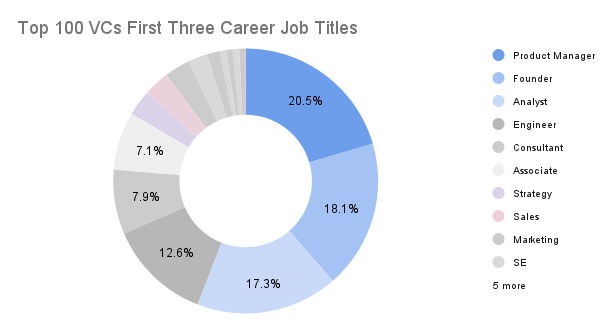
UNDERGRADUATE UNIVERSITY TRENDS
Looking at the data in more detail, tops VCs value education. They all have an undergraduate degree. They also go to the best undergraduate universities. 33% of all VCs attended an Ivy League undergraduate university. The next 46% after that went to a Forbes top 100 school.
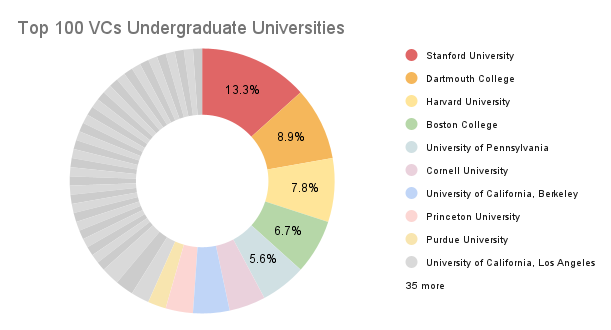

Over half of VCs obtained an undergraduate STEM degree. Nearly another quarter studied some combination of Finance, Economics, or Business. It’s nice to see that 21% studied Liberal Arts and that VC as an industry doesn’t only filter for STEM degrees. Many VCs had philosophy, history & literature, government, and psychology degrees.
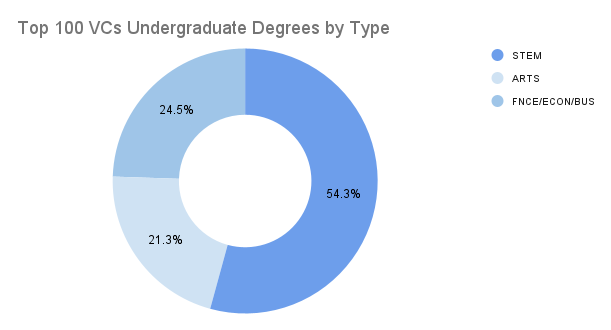
GRADUATE UNIVERSITY TRENDS
Graduate school was also quite popular among top VCs. 78% get graduate degrees. They also doubled down to primarily go to only the highest-ranked universities. 57.9% of all of them went to three universities: Stanford, Harvard, and MIT for graduate school. 27% of them overall went to Ivy League universities. Another 46% went to a Forbes, US top 10, non-Ivy ranked university. Very few come from universities ranked lower than the Forbes top 50 universities. Graduate education school is a conspicuous filter criterion for venture capital hiring.
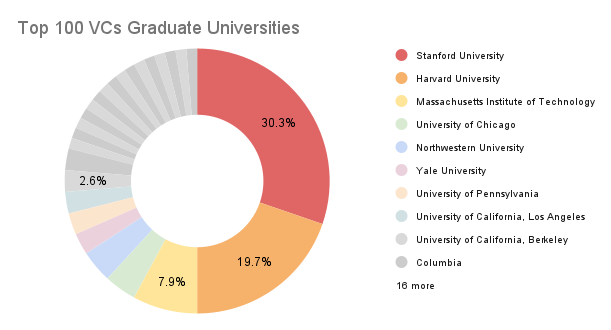

Another overwhelming trend is that top VCs get MBA degrees. 66% of all of them got a MBA. Another 16% got a STEM masters degree. 5% went to law school. A small handful got PhDs or dual JD/MBA degrees. The MBA appears to be a critical minimum qualification level, followed by STEM, and law.
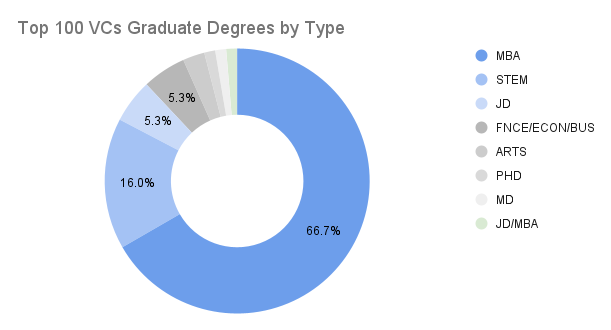
PM TO VC AND BEYOND
Careers are interesting and long. If you only look at the data you might think that top VCs planned their career from high school and tracked all the way through perfectly. I don’t believe this is true, however. Having listened to many interview podcasts and YouTube, it’s clear that one door led to another even for them. School selection and admission is one door opener but it still doesn’t dictate what career you choose and where you ultimately go.
If you’re already working and your school days are behind you, you will still have many opportunities ahead of you. I personally think that product management is a fantastic career. I love that PM is a strong feeder into VC along with being an analyst or a founder. The skills you need and will learn to be a great PM will have compounding effects on your career long term. Maybe the future opportunity is VC, C-suite, founder, philanthropist, or something altogether different.
DATA SOURCES
Top 100 Venture Capitalists: List from The New York Times and CB Insights
 Google Sheets: Data, Analysis, and Charts. Subscribe to get free access to the source data for reviewing, slicing, and dicing yourself. Just email me at luke@lukecongdon.com after you subscribe and I'll send it out asap.
- The New York Times and CB Insights data for the top 100 VCs was published in February, 2018. It’s a few years old, but as a selection of top VCs I feel this is valid enough data sample to draw career and education trend data from.
- I used a 2022 Forbes ranking of US-based universities to distinguish universities. Several top VCs went to non-US universities which are not captured and ranked in the Forbes US-centric rankings.
- I separated Ivy League out as this is a well-known group of elite universities. The top 10 ranked universities according to Forbes 2022 do include 4 Ivy League schools (Princeton, Columbia, Yale, UPenn).
- I used LinkedIn and public profiles to verify education and self-reported career history. With careers spanning decades, many top VCs and professionals commonly selectively list their per-role job histories. The ‘First three jobs’ results excludes VCs whose only listed jobs were Executives, Investors, or Partners. These likely don’t reflect first career roles. I also excluded internships.
- Job titles vary immensely. To cleanse the data for reporting, job roles have been bucketed into groups. University degrees also have some variability and have harmonized as well for reporting.
- Job titles were summed across the first three listed roles which do count any single person with the same job function more than once. This was done uniformly across all job roles.
ABOUT LUKE
Luke Congdon is a career product manager living and working in Silicon Valley since 2000. His areas of focus include enterprise software, virtualization, and cloud computing. He has built and brought numerous products to market including start-up MVPs and billion-dollar product lines. Luke currently lives in San Francisco. To contact, connect via luke@lukecongdon.com or https://www.linkedin.com/in/lukecongdon/.

YOU BUILD WHO YOU ARE
I love creating things. This blog is one thing I’ve made. Another example is my enjoyment of cooking and experimenting with recipes. I cook because I (usually) love the result of being able to enjoy the food I put effort into creating. I even don't mind when a dish isn't so amazing because I will develop ideas of how I can make it better next time. I recently tried to make colored pasta and used beet juice to try and provide a magenta color to the dough. The pasta came out well, but the bold color I wanted was ultimately not that brilliant. I plan to try it again soon.
The process of cooking often reminds me of being a software product manager because you start with an idea, imagine the future, and work on a number of parallel activities to achieve it. Unless you are practiced and precise, the process can go sideways unexpectedly. Before you start, you need to imagine the end, and bring together many different parts, steps, and techniques to get to your result successfully. I once had a manager who would say, "You build who you are." It's an interesting phrase. How you approach your job is how your product turns out.
In PM there are many ways to be successful, and equally many ways to be mediocre or fail. Some companies with well established PM culture excel at the ‘performing the craft’ of product management. Most companies in my career experience however tend to let you do whatever you want by not giving input or guidance on how to be a PM. That may sound like freedom, but it can be a recipe for products or features with incomplete vision, missing go to market, missing important attributes, or poor fit with company vision.
ROOT OF THE PROBLEM
‘Do whatever you want’ is a symptom for a company with no PM processes or training. One dirty secret that I've noticed in my time in Silicon Valley is that most companies offer no training at all for PMs. This is especially true in start-ups. The start-up case is more understandable but it extends outwards as companies grow which can become problematic long term. If you're struggling to survive, you hire people who have existing strong talents who are immediately value-additive. It’s a reasonable approach. Start-ups that thrive hire additional people, but often fail to consider training. This creates teams with highly variable PM skills and culture just a few years out.
I’ve heard first-hand anecdotes that old blue chip companies like IBM and Microsoft have robust training regimens for hires. They teach you what you need to know. It’s a great value proposition for joining a big corporate company as you start your career. E.g. I have a good friend who joined AWS as a sales architect two years ago and he told me that he was not allowed even speak to a customer until he successfully completed nearly a hundred hours of various product training. These companies are not common in my experience; at least not for PM roles. If you're starting your career and you can get into a company that will train you, I think this is a great way to begin for long-term success. By the way, my friend that joined AWS was already a stellar SE before he joined. That’s company commitment to training for a strong employee base and reliable customer experience.
‘You build who you are’, therefore, is shorthand for the sum of your personal values, attention or inattention to detail, level of follow-through, ability to document, ability to work with other people, etc. as they pertain to what and how you build product. These reflect in product who you are as a person. It helps to explain why some people are natural PMs while some are less effective. It can also help explain why some PMs never get the whole product out the door. You don’t build what you don’t care about.
EXAMPLE ATTRIBUTES
Here are a few personal attributes that contribute to how people translate who they are into what they create. There are undoubtedly more that could be applied.
ORGANIZATION
Are you organized or disorganized? Getting a product to ship in a large organization, i.e. more than 200 people, means you have to work with many teams to reach a final product. Larger more mature companies organize labor into specialized teams including release management, documentation, QA, system test, engineering, support, sales, marketing, and more. We’re all gears in the machine. If you’re disorganized you are relying unfairly on other teams to cover for your gaps. That can show up in the end product. In my world of cloud computing software, OpenStack is a prime example. Nothing worked together with OpenStack and it was very painful for customers to get running. The product components were shipped separately and didn’t simply work together. It wasn’t organized and any OpenStack purchase had to be paired with a company also investing at least five engineers to get it installed, and permanently staffed to keep it running. Just to be clear, this was a permanent investment even before you got any value out of OpenStack, which was dead money.
OPERATIONS
It takes motivation and talent to be the active gear in the machine that gets all other gears turning in the right direction to produce the right end result. These PMs are valuable. A good PM needs more than the ability to move people however. They need some amount of product vision. If they don’t possess vision you can end up with a talented project manager and this is not great. PMs have to constantly ask customers and themselves why they are building something, and is it the right solution to the problem statement? A project manager cares about time, scope, and cost. They don’t necessarily care about the vision. That’s no slight on good project managers by the way. Vision is not their responsibility. It is for PMs though. When a PM is operating and moving product through the system, a narrow operational mindset can get them off track and not solving the urgent customer problems. What’s worse, they might not ask the critical questions along the way. If that happens, you get bad product delivered on time, for low cost, an in-scope. Your release date is meaningless when the product is wrong.
REGULARITY
Inspiration is awesome. So are bursts of creativity. They are transient however. Great PMs keep showing up; especially on the days when there is no creativity, the engineering team is late, your execs are debating disruptive new ideas, someone on a dependent team just resigned, etc etc. Great PMs keep trying to talk to customers, and keep working on the present and future. What you do everyday outweighs what you do occasionally.
PRESSURE
In the course of product development, a PM may occasionally need to insert themselves to adjust and align team efforts. These periodic interrupts can be necessary, but consistent gentle pressure is better. In engineering there is a concept of entropy. Entropy is defined as, a "lack of order or predictability; (a) gradual decline into disorder." I would express this from a PM perspective that a product effort left untended by its PM will slowly devolve into something you don’t want. Great PMs know the end state they need, and keep regular and consistent pressure on the various teams until the product is delivered. You may still need occasionally to add more pressure urgently, but there is never a time when there is no pressure.
PACE
PMs set the running pace of the team. If you phone in your effort and your pace is slow, the entire org sees this and they will meet you at your pace. If you show no urgency, they give you late, half-hearted results without urgency. This is human nature. No one needs to care more than you. If you don’t care, no one else will either. Remember, enterprise product sales is a zero-sum game. E.g. If you’re selling an expensive product to a company for six or seven figures, that customer is not buying two of them. If someone beats you to the sale, you lost. For big purchase tools which are complicated to install and configure, you might have a chance to compete again in 5+ years for that same customer. E.g. Servers have a useful lifespan of ~3-4 years. Storage arrays have a useful life of ~5 years. These are not consumer products. When you don’t like your cordless ear buds, you grumble and buy another pair. When you don’t like your storage vendor, you’re stuck with them for several years. This kind of competition requires that PMs build and deliver customer value on time. Your competitor will set the pace if you don’t.
YOUR PRODUCT IS YOU
If you love building and iterating to constantly make your results better, then you may already understand that you bring yourself intimately to your PM job. You keep striving because you love making it better. My pasta results are gaining a fan base inside my family. Many are more than happy to be invited back for future iterations, and I’m happy to keep trying recipes. Because I love it, I don’t care that I’ll spend six hours on it only to eat it in a few minutes. The time spent is fully part of the enjoyment. How great it turns out is a function of how much of myself I invest into it.
ABOUT LUKE
Luke Congdon is a career product manager living and working in Silicon Valley since 2000. His areas of focus include enterprise software, virtualization, and cloud computing. He has built and brought numerous products to market including start-up MVPs and billion-dollar product lines. Luke currently lives in San Francisco. To contact, connect via luke@lukecongdon.com or https://www.linkedin.com/in/lukecongdon/.