
12 PRODUCT MANAGEMENT TRAPS TO AVOID
LESSONS LEARNED
In the course of a long career in product management I’ve seen and experienced many issues that could have been avoided. In this event with the Silicon Valley Product Management Association I shared my 12+ observations and traps for PMs to avoid. I hope this helps you too; especially if you’re early in your PM career.
I’ve been tuning and building products for a long time now and it’s a career I really enjoy. In the early years I spent a lot of time just trying to be good and learn the basics. In the middle years I branched out and crossed over into startups that were an entirely new challenge. Over the last several years I’ve been working on building great products and teams together. In recent years I’ve enjoyed sharing some of my learnings on this blog.
In early 2021, Debashish Niyogi, Director of Programs, and Tom Gilheany, President, invited me to be a featured speaker at the venerated Silicon Valley Product Management Association. As we discussed options for interesting topics, I suggested a backward-facing review of sticky pitfalls PMs can fall into. These were easy to put together since I’ve fallen into half of them myself, and observed the others repeatedly in my career.
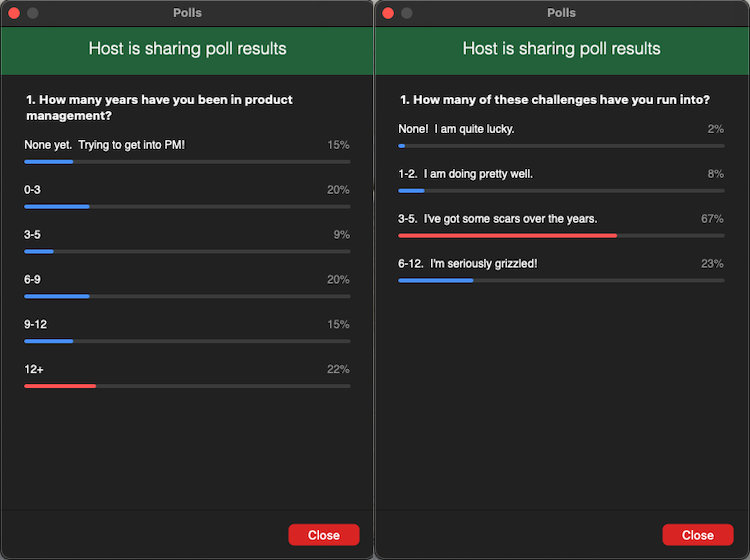
During the event, we ran two polls among the attendees. Attendance varied from long-time PM veterans to those just trying to get started. 37% of attendees had over 9 years of PM experience! I also asked at the end of the main discussion how many of these issues the attendees had personally run into. 67% reported 3-5, and another 23% reported greater than 6. You can see the detailed poll results at the end of this post.

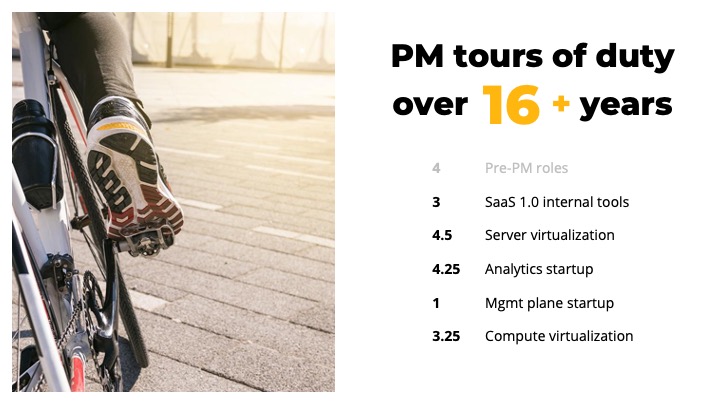
- 16 years is a long time, spanning several different kinds of software product companies. I was not a product manager at all in the early years. Following my MBA I got started doing PM by taking a project management role and transitioning over to product management. Since then, I’ve hit or observed many different types of career traps.
- Notably, many of these traps are not specific to product management. Others are more specific. Consider these to help shape your career in the direction you want it to go in.
- When I was in school finishing my MBA in 2003, only a little bit of product management was being taught. I remember taking an elective class called Software Product Management that was a fun walk-through of how software is designed conceptually. I recall working on a software product project; defining how to identify, spec and build a product. We did not actually build the product however. This was a formational class for me which really attracted me to actively participating in the software industry.
- These traps below are those I felt were never really taught in classes. It’s possible that modern management and PM courses do teach more of these examples more often.

- I’ve personally made many of these mistakes myself. You learn by doing; especially when things don’t work out for you. Hopefully you can avoid some of these and save yourself some career time and unnecessary strife.
- Since there are very few universities offering degrees in product management, most that enter the field self-select and leverage their studies in business, engineering, human computer design/UX, etc. and continue learning on the way. If you can work with a great team of PMs, you can learn even faster. I like to think of PM as a journeyman career. I.e. You start as an apprentice, you level up to journeyman after a few years, and a few years after that you become a master. You will definitely make mistakes along the way.

- To debunk old myths, you are not the CEO of your product. However, I strongly believe you should act like the CEO.
- Acting like the CEO says you consider the whole picture of the product. E.g. How will sales consume and sell your product? How will finance recognize revenue for it? How will you pitch it to customers? How does it fit the company story? How will an SE demo it?
- If you would rather be a CEO, CTO, or salesperson, you could pursue career tracks to those roles too; recognizing that there are not that many C-level roles in total. Product management is a great role. It has elements of all the roles above, but it is still not those positions.

- First and foremost, if you work on a product and are empowered to make product development decisions, drive the roadmap, release and iterate on products, you are a product manager.
- Some products, however, will help you grow and accelerate your career faster than others. Even at the same company, some products will have more impact and gain more attention from the company and from customers. A simple example is, does your product earn (a lot of) revenue?
- At a large enterprise company, for example, there will be a multitude of products in the suite of products and solutions available to customers. Some will be for sale, others available for use, others are internal tools which get tasks done. Those that earn revenue will have a far higher chance of getting investment. That means dollars, headcount, and inquiry and time from executives.
- If you work on a product that doesn’t earn money, or isn’t strategic to the company, your opportunity to grow may be impeded. You could be doing great work, but without revenue or importance you could be stuck treading water. You might need to change products to change that. You can still do good work, but be aware if your growth expectations aren’t being met by the product you’re working on.
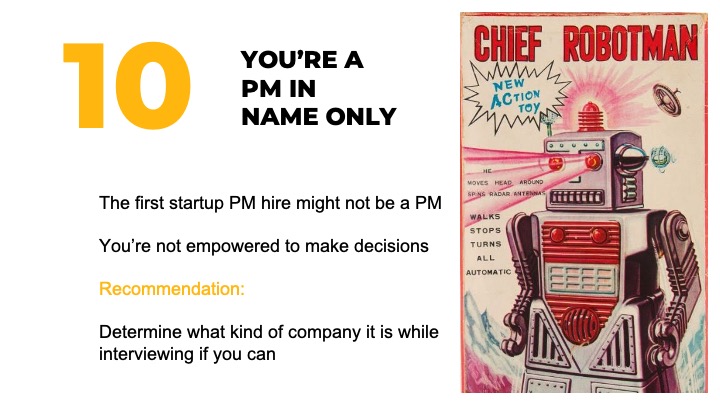
- Startups are hard. At the very early stages (seed, series-A) you probably don’t even have a product or an MVP yet. This means you and the team are working hard to just figure out if your collective idea can be built and actually sold to paying customers. If you can’t sell it, your outlook won’t be good as a company.
- In those early phases, the actual product manager making all the most important decisions is the founder. That person is the leader and usually the one with the sharpest idea of what the product should be. The first PM hired into a startup is still the second product manager. This can be a tough position if the founder is not ready to hand over the reigns. If they don’t you can end up being the founder’s errand handler and assistant. Nikhyl Singhal calls this the drunken walk stage of a company. It can be rough.
- Company lifecycle can help you identify if the PM job opportunity is real. Is there a product that already sells? Is there already a team? Is there a clear vision for the future?

- Did you ever take a public speaking class? Were you terrified to make that first (and second, and third) speech in front of the class? Some PMs view direct customer outreach this way and avoid it.
- Speaking with customers is usually not a speech. It’s discovery. The truth is, many customers want to speak to you! If they say yes to a meeting, they want to hear from you because they’re invested in your product and want it to succeed because it’s solving a pain point for them.
- Outside of support escalations, and inquiries from sales/SEs, you will have to do your own legwork to find customers. Fortunately, this is usually easier than you might think.
- In time you may grow to love it. The voice of the customer is a key source of authority for PMs.
- Eventually you will present roadmaps and even speak on a stage at trade shows. This is public speaking. Getting good at these is also a great way to raise your profile and confidence as a PM.
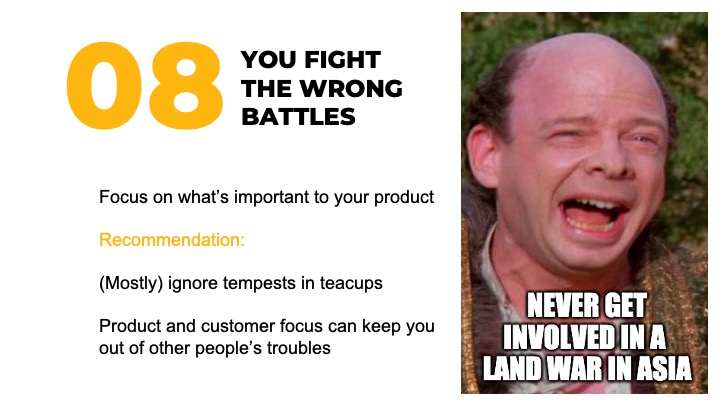
- Focus makes a great PM among other things. To that point, some things aren’t worth your time.
- As a result, some may try to pull you into battles that aren’t actually yours to fight. This applies to PMs and many other roles too.
- Some decisions, likewise, aren’t yours to make in the first place. How a product is built isn’t your decision. The attributes and outcome of a product are. E.g. Whether your product is coded in C+ or Java or Go is an engineering decision. If you get asked to make this choice, it may come back to bite you if a future limitation is discovered. “The PM said use C++.” can be a dodge for an engineering decision you should not have been involved in anyway.

- When you need to get things done, you need to know who to go to. In many cases, executives and leaders have people working for them to get things done they don’t do themselves. E.g. Admin, Secretaries, Chiefs of Staff, Subordinates. It will help you to be aware of these people, what they do, and who they work for.
- When something requires immediate attention and the person you need doesn’t know you, it may take longer to get it done. Forging relationships ahead of time takes a very modest amount of effort. Simply saying, “Hi [name]” when you see them is easy to do. An occasional conversation helps too. If you work remotely, this can be a bit harder. It’s simple to make email request kindly and respond with a “Thank You” once done.
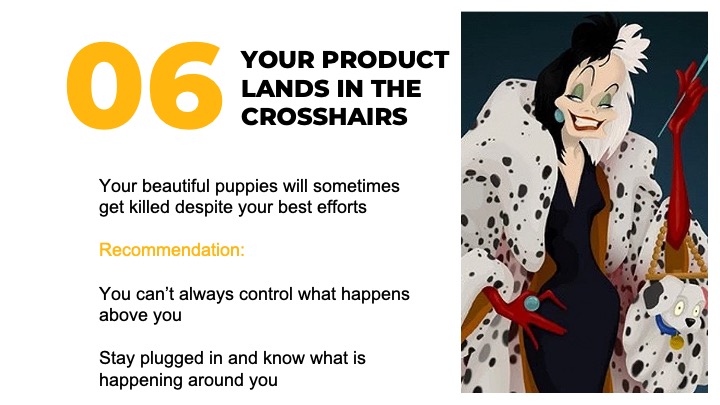
- It can be a dog eat dog world out there. In business products get reevaluated all the time, and sometimes outright killed. When it’s your product, that can be painful.
- You can try to avoid this by letting people know the value of your product, making it successful, and internally promoting it. I.e. Don’t hide out and hope for the best.
- It’s also helpful to realize that sometimes it will simply happen. Keep plugged into the company goals, health status, values, etc. and this should not come as a surprise. If it does happen, you can fight for it to live, but that might not change the outcome.
- When it comes from the top, you might not have a choice about the outcome, but you can choose how you handle it and get lined up for your next product at the company in a positive fashion.
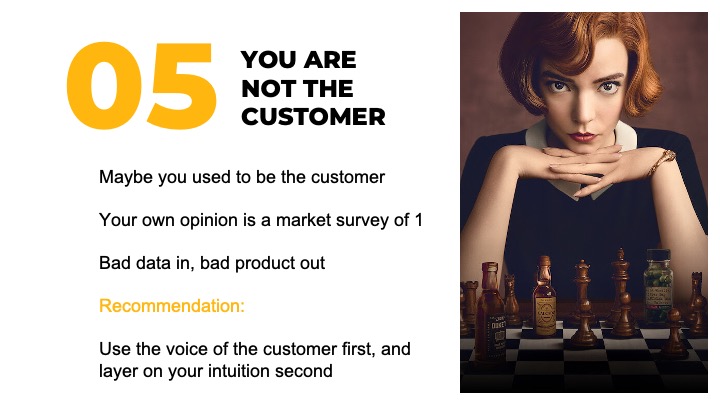
- PMs often enter a product area based on their industry expertise in that area. E.g. If you worked as a sales engineer or customer support for a database company, you might have successfully translated that experience with the technology and direct customers in a product opportunity. That’s smart and it opened an opportunity for you. I know many PMs who started this way.
- The challenge over time, is substituting your opinion in place of the customers’ opinions. More dangerous still, is when you’re right a couple times. If you feel validated that you’re right, you might stop talking to customers, and then you really lose touch over time. This leads to guesswork and bad data in, which leads to bad product out.
- Intuition or prior experience has its place, but in my opinion this comes after you’ve done discovery, validation, and then are left with a decision to make. If you have two great and validated options, you might make a choice of which to start with.
- PMs own product, and by direct proxy, the business related to that product. This is why the “CEO of the product” expression has persisted so long. You won’t do everything yourself and outside of an underfunded startup, you probably shouldn’t. Many teams contribute including product marketing, SEs, technical marketing, competitive analysis, etc.
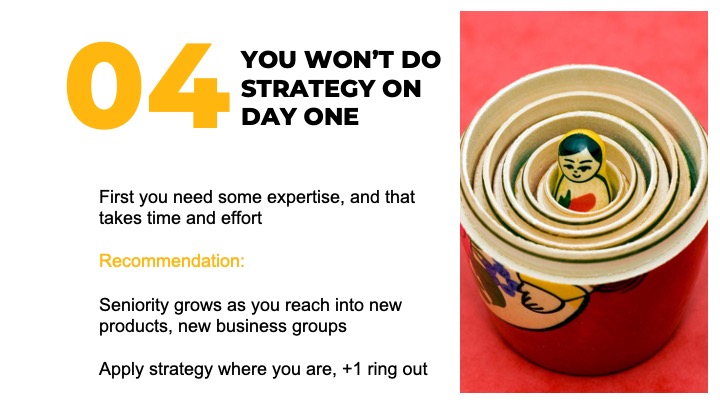
- New PMs often express that they want to work on strategy. I think this is because business schools teach it a lot. The trouble is that outside of a firm that focuses on strategic work like McKinsey, a new product manager needs to understand the product they own first before they think about strategy. My view is that they need to build up direct product expertise. As you grow you’ll learn more about how the industry you’re in and how the company itself runs. As you expand your expertise you may be asked to think about strategy. Brand new PMs aren’t usually asked to think about strategy in my experience.
- That shouldn’t stop you per se. You can think about strategy as it pertains to where you are, and perhaps the next level like rings on a tree. I.e. You own a single product? What’s next for that product? What about the product family?

- Customers do often know what they want, but they don’t often think years into the future. Some exceptions apply.
- Customers in a competitive product environment usually know your largest competitor’s product. They probably used to use it. In fact, they probably still use it since many customers don’t like getting locked in on a product solution and keep their options open. When asking customers for product feedback, you will very often hear that they want feature X that your competitor has. This may be because they used and liked it. Or perhaps they didn’t use it but they know you don’t have it. This is not always the best feedback.
- You need to find out what pain actual points your customers have. They aren’t the PM and they probably haven’t thought about a cutting edge solution to the pain they feel. That’s your job. As you speak to lots of customers you can start to aggregate pain points and begin defining a point of view you can validate.

- Lots of people in Silicon Valley talk about startups like it’s a foregone conclusion that every one of the world’s problems will be solved by three people in a garage with an idea and a blind rapture to solve it with a computer.
- In my view, startups can be fun, unbounded, and risky. I’ve done a couple and I can say that they were a learning experience.
- If you’re trying to get into a PM opportunity, startups are like driving 100mph with no seatbelts. You might get lucky, or you might hit a wall going very fast. Startups can’t really offer training to you as a PM. From moment one they are running to succeed (or stay alive). If you already have skills, that’s probably why they hired you.
- If you need PM training, I believe a large company is much better. They are striving, but already have products that sell, and teams with skills that can help train you. Determine which kind of company works best for you and your ultimate success. The world won’t care if you never worked at a startup.
- PM is a role with a lot of expectations. It is not a show up and phone it in kind of career. I think it’s a great job if you love building, solving problems, and chasing a vision of the future. To do that, you will have to convince people above you, below you, and on different sides that your vision is the best one to follow, and then convince them to help you get to the promised land. When it works it’s amazing. It can also be exhausting.
- If you love achieving the creation, shipping, and usage/feedback loop of products this is the job for you. Since it’s a full-contact career you have to love it to get up every day and go for it.
BUILDING PRODUCTS, BUILDING CAREERS
Being a builder is a great career if you love doing it. Sometimes it’s not easy for many reasons, but in my view, that’s why succeeding despite the challenges can be so satisfying. Align yourself for personal success to avoid common traps of PMs. E.g. Simply getting attached to the right product can have a huge effect on your career. While working hard on behalf of your customers and your product is a given, not every challenge has to be lived to be appreciated however. Use these recommendations above to avoid common pitfalls and grow your PM career.
PEER PM POLL RESULTS
At the end of the SVPMA presentation we ran a couple informational polls. These results were very interesting to me. We had a nice distribution of young, medium, and older PMs. I initially predicted more future and early PMs; and few seasoned PMs. The self-reporting on number of issues experienced was also illuminating. A select few felt they were doing very well and had hit very few of the traps described. As a virtual event I wasn’t able to get a live sense if these corresponded to people in pre or early PM roles.
- If you have questions, please reach out on my web site or via LinkedIn.
- Thanks!
BONUSES
This presentation event with the SVPMA included a robust Q&A session at the end where attendees asked some great questions. Just before that I also included three bonus pitfalls I felt were less PM-specific but important human traps to avoid. Watch the full recording or skip to the end for these sections.
ABOUT LUKE
Luke Congdon is a career product manager living and working in Silicon Valley since 2000. His areas of focus include enterprise software, virtualization, and cloud computing. He has built and brought numerous products to market including start-up MVPs and billion-dollar product lines. Luke currently lives in San Francisco. To contact, connect via luke@lukecongdon.com or https://www.linkedin.com/in/lukecongdon/.