
CONVERTING ATTRITION INTO STRONGER PRODUCT TEAMS
A SEA CHANGE FOR PM TALENT
You may have seen the numerous articles about the great resignation over the past year. At a time when the world is just about to mark two years into the COVID pandemic, in tech we’re seeing much higher than normal attrition in technical knowledge worker roles. That includes product managers (PMs) and engineers among others.
If you’e a PM with three years of experience or less, this period of attrition may counterintuitively be a great time to identify a growth opportunity. If this is you and you’re also someone who is underrepresented in technology, e.g. women, Black/African American, Hispanic/Latinx, this is also a good opportunity. Most technology companies have been focusing on improving diversity numbers. Many managers are searching for PM talent with diversity as a key focus area.
CONCENTRIC, TIGHTENING CIRCLES OF TALENT
A real challenge for finding and replacing tech talent attrition is based on the job to be done and sourcing people that match your requirements. I’m generally not talking about entry level roles. Entry level assumes you trained in a certain area or have a specific skill. E.g. You recently completed an undergraduate accounting or marketing degree. I.e. You may not have worked much yet, but you have a base level of education for the role, and you can perform that level role. Ideally, that company that hires you will train you to improve, or at a bare minimum, give you the opportunity to learn by doing and observing colleagues who are much better at the role than you.
Finding mid-career talent can be quite a bit harder because required skill sets start layering, with each layer resulting in a rapidly declining pool size of candidates. I’ve observed this for years. This is what I mean by concentric circles. Here’s an example: ‘We need to hire PM talent with an understanding of technology, our industry, specific solutions, customers, and business acumen. Years of experience also matter.’ Here’s how a search starts for a mid-career PM role.
DESCENDING SEARCH INTO THE SINGLE DIGITS
Recruiters rely on various professional networking search engines to find candidates. E.g. LinkedIn. Internal ATS tools are also common. Finding people starts with a filtered search. You start with thousands of matches, and within 60 seconds and a couple clicks you are hoping you have any resulting matches to work with. This is the crux of why finding the perfect talent is so hard. Here’s a common set of PM filters I use to demonstrate:
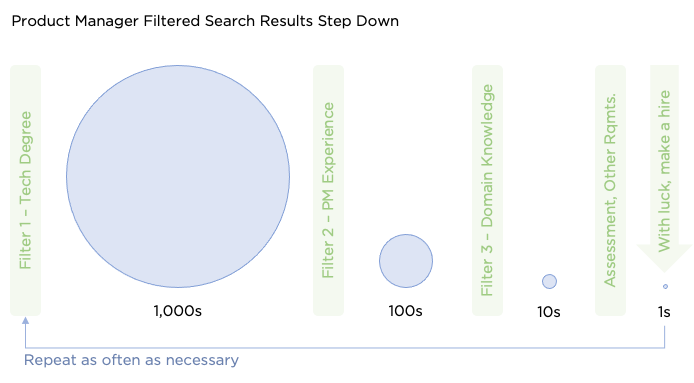
- Filter 1: A Computer Science or Engineering degree is required. This is a coarse-grain relevance filter which invokes the sheep skin effect. It gets used because as a tech PM, you need to know some technology. A technical degree attempts to quickly verify this.
Result: This will give you a large pool of technically-educated people.
Weakness: At this point you have tons of people who aren’t PMs and who probably don’t want to be either. You will also filter out some good people in the process who didn’t study STEM. Many companies also add in a short filter list of universities. This will also exclude a lot of smart people who don’t have this exact criteria. - Filter 2: “## years experience in PM required”. This is a two-in-one filter. It verifies that they have they been a PM before, and it verifies that they have a minimum number years of experience.
Result: This is the first major step-down in the candidates list by ~95%. At least now you have a list of technical + PM candidates.
Weakness: This covers PMs with product experiences across every type of product which is still too many. You may also be missing people with non-standard titles. We still don’t know if they’e good for our company, or good at their job. - Filter 3: Keywords for relevant, focused knowledge areas. E.g. ‘Cloud computing’ or ‘hypervisor’. I.e. Do they come pre-trained in a topic area we need?
Result: This is the second major step down by another ~95%. If I want someone who knows virtualization, for example, I’m not looking for someone who is a product expert at A/B testing B2C SaaS personal finance phone app products.
Weakness: A person with strong PM fundamentals should be able to take up any product. PM skills should be fungible, but you’ll have to train someone without your needed product knowledge for your area. More often however, I find that PMs specialize and don’t cross back and forth across vastly different kinds of products.
When it comes to hiring and the great resignation, if you’re a hiring manager you have a great opportunity to move the needle on diversity as you rehire into your teams.
After this, if we add in constraints like location, the pool gets smaller. If we add in requirements like a diverse final list of qualified candidates (which I believe you should), you also have a smaller list. Now you’re ready to contact them and see if they reply with interest. That will also reduce your list. Many great PMs already have great jobs and don’t want to move. If you haven’t reduced the candidate working set to zero yet, you can move to interviews and see if these candidates do indeed have the skills, motivation, intelligence, etc. as they claim and could be a finalist for your role. It is common to restart this search once or twice for a single role. Finding, vetting, and making the final offer is a real challenge that can take months of time investment.
UGLY CANDIDATE TRENDS
In a career spanning a couple decades, I feel that some job seeker platitudes have always been around. E.g. Get multiple offers, negotiate the offer, don’t give the first number, etc. This is all well and good in general assuming you can get multiple offers. Having lived through a few different up/down cycles myself, it’s not always possible. If you have never had the experience of only a single offer, I applaud you and hope that your good fortune keeps up. I remember working post dot com bust, mini-recessions in 2003, the housing bust in 2007/2008. Until two years ago, the last 10 years before that had been more or less up and to the right with everything running without major interruption. The pandemic is the latest cycle impacting careers.
In recent years as a hiring manager, I feel that I’m seeing a new unattractive trend in high tech enterprise hiring. Perhaps the phenomenon also impacts other career segments too. Tech talent in product management, especially in India, is getting cutthroat. I’m seeing professionals young and old optimize uniquely for money and title, while gathering and formally accepting as many offers as they can simply to arbitrage for the best one and ghost unselected employers. ‘Too bad, so sad’ you might say and there is a basis for that. Many job seekers have had the experience of never hearing back after interviews. I personally have been ghosted many times. Also, why wouldn’t you want the highest salary and corresponding title? The ugliness is the accepting of numerous offers. At the point where you verbally accept and sign the offer, the hiring manager and company believe you are joining the company because you told them you are. To no-show or cancel for another offer in my opinion is unethical. This has been on the rise lately. I’m seeing it in India quite a lot, but I may have observation bias since nearly every company in my industry has offices there.
THE INSIDE JOB
If you’re an employee who is debating their options, I suggest asking yourself the following. Why do you want to go? If you’re not being treated well, that’s a good reason. If you are fairly compensated, treated well, and have future prospects to grow, I would suggest staying where you are and continue to develop yourself. If you’re a PM, you already know that PM teams tend to be small since PMs are typically staffed at the rate of 1:15 engineers. Attrition opens opportunities for those who remain. When PMs leave, others get asked to step up to do more. Backfill hiring also occurs but since that takes time, people already in the company have the opportunity to raise their hand first to do something new or enter a new topic area. You may have a stronger opportunity inside your current company versus jumping to a new company with unknown risk. It’s an ROI argument you need to work out for yourself. Just don’t miss the return of where you are as an option.
DIVERSITY IN TECH
Silicon Valley (globally) runs on diversity. I’ve been working for enterprise IT companies for 20+ years. On a daily basis I work with brilliant men and women from many different origins, cultures, and languages. I’m gratified to have broad exposure to people and ideas, and I do believe it does help build better products for customers. What is also true at the same time, is that representation of Black/African American people, Hispanic/Latinx people, and women overall is weak. In some cases, extremely weak. That’s a problem.
When it comes to hiring and the great resignation, if you’re a hiring manager you have a great opportunity to move the needle on diversity as you rehire into your teams. Build diversity into your candidate search pipeline and final candidates sets, and build interviewer teams that include diverse people. Your results will reflect these actions.
There is great PM talent that didn’t go to the top 20 universities. Go find them. It’s not a risk because you’re still going to vet and interview them in the hiring process.
HIRING FOR TEAM STRENGTH
The culture of job applicants may have shifted temporarily or permanently. Perhaps newer careerists are being explicitly taught to do whatever it takes and that accepting all offers is the new norm. I don’t think that’s a great idea since it burns bridges, but regardless I will continue to work on building the best possible teams I can with the best people I can find and hire. Here are my suggestions below. If you have more, please comment or message me. I’d love to incorporate more ideas into my thinking.
- Intentionally cultivate and maintain a great company culture. A good culture is an asset. People stay when they like the manager they have, and their coworkers. Work to make sure you can create a high-performance team that also has a great culture which attracts and retains people.
- Cultivate team diversity. Diversity can mean several things including gender identity, ethnic origin, career origins, education, and location. A rising attrition trend is an opportunity to build diverse hiring pipelines and diverse teams. Seize the opportunity.
- Always be closing (ABC). Talent is a long game. Reach out and introduce yourself to promising people in your network even when you don’t have a role. Don’t misrepresent that you have an open role if you don’t obviously. Get to know people and cultivate professional relationships. They might be your next hire once you have an opening.
- Retain your winners. The best way to reduce attrition and hiring is to keep your best people. I find that great people want to work with other great people.
- Widen your search filters and remove university filters. Everyone wants to hire from MIT, Stanford, University of California Berkeley, and the other top 10 or 20 schools. I’ve heard it a million times. There is great PM talent that didn’t go to the top 20 universities. Go find them. It’s not a risk because you’re still going to vet and interview them in the hiring process. This is a good way to start removing bias by removing the use of the sheepskin effect for school names.
- Consider not using the initial filter on STEM degrees. Or at least, also run a query on people without STEM degrees. STEM degrees are great and often a very relevant background for technical PMs. Take a look for people without them too though. You can still filter down on domain expertise or other criteria like technical certifications. You may be surprised at who you find (and possibly hire).
Attrition is on the rise lately but so is opportunity. Whether it is a temporary trend or not, talented PMs looking for new work options can raise their hands to expand responsibilities or do different and new product work in the gaps that are opening. With diversity programs being increasingly adopted, this is a great time for hiring managers to find motivated overlooked talent as well. If you’re an ambitious PM with a few years under your belt, talk to people where you are to see what opportunities are opening. If you’re a hiring manager, use this time to think about how to build up your stronger team. Unexpected attrition is a tough blow, but you can get the best out of the great resignation by planning for team regrowth early.
ABOUT LUKE
Luke Congdon is a career product manager living and working in Silicon Valley since 2000. His areas of focus include enterprise software, virtualization, and cloud computing. He has built and brought numerous products to market including start-up MVPs and billion-dollar product lines. Luke currently lives in San Francisco. To contact, connect via luke@lukecongdon.com or https://www.linkedin.com/in/lukecongdon/.